As the craft beer industry matures, many companies have rediscovered the power of Lagers. It’s not used as a novelty, but instead it can be a long game that challenges how the industry has trained drinkers to buy beer.
At Michigan’s Old Nation, co-founder Travis Fritts told Brewer recently the renewed interest in Lagers exposes a central contradiction in American craft beer. Lagers, by design, resist the very marketing hooks that helped craft grow in the first place.
“Lagers don’t depend on flash. They don’t depend on something crazy,” Fritts said. “They’re kind of antithetical to all of that.”
While more breweries are embracing Lagers, the shift has often leaned toward light, approachable offerings meant to compete with macro brands. Fritts argues that approach risks flattening what makes craft Lagers distinct and misunderstands the core challenge.
“There are thousands of American breweries, and there aren’t thousands of different ways to describe why a Pilsner is the way that it is and why it’s different from another Pilsner,” he said. “So there’s no hook in Lager.”
That lack of an obvious hook presents both an opportunity and a liability. On one hand, Lagers can broaden a brewery’s audience and signal maturity. On the other, they are difficult to sell in a marketplace conditioned to chase novelty, adjuncts and hype-driven releases.
“The hook in Lager is, this is what a beer tastes like when someone dedicates their life to making this thing as good as it can possibly be,” said Fritts, who apprenticed under lassic brewers like Pierre Celis and John-Luc Suys. “Not, ‘this tastes like mangoes.’”
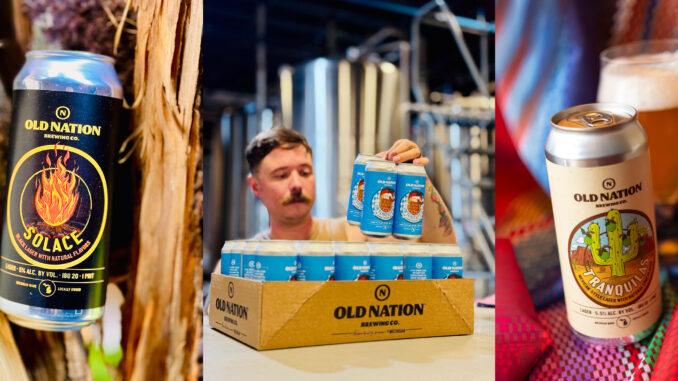
Fritts speaks from experience. He said his career includes “losing millions of dollars” trying to convert drinkers to Lagers, a reality that shaped Old Nation’s strategy. Instead of betting heavily on individual Lager launches, the brewery created a rotating Lager series that occupies a single SKU in chain stores, swapping styles every few months.
“It’s one slot,” Fritts said. “We rotate it out every couple of months, and we do that legitimately just to see what people buy, because we don’t have the budget to do a ton of marketing for every beer that we release. And we certainly don’t have the budget to spend a ton of money on every Lager.”

The approach limits financial risk while allowing Old Nation to test consumer response and slowly build loyalty. Over time, Fritts said, it has created a dedicated audience willing to follow the brewery’s Lager-focused education and storytelling.
“We’ve built this pretty big contingent of folks who are waiting on our next lager,” he said. “They’re kind of educating themselves and taking the little tidbits we’re giving them and doing their own thinking.”
Still, Fritts is blunt about the trade-offs. Breweries expecting lagers to deliver immediate volume or solve short-term cash flow problems may be disappointed.
“You’re probably not going to make a Pilsner that’s really going to compete or sell a bunch of volume or save your life this month,” he said.
READ MORE: The Support Old Nation Demands from its Distributors
Instead, Old Nation has accepted that Lagers — just like brewing them — require patience and restraint.
“If you accept that there’s no real hook and Lager doesn’t really align with the established values currently of American craft beer, then what you have to do is make the best Lager you can possibly make and wait,” Fritts said.
Old Nation’s experience suggests the category isn’t a shortcut back to growth. Instead, it’s a test of discipline with brewing precision, financial patience and a willingness to let quality, not spectacle, do the work over time.