
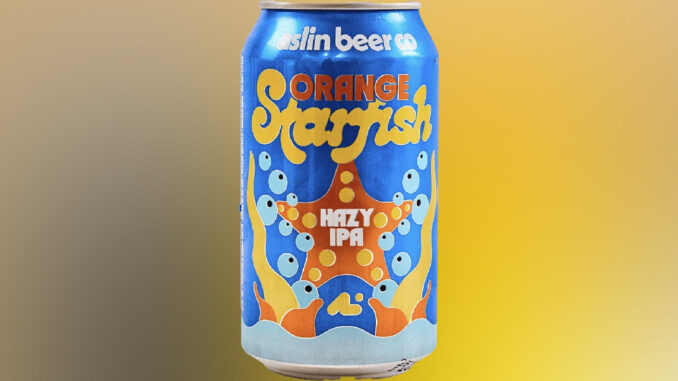
Double Orange Starfish wasn’t built to become a flagship. It wasn’t even built to become a sales success and driver. But, like many beers that go on to shape a brewery’s trajectory, it started with curiosity, a memorable pint abroad and, eventually, a surge of demand that Aslin Beer could neither predict nor ignore.
Co-founder Kai Leszkowicz traces the beer’s origins back to a JW Lees’ beer he tried in the U.K. in 2009. That experience led to Orange Starfish, and eventually to the bigger, denser version that would become Double Orange Starfish.
“We were thinking about bigger ABV and bigger mouthfeel,” he said. “Eventually we landed on what we all know as Double Orange Starfish.”
The early momentum came fast. As Aslin’s visibility climbed in 2016, Double Orange Starfish was swept up in the same wave of attention. February saw products moving quicker than expected, but the real inflection point arrived months later.
“By Father’s Day 2016 we had a day we called ‘beer-maggedon,’ where all the beer we had in stock was accounted for as sold prior to the doors opening,” Leszkowicz said.
The beer shared the lineup with Mind the Hop and Master of Karate, but the collective sellout made one thing clear: demand now dictated the pace.
It isn’t that a single hit beer guarantees longevity. It’s what Aslin did next that was intriguing. Instead of riding hype blindly or freezing the beer into a static flagship identity, the team used Double Orange Starfish as a strategic compass.
“It has been a mainstay and a guiding light,” Leszkowicz said. “We use this product to confirm or reaffirm the direction we are going or drifting from.”
The beer didn’t just sell; it helped shape decisions across realms like production planning, portfolio architecture and packaging strategy.
Branding evolved along the way. The original black-and-orange label gave way to a retro aesthetic with bubble fonts and ’60s tones. Leszkowicz doesn’t believe the name drives retail success, especially at chain accounts. But the packaging helped reinforce an identity that fans recognized instantly. Importantly, Aslin didn’t over-market the beer.
“The majority of the success has been built off of the original demand,” he said.
Locally it has a loyal following; broadly it has the benefit of reputation.
“That storytelling adds to the mystique and lore of the beer, increasing the desire to know,” Leszkowicz said.

That organic mystique also influenced how Aslin measures the beer’s performance. Sales matter, but Leszkowicz said the team watches consumer feedback on platforms like Untappd or Reddit. He’s aware the commentary may not be entirely accurate, but patterns often provide “a grain of salt that can lead to correction or innovation.”
Aslin has since moved the beer from a year-round offering to a seasonal and now a rotating product in multiple formats, including 19.2-ounce cans and 12-ounce 12-packs. They’re still evaluating whether those shifts unlock new success or introduce new complications.
Scaling brought real friction points. Maintaining the original sensory profile hasn’t always been easy.
“As with anything transitioning from a small scale to a large scale, we have had difficulties maintaining the color or flavor exactly as intended,” Leszkowicz said.
Even more challenging is the consumer’s memory of their first time drinking the beer.
“Over time that experience becomes enshrined as this epic, mind-blowing experience. Sometimes, that is a false narrative.”
When managing long-term flagships, confronting nostalgia — without contradicting the customer — requires careful messaging and consistent transparency about ingredient fluctuations.
As for why Double Orange Starfish resonates so deeply with local drinkers, Leszkowicz isn’t entirely convinced there’s a tidy explanation.
READ MORE: Aslin, Torch & Crown Merge to Launch Driven Collective
“My knee jerk is to say that everyone loves their home sports team,” he said, but he quickly rejected that notion given the competition in Northern Virginia alone. The truth may be simpler: the beer hit the market at the right time, from the right up-and-coming brewery, and the region embraced it.
Its influence extends into broader opportunities, though not because it was a lone standout.
“It was one of a few products that gained notoriety relatively quickly,” he said.
Together they created the impression of a newcomer brewery worth watching, which helped attract collaborations and fuel expansion.
Double Orange Starfish shows what happens when a beer becomes more than a recipe. It can become a barometer for strategic decision making. When a product’s momentum starts to outrun your expectations, the job isn’t just to keep up. It’s to listen hard, adapt thoughtfully and let the beer teach you where your brewery is headed next.
Be the first to comment