The hardest question in utilizing new technology at your brewery often is not whether a piece of equipment can work. It’s whether the technology solves a big enough operational problem to justify changing the way the your brewery does business.
Pure Project Brewing approached on-site CO₂ recovery with that question in mind.
The San Diego brewery installed a CO₂ recovery system from Dalum Beverage Equipment in February 2026, with the goal of capturing the gas naturally produced during fermentation, cleaning and condensing it, and putting it back into the brewery’s operations. Since the installation, Pure Project says it has recaptured more than 74,500 pounds of CO₂. That’s enough to eliminate an equivalent amount of purchased CO₂ for its production facility.
But how Pure Project arrived at the decision and what happened after the equipment was installed was just as important for those considering such options.
“Our commitment to sustainability led us to examine our carbon footprint, and how to have the least negative impact on the environment,” said Winslow Sawyer, co-founder and brewer at Pure Project. “CO₂ recapture was always a dream that was just out of reach for breweries our size, but Dalum has made that a reality.”
Pure Project’s evaluation began with a straightforward business calculation: What was the brewery spending on CO₂, what would the equipment cost, and could the system ultimately supply what the brewery needed?
“We looked at how much we were spending on CO₂ a year, how much the equipment cost, and if we really could become 100% self-reliant on our own recaptured CO₂,” Sawyer said. “Assuming we could ‘go off grid’ for our CO₂ needs, it was an easy decision to make.”
Sustainability can be the reason an idea gets attention, but the investment still has to work within the operating model. Rather than treating the environmental benefit and financial return as separate questions, Pure Project tied them together through supply independence. If the brewery could capture enough of its own CO₂ to eliminate most or all of its outside purchasing, the environmental goal would also produce a measurable operational benefit. That distinction matters because brewery technology can sometimes be evaluated too narrowly. A new system may reduce waste or emissions, but an owner still needs to understand what happens to purchasing, labor, maintenance, production capacity, quality control and other parts of the business.
For Pure Project, the answer became clearer once the equipment was operating.
“It took us a few months of getting to know the machine, and how to best capture CO₂, but we were able to quickly become CO₂ independent at our production facility,” Sawyer said. “A few minor adjustments to our processes that use CO₂ got us to never seeing our bulk CO₂ volume go down.”
The brewery also had to consider whether changing the source of its CO₂ would introduce quality-control concerns. In Pure Project’s setup, the recovered CO₂ was blended into its existing supply rather than immediately replacing the conventional source. That allowed the brewery to transition gradually until the supply became entirely recaptured.
“We have not seen any distinct changes in quality,” Sawyer said.
The two projects are different technologies and business models, but they point toward the same management exercise: A brewery does not necessarily have to accept its existing supply chain as fixed simply because it has always worked that way.

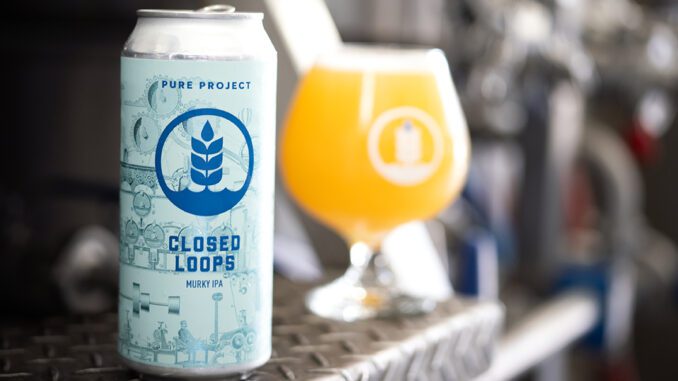
For Pure Project, the technology also created an opportunity to make an otherwise invisible operational change understandable to customers. The brewery partnered with Societe Brewing, which also installed Dalum’s CO₂ recovery equipment, to brew Closed Loops, a Hazy IPA made using recaptured CO₂. The beer provided a tangible way to connect an operational investment to something customers could experience.
“Projects like this can be a difficult to describe to the public, but connecting it to a beer has given our audience something physical to connect to an achievement as ephemeral as gas,” Sawyer said.
New equipment does not always make for an obvious consumer story. Customers rarely care about the details of a compressor, recovery system or supply contract on their own. But when an operational improvement can be connected authentically to a beer, process or experience, the brewery has a way to explain why the investment matters without turning the technology itself into the product. For Pure Project, the collaboration also created a way to make the change bigger than one brewery.
“Societe installing the Dalum equipment shortly after us made brewing a beer a great way to announce the new technology at each brewery,” Sawyer said.
Rather than making an operational change binary, a brewery may be able to build in a period where the new system can be monitored alongside an established process. In Pure Project’s case, the transition ultimately led to its production facility becoming 100% CO₂ independent, including its tasting room. The brewery has not extended that same model to its remote tasting rooms because compressing gas for those locations would currently be cost prohibitive, although Sawyer said that represents only a small portion of the brewery’s overall CO₂ usage.
Pure Project estimates it has avoided purchasing about 74,500 pounds of CO₂ since the system was installed. Sawyer said the brewery’s storage tank is being depleted at roughly the same rate it’s being refilled through recovered gas.
For other breweries considering the investment, however, the economics cannot simply be copied from Pure Project.
“I have had some calls with other breweries interested in the technology,” Sawyer said. “For ROI, it really depends on what your CO₂ contract price looks like, since they vary so much across the country, but if you are making 2,000 barrels or more, you should at least consider the cost and run the calculation.”
Ultimately, Pure Project’s experience is less about telling other breweries to install CO₂ recovery equipment and more about demonstrating a method for evaluating what comes next.
Pure Project’s experience suggests that periodically questioning and reviewing costs can uncover opportunities that were not practical a few years earlier. A similar approach was explored by Almanac earlier this year with its Flow – Clean Air Edition, a Pale Ale made using CO₂ captured directly from ambient air at the brewery. That project approached the same brewery input from a different technological direction, with Almanac evaluating the system not only against delivered CO₂ costs but also long-term supply risk and operational reliability.
“We would definitely make the investment again,” Sawyer said. “Get a quote for the system, and look at how much you are spending on CO₂. It’s an easy calculation if you can capture 100% of what you need and get out of your CO₂ supply contract.”