Celebrating 40 years in business was not simply a matter of putting a commemorative label on its flagship beer for Alaskan Brewing. The company turned an idea to celebate the anniversary into a test of its portfolio, production capabilities and ability to bring an unconventional idea to market.
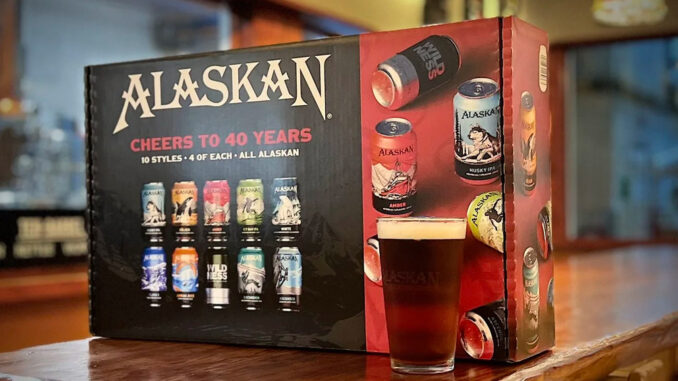
The result was the 40 Beers for 40 Years variety pack, a 40-can package featuring four cans each of 10 Alaskan beers: Amber, Husky IPA, Kölsch, Icy Bay IPA, White Ale, Class 5 Pale Ale, Juneau Juice IPA, Excursion West Coast IPA, Ascender Pale Ale and Wildness Golden Ale.
What began as an anniversary idea eventually required the brewery to coordinate production, packaging, warehousing, quality assurance, marketing, finance and other departments to hand-build 10,000 cases containing 400,000 cans.
For CEO Max Rule, the idea initially sounded simple.
“It was like, how do we celebrate 40 years? I mean, it’s an amazing, amazing story for a regional craft brewery,” Rule said during a video conference call and tasting with journalists from across the country. “I came up with, ‘Well, let’s do a 40-pack.’”
The response from the production side was less enthusiastic.
“We’re all like, ‘What? Are you kidding? We can’t do a 40-pack,’” Rule recalled.
Going from a compelling market idea to the reality of executing it is one that many breweries face when developing any kind of special packaging. Alaskan ultimately decided the concept was worth pursuing, but it approached the project by working backward from what the brewery could realistically produce without disrupting its core business.
The first major decision was what beers belonged in the package. Rather than create 10 beers specifically for the anniversary, Alaskan chose beers already being brewed regularly.
“The beers that are in the 40-pack are all our beers that are currently in tanks that we brew regularly,” co-founder Marcy Larson said. “So we really are truly bringing what Alaskan Brewing is brewing all the time in the 40-pack.”
That decision mattered for smooth operations. It allowed the anniversary package to showcase the existing portfolio without creating an entirely separate production schedule around beers that might have required new ingredients, recipes, tanks or additional brewing time. It also gave the package a larger strategic purpose.
Alaskan Amber was the obvious anchor. The beer was the brewery’s first release and remains its flagship, giving the anniversary package a direct connection to the company’s history. But the remaining nine beers provided an opportunity to demonstrate how the brewery has evolved.
Co-founder Geoff Larson described the package as a way to connect the company’s heritage with its more contemporary brewing work.
“Our 40-pack is all about innovation, and it’s also about who we are,” he said.
A flagship beer can provide consistency and recognition, but relying too heavily on the past can make a portfolio vulnerable to changing consumer preferences. Alaskan used the anniversary package to put those two ideas in the same box.
The larger challenge was figuring out how to physically get 40 cans representing 10 different beers into one package, then do it 10,000 times.
Production Operations Manager Dave Martin described the project as an exercise in solving problems that did not have an obvious precedent.
“Nobody really knew what to expect,” he said of the initial planning meetings. “How the heck do we do this?”
Alaskan brought production managers, packaging, quality assurance, marketing and other personnel together to work through the logistics. The early discussions were intentionally broad, with the team considering how to move the cans through the packaging process quickly enough to make the project financially and operationally viable. The breakthrough came when the brewery received approval to purchase additional conveyors.
“That was the breakthrough on this,” Martin said. “We were trying to figure out how do we get 10 different beers into this 40-pack, and we’re counting seconds at this point because we’ve got to do 10,000 of these things, and every second counts.”
The team then determined it could run the conveyors in both directions. That increased the speed of the process, but it also created a significant staffing requirement.
“We need 16 employees to do this, but we can double our speed,” Martin said.
The project became an all-hands effort. Employees from accounting, marketing, quality assurance, the warehouse and other areas joined brewery and packaging personnel on the line.
“Every person in this room had a shift,” Martin said. “Every single person in every single room.”
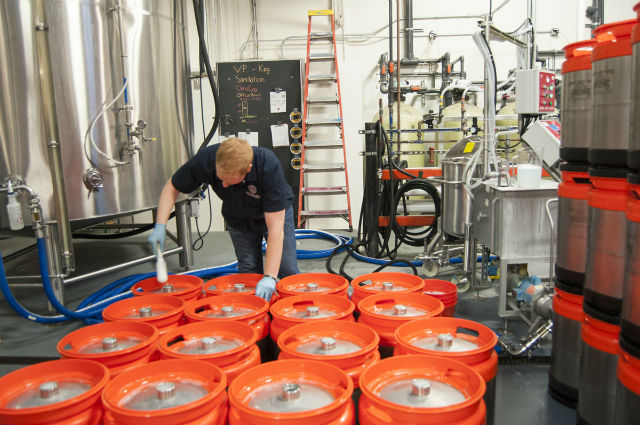
The cases were not simply filled by an automated system and sent down the line. Alaskan hand-packed the cans, hand-sealed the packages, hand-palletized them and built the boxes.
“We were all hands on deck,” Martin said.
The scale of the project made that labor commitment particularly important. Alaskan ultimately produced 10,000 cases, representing 400,000 cans. Martin said the 10,000-case figure was not an arbitrary anniversary number. The company had to determine how much additional volume it could reasonably produce while maintaining normal brewery operations.
“We had a window of time that the brewery could focus entirely on these 40-packs without the other operations suffering,” he said. “And so that’s kind of how ultimately where 10,000 units was kind of our peak.”
The maximum production volume was determined not simply by how much demand might exist, but by what the brewery could execute without allowing an anniversary project to compromise its regular business. Geoff Larson said the brewery also relied on its sales team to help establish the appropriate production target.
“We asked our salespeople in the field, ‘OK, what do you think? How much can we produce?’” he said. “And we figured there are certain incremental volumes, and so we settled on 10,000 cases.”
The gamble paid off. Wholesale partners committed to the package, allowing Alaskan to ship cases as they were produced rather than waiting for the entire run to be completed.
“We sold out,” Geoff Larson said. “We produced and shipped as we produced, because it was already sold to our wholesalers.”
If your brewery is contemplating a large special package, take note. Production planning does not have to happen in isolation from sales planning. In Alaskan’s case, wholesale commitments helped reduce the risk associated with producing a large, labor-intensive package. Rather than manufacture 10,000 cases and then hope the market absorbed them, the brewery had a clearer indication of demand before and during production.

The package also served a purpose beyond the anniversary itself.
“It’s an introduction or reintroduction of what Alaskan Brewing is,” Geoff Larson said. “We have our Amber in there, but also there’s plenty of discovery that can be had for a new consumer or basically a refresh from some of our longstanding partners on the opposite side of the bar.”
Sure, a variety pack can be treated as a merchandising exercise, but it can also function as a portfolio education tool. Alaskan’s decision to include four examples of each beer gives drinkers enough volume to revisit a beer, compare styles or share them with others.
For the brewery, that creates multiple opportunities to put products in front of people without requiring each beer to independently win the consumer’s attention.
Amber’s role in that strategy is especially important. The beer is not simply another can in the box. It is the connection between Alaskan’s history and its current portfolio.
The company still manages Amber differently because of that status. Rule said the flagship remains the brewery’s “number one priority,” with the company focused on maintaining points of distribution while continuing to develop innovation around it.
That approach also helps explain why the anniversary package did not abandon the flagship in favor of a collection built entirely around newer beers. The company’s original beer provides the foundation, while the other beers show where the brewery has gone since 1986.
Even the absence of Alaskan’s celebrated Smoked Porter (which was just named to the American Craft Beer Hall of Fame’s Landmark Beer Class of 2026) illustrates the discipline behind the package. Martin said the beer was not included because it does not go into cans and its brewing schedule did not align with the project.
The omission is a reminder that anniversary packages are constrained by manufacturing realities. A beer can be important to a brewery’s identity and still be the wrong product for a particular package.
Ultimately, Alaskan’s 40-pack became as much an organizational exercise as a beer release. Rule said the project created something that can be difficult to achieve in a brewery where departments naturally become focused on their own responsibilities.
“Sometimes we get wrapped up in the day-to-day where things get siloed,” he said. “You got brewing, you got packaging, you got finance, you got administration, whatever.”
The 40-pack temporarily erased those boundaries.
“This was a time where everybody came back, came together, and was able to produce this package and get it out to the market,” Rule said.
Marcy Larson sees that cross-functional involvement as one of the most meaningful parts of the project.
“I love the fact that it’s organic,” she said. “It came from within.”
READ MORE: How to Handle Your Spent Grain
Alaskan’s experience also demonstrates that innovation does not necessarily require abandoning the products that built the business. The 40-pack used Amber as its foundation while allowing the brewery to tell a broader story about its portfolio. And perhaps most importantly, the brewery did not confuse an interesting idea with a feasible production plan. The idea came first, but the final size of the opportunity was dictated by people, equipment, time, sales commitments and the brewery’s need to keep its normal business running.
Martin’s biggest concern now may be less about whether Alaskan can execute another large project than whether its success will encourage another one.
“My biggest fear on this 40-pack is that we did it so well and so efficiently that these yahoos next to me are going to say, ‘Let’s do it again,’” he said with a laugh.