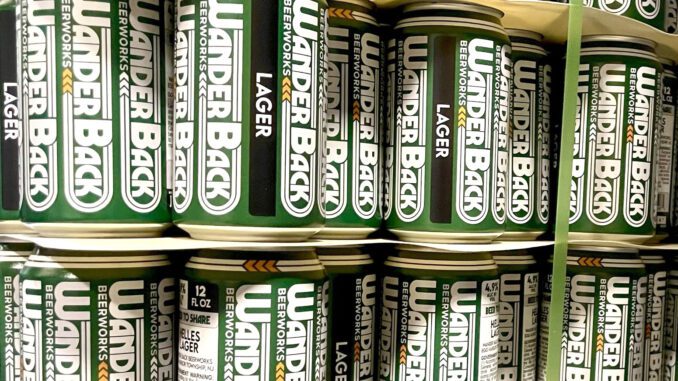
Wander Back Beerworks didn’t set out to make its flagship lager complicated. The Vineland, New Jersey, brewery was founded by former Cape May Brewing staffers Chris Henk, Brian Hink and Justin Vitti, and when it launched commercially in 2024, Wander Back Lager was the first beer it put into the market. The 4.9% ABV Munich-style Helles Lager was designed to be approachable, technically sound and easy to understand.
That simplicity, however, doesn’t mean the beer’s business strategy was simple.
Wander Back built the Lager around the idea that an everyday beer has to work for more than the person drinking it. It needs to make sense to retailers, fit naturally into a brewery’s portfolio, be priced appropriately and generate enough repeat business to justify the space it occupies.
The beer’s Gold Medal at the 2026 World Beer Cup added recognition to that approach, but the brewery’s experience suggests the award was more of an amplifier than a turning point.
“Winning Gold didn’t make us reinvent the marketing,” Vitti told BREWER. “Lager is still our everyday core brand.”
That distinction is important for breweries that can be tempted to overhaul a successful product after a competition win. Wander Back instead added a small “2026 Gold Medal” callout to its PakTechs and keg collars and incorporated the recognition into its social media marketing while continuing with the strategy already in place.
The strategy begins with making the beer easy to understand. The name “Wander Back Lager” was deliberate, particularly in a market where Lager is already familiar terminology.
“We’re in Yuengling country, with their brewery right across the river in Pennsylvania, and ‘Lager’ is already part of the everyday beer vernacular here,” Vitti said. “People walk into a bar and order a Lager. We didn’t need to teach consumers a new language.”
That approach also carries into the brewery’s broader portfolio. Wander Back has more playful and longer names elsewhere, but the flagship tells customers exactly what they’re buying.
“It’s easy to say, easy to recognize and easy to remember,” Vitti said.
For a brewery trying to build distribution, that can be more than a branding preference. Wander Back’s founders entered the company with experience at a larger craft brewery and they knew they wanted the business to have a meaningful retail presence rather than depend solely on taproom traffic. That meant considering the retailer’s perspective from the beginning.
The brewery leads with three core brands and uses rotating 12-ounce six-pack seasonals and 16-ounce four-pack Pilsners and IPAs to add variety without continually creating another permanent SKU that needs shelf space.
Packaging format has been particularly important for Lager.
The beer initially launched in 16-ounce four-packs in May 2024, but Wander Back always intended to move into 12-ounce six-packs. The brewery introduced that package in March, 2025, after determining that the New Jersey off-premise market was particularly occasion-driven.
“Six-packs simply perform better with that everyday consumer,” Vitti said.
Price also plays into the positioning. Wander Back Lager generally sells for $10.99 to $11.99 for a six-pack in New Jersey. That’s more than macro beer and generally a dollar or two above some larger craft breweries, but the brewery sees the price as competitive while still supporting its use of New Jersey-grown and malted grain and digitally printed, curbside-recyclable cans.
Draft pricing follows the same philosophy.
“A 4.9% Helles is meant to be an everyday pint, so we price our draft program competitively to give our retail partners room to put it on the menu at a price that fits that role,” Vitti said.
The distinction between maximizing the price of an individual sale and creating a sustainable account relationship comes through repeatedly in Wander Back’s approach. The brewery looks at whether a retailer reorders the second keg and the fifth keg, or whether a six-pack remains permanently in the cold box. Those repeat purchases provide a better indication of whether Lager has become an everyday brand.
“We’re just as interested in repeatability as we are in the initial sale,” Vitti said.
Lager currently represents about 21% of Wander Back’s total volume on a rolling 12-month basis, making it an important part of the company’s business. But the brewery also sees the beer as an entry point into the rest of its portfolio.
“If an account has success with Lager and that relationship eventually opens the door for our IPA, a seasonal or one of our rotating Pilsners, that’s valuable beyond the original Lager sale,” Vitti said. That makes the flagship more than a volume producer. It’s also a way for the brewery to establish a relationship with an account before asking the retailer to take on something less familiar.

The beer’s recipe has undergone a similar balancing act.
Wander Back Lager was brewed for the first time in March, 2024. From the beginning, the brewery wanted an easy-drinking beer that could appeal to experienced Lager drinkers while not alienating customers whose normal choice might be a macro lager.
The brewery also wanted to maintain a strong connection to its local supply chain. Rabbit Hill Farms in New Jersey supplies the locally grown and floor-malted grain used in the beer, which has also remained single decocted since its introduction. But maintaining those principles didn’t mean refusing to make changes.
Originally, the beer was brewed with 100% Rabbit Hill Pilsner malt. The current recipe remains predominantly Pilsner malt but incorporates Rabbit Hill Chillum malt and raw barley. The change lowered ingredient costs without removing the local-grain component that was fundamental to the beer’s identity.
“With a core beer we want to keep competitively priced and widely available, those efficiencies matter,” Vitti said.
The result is particularly noteworthy because the current recipe is the one that won the World Beer Cup Gold Medal. That doesn’t prove every cost reduction will improve a beer, but it does demonstrate the value of testing where a brewery can create production efficiencies without compromising the characteristics that define a core brand. For Wander Back, the competition result also provided external validation of the beer’s intended balance.
Vitti said that judges described the beer as “very drinkable” and noted dough and cracker malt character, malt-hop balance, body, finish, freshness, crispness and minerality. In the final round, the judges noted that the beer had broad support among the panel. That aligned closely with what Wander Back had been trying to accomplish.
“We weren’t trying to make a Helles where you needed to be a beer judge to appreciate,” Vitti said. “We wanted a beer that someone really into Lager could appreciate, and that someone whose usual order is a macro Lager could enjoy just as easily.”
The competition result has translated into measurable business momentum. Since winning Gold in Philadelphia, Wander Back Lager’s weekly rate of sale is up about 52% compared with the period before the medal. Draft sales have increased as well, and through the end of September, Lager volume was up more than 50% compared with the same period the previous year.
The brewery is careful, though, not to attribute all of that increase to the medal. Summer is naturally a strong period for a beer like Lager, and the brewery had already spent considerable time building the brand.
“It didn’t explode overnight,” Vitti said.
Instead, Wander Back had already focused on consistent availability, appropriate packaging, retailer relationships and establishing Lager as an everyday beer rather than another rotating craft SKU.
READ MORE: How Planning Can Beat Pitching as a Better Way to Build Distribution Growth
“I think the Gold Medal amplified the work we were already doing rather than replacing it,” he said.
The brewery hasn’t yet been able to point to a major collaboration or business opportunity that happened specifically because of the Gold Medal. Instead, the immediate value has been credibility and awareness for a relatively young brewery.
“Beyond that, we’ve mostly stuck to our game plan, put our heads down and kept doing the work,” Vitti said.
That game plan will soon extend to a physical taproom on Landis Avenue in downtown Vineland, pending final approvals. Wander Back Lager was the brewery’s first commercial beer in 2024, and the brewery plans to put that same beer on the first tap handle at its new location.