For TailGate Brewery owner Wes Keegan, expanding past just beer has never been about chasing the latest trend. Instead, it’s been about making sure the brewery stays relevant to every customer who walks through the door while finding new ways to leverage the business it has already built.
That philosophy has led the Nashville-based brewery to steadily grow a portfolio that now includes hard cider, canned sweet tea, and cold brew coffee alongside its beer lineup. But Keegan said the decision wasn’t driven by a desire to become something other than a brewery. It was driven by listening to customers and responding to how they were already using TailGate’s taprooms.
“We’ve always had the approach that, rather than try to guess or satisfy somebody or tell them what they like, why not just make it available?” Keegan said. “If somebody decides they want to drink cider, great, we want to have one for them. If somebody wants to switch from beer to cider or vice versa, we want to be there. We want to be in play.”
That mindset extends beyond beverages. TailGate’s pizza program has become another significant part of its business, but Keegan said the same standard applies whether the company is brewing beer, fermenting cider, making up a coffee drink or serving food.
“We just don’t do it if we can’t do it great,” he said. “We’ve had examples where we’ve tried to do different stuff and it’s not great. We just don’t do it.”
That restraint may be the most important lesson for others considering diversification. Rather than introducing products simply because consumers are talking about them, TailGate looks for opportunities that fit both its customers and its operational capabilities.
Cider was one of the earliest examples.
The brewery began making cider in 2016 after discovering it had become one of the largest retail accounts for multiple cider producers in Tennessee. Instead of continuing to buy someone else’s product, Keegan saw an opportunity to create one that better fit the brewery’s business.
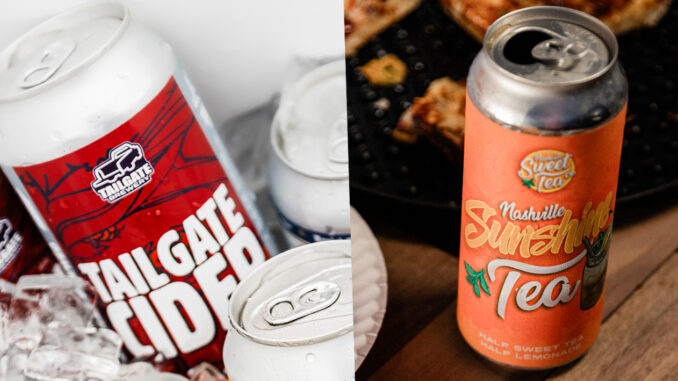
Today, the brewery’s semi-sweet cider remains a year-round offering while seasonal releases continue to rotate through both its taprooms and distribution network. One TailGate location near Music Row even operates as a de facto cidery, giving the brewery a place to experiment with recipes before deciding which deserve broader distribution.
Distributor feedback has reinforced that approach. Rather than asking for more permanent SKUs, Keegan said one partner recently encouraged the brewery to continue producing rotating cider flavors because the variety keeps retailers engaged. The lesson, he suggested, isn’t necessarily to launch a cider program. It’s to recognize where customers are already spending money and determine whether the brewery is in a position to serve that demand better itself.
That same philosophy unexpectedly opened another business during the pandemic. Like many breweries, TailGate looked for products it could continue selling while normal taproom operations were disrupted. Keegan turned to a family sweet tea recipe that had been passed down through generations, packaging it as Nashville Sweet Tea.
The response quickly demonstrated that the opportunity extended well beyond the brewery.
Kroger expanded the product into dozens of stores, creating an immediate production challenge as TailGate raced to package enough inventory. Even with the operational hurdles, Keegan said the experience proved the value of developing products that could utilize existing brewing equipment while opening entirely new revenue streams.

“It was an absolute springboard,” he said. “We saw a bunch of this online. People order direct from us, which is just the holy grail.”
Unlike beer, sweet tea also offered another attractive advantage.
“The margins are amazing on this,” Keegan said, noting the product is built from relatively simple ingredients while remaining affordable for consumers.
If your brewery is evaluating adjacent beverage categories, however, Keegan cautioned against assuming every trend deserves equal investment. TailGate intentionally avoided heavily investing in hard seltzer despite its rapid rise because the brewery viewed it primarily as a way to satisfy existing guests rather than transform the business. The same disciplined thinking currently guides its approach to non-alcoholic beer.
Although Keegan believes NA beer represents an important category, he has resisted purchasing expensive dealcoholization equipment simply to participate. Instead, TailGate continues researching alternative production methods until it finds one that meets its quality standards.
“We haven’t found one that we like,” he said. “We’re definitely not blind to what Athletic’s doing, but for us it hasn’t been too big of a hole either.”
That willingness to wait reflects a broader strategy that extends across the company’s entire portfolio. Rather than continuously adding more permanent offerings, Keegan said TailGate has intentionally narrowed its core lineup while using limited releases to maintain variety.
READ MORE: The Metrics That Matter: Wes Keegan’s Discipline for TailGate Brewery
“We’ve tried to keep a real narrow thing,” he said. “We’ve got variety covered.”
That distinction may be one of the more valuable ideas for others. Diversification doesn’t necessarily mean carrying more products. It means identifying opportunities that complement the existing business, maximize available assets and provide customers with reasons to choose the brewery more often. Ultimately, Keegan believes every brewery has to determine what fits its own market and business model. A destination brewery focused on a niche beer audience may reach different conclusions than a neighborhood brewery trying to become the preferred gathering place for families, friends and mixed groups with different tastes. What matters, he said, is making those decisions through the lens of building a sustainable business rather than protecting an identity.
“Everybody’s allowed to create their own business model,” Keegan said. “But if you’re not doing business, you’re not going to stay in business.”