

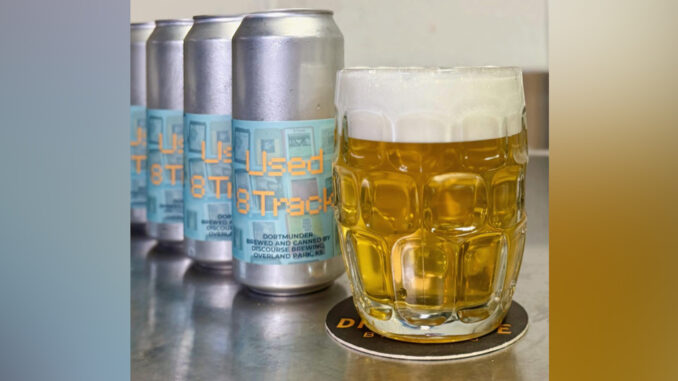
For many small and upstart breweries, competition entries are often built around convenience, which means sending whatever beer is performing well or already in the tank. For Kansas’ Discourse Brewing, founder Matt Britton said the brewery took a different approach with its recent World Beer Cup gold medal-winning Dortmunder/Export or German-Style Oktoberfest, Used 8-Track.
“Another more accomplished brewer asked recently if we truly brewed a Dortmunder for competition,” Britton said. “They were amazed that we intentionally brewed a Dortmunder for competition, that it wasn’t just another beer entered out of category.”
That reaction underscored something Britton believes still exists in the industry: the thought that medals can sometimes come from luck rather than deliberate production planning. For Discourse, a brewery that opened in September of 2023 with a five-barrel brewhouse and a 97-seat pub in Overland Park, Kansas, the beer was built with competition in mind from the start.
“The brewers thought about the Dortmunder style, and while the first (version) was very good, the second iteration really hummed,” Britton told BREWER.
Ironically, the beer itself originated from a mistake. Britton said the foundation came from the brewery’s Helles Lager called ”I’m a Dinosaur,” but too much foam stabilizer altered the bitterness profile beyond style guidelines.
“The Helles was too bitter to be called a Helles,” he said. “So, Used 8-Track came from a true error.”
Instead of scrapping the concept, the brewery used it as an opportunity to create another rotating Lager brand. Britton said that strategy aligns with what the brewery sees from consumers in its market.
“At Discourse Brewing, we have noticed folks like new, new, new,” he said. “So, we are in a constant rotation of brands.”
The iterative process became especially important because the brewery was working in a style category with limited local demand. Britton acknowledged that Dortmunder remains a difficult sell in the broader Kansas City market compared to more recognizable Lagers.
“Folks just don’t know it as a style,” he said. “The Helles sells so much better in comparison.”
That disconnect between technical quality and commercial demand is something many breweries continue to wrestle with, especially as Lagers become more prevalent in taproom lineups. Britton said the brewery adjusted the recipe over multiple batches, reducing smoked malt and finishing with Hallertauer Blanc hops to create a more layered but balanced beer.
“Overall, the beer is balanced so well and flavors stack,” he said. “We sent it out into distribution, and it just did not sell.”

Britton said the lesson is less about whether a beer wins awards and more about understanding throughput and freshness expectations inside a taproom-focused model. Discourse sells roughly 90% to 95% of its beer internally, making keg turnover critical regardless of style.
“Sell-through is huge,” Britton said. “On a NEIPA or West Coast, anything with aroma and flavor hops, you should be moving a keg a week or at least three quarters of a keg.
”On a Dortmunder or Lager, you have a little more time, but still you want to keep things fresh and the menu flipping.”
Even after the medal, Britton said the brewery is still trying to determine how aggressively to lean into the accomplishment from a marketing standpoint. Like many young breweries, Discourse is navigating the balance between promoting accolades and maintaining brand identity.
“We have seen other breweries locally and nationally make flags, print things on menus, and have a wall of trophies,” he said. “Since this is our first-ever medal, we are still thinking (how to proceed).”
The brewery plans to place the medal behind the bar and acknowledge it on menus when the beer returns, but Britton said the larger branding strategy remains unresolved.
“How do we advertise the medal without being obnoxious and still fit with our branding?” he said. “This is new to us, and I do not think we have a solid answer.”
That uncertainty also extends to how often the brewery should bring the beer back into rotation. Britton said scarcity may ultimately become part of the strategy.
“I think that this beer is special, and it will go back into rotation, keeping it fresh for when we do bring it back,” he said. “The real question is how many times to bring it back before it feels like too much. How much runway does a World Beer Cup Gold bring?”
Still, Britton believes the award has already shifted perception around the brewery, both among consumers and peers. When reputation can drive pricing power, Britton said external validation can influence purchasing behavior in ways many breweries underestimate.
“It is much easier to sell a premium-priced beer after tax and tip when you have a medal for a beer of quality,” he acknowledged.
Britton also noted that the brewery has seen increased recognition beyond the individual beer itself, including stronger customer perception across the portfolio.
“Our Untappd score for all beers has increased,” he said. “In today’s market, especially in a major metropolitan, breweries need to be in folks’ minds as a consensus of top-3, top-5, to really ‘make it’ or strive.”
1 Trackback / Pingback
Comments are closed.