Just more than a year after opening its doors, Tragmar Ale Works has already found itself attached to a milestone moment for Rhode Island beer.
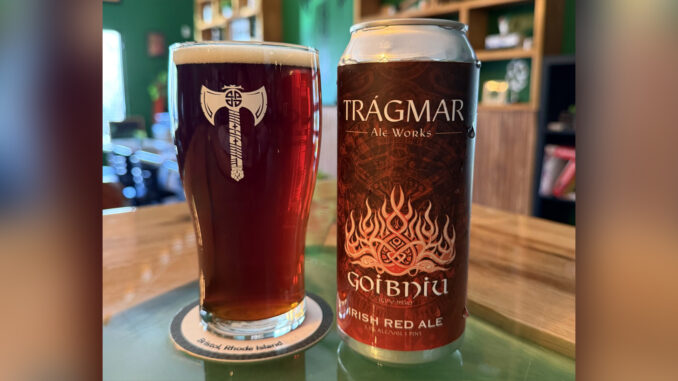
The Bristol brewery’s Goibniu Irish Red Ale captured a gold medal at the 2026 World Beer Cup in the Irish-Style Red Ale category, marking the first gold medal for a Rhode Island brewery since the competition began in 1996. For partner, operator and brewer Mike Godet, the recognition validated something the brewery had already been seeing in its own taproom since opening in March of 2025: consistency and stylistic focus can still carve out demand in a crowded craft landscape.
While many newer breweries chase breadth and rapid rotation, Tragmar found its early identity by leaning heavily into an Irish and Celtic mythology-inspired concept, complete with a pub-style atmosphere and a core emphasis on Irish beer styles. Godet said that focus gave customers an immediate point of connection.
“With the brewery being Irish themed and built to resemble an Irish pub, people wanted to try the Irish red and Irish stout,” Godet said. “People love all of the beers made in house but this one is definitely the house favorite.”
That clarity of identity may be one of the more transferable lessons for others watching consumer habits fragment across dozens of styles and drinking occasions. Rather than treating its Irish Red as a seasonal nostalgia play, Tragmar positioned it as a year-round flagship from the beginning.
“This beer is always in the tank and being packaged to keep up with demand,” Godet told BREWER. “It sells all year round.”
Internally, the brewery measures the beer’s performance by more than medals or online ratings. Godet said the Irish Red routinely outsells every other offering in the taproom, often by a substantial margin.
“The sales on this beer typically double compared to the second best-selling beer on any given day,” he said.
That type of sales separation is increasingly uncommon in taprooms where customers often gravitate toward variety and limited releases. Yet Tragmar’s experience suggests there may still be substantial market value in creating a dependable anchor brand, particularly when it aligns naturally with a brewery’s physical environment and story.
Godet said the beer’s rise was not manufactured through aggressive campaigns or distribution pushes. Instead, the brewery relied largely on organic adoption in local accounts and among repeat customers.
“I think the beer speaks for itself,” he said. “We distribute small volumes to local restaurants. This has been a crowd favorite since the beginning. We knew we wanted to push this beer into the market as our flagship. It has mostly been word-of-mouth.”
That approach also reflects the realities of a young brewery still managing production limitations. Success, in this case, has created a new challenge: how to scale without sacrificing quality.
“We are a new brewery,” Godet said. “We have been operating for only one year so the thought is that (this recognition) could open up the doors for growth and brewhouse expansion.”
Demand has already forced the brewery to consider interim production strategies before committing to larger capital investments.

“Since we cannot currently produce large volumes, we are considering contract brewing until we can expand our brewhouse,” he said.
For brewery owners, the situation highlights a balancing act many small producers face after an unexpected breakout hit. A medal can accelerate awareness overnight, but operational infrastructure often lags behind market opportunity. Contract brewing, once viewed cautiously by many, increasingly becomes a strategic bridge rather than a compromise when growth outpaces tank space.
The brewery’s early competition success also reinforces the business value of entering judged events with focused intent instead of treating competitions solely as marketing exercises. Goibniu had only previously been entered once nationally, earning a bronze at the 2025 Great International Beer, Cider, Mead & Sake Competition before taking gold at the World Beer Cup.
“This was the first time we entered into WBC,” Godet said.
The beer had already built strong consumer recognition locally, including honors from Rhode Island publications and strong ratings online, but the World Beer Cup result provides a different type of validation. That can especially weigh heavily for distributors, retail buyers and new consumers unfamiliar with the brewery.
READ MORE: The Creative Solutions Vermont’s 1st Brewery Has Implemented to Retain Staff
For Godet, the appeal of the beer remains rooted in execution rather than novelty.
“It’s very clean and refreshing,” he said. “It is smooth and to style.”
He added that while the beer pours with a deep red appearance that can visually suggest heaviness, the drinkability is what keeps customers returning.
“Every sip you take makes you want more,” he said.
That emphasis on drinkability may ultimately be the most important part. At a time when many continue to compete for attention through intensity, adjuncts or limited-release hype, a technically sound, approachable flagship can still become the product that defines a brand. Iin Tragmar’s case, it can potentially change the trajectory of a young brewery far earlier than expected.