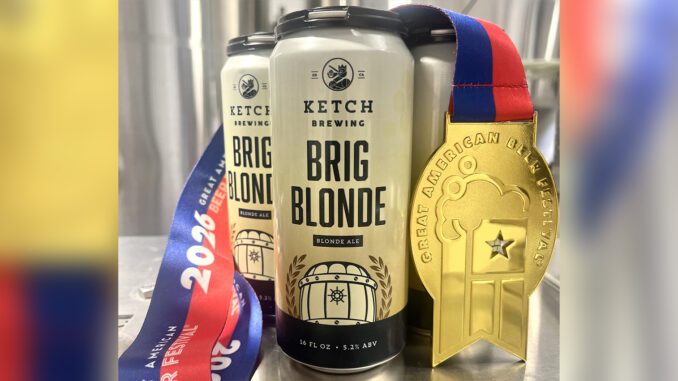
Brig Blonde wasn’t created with the intention of becoming a flagship brand or a national competition standout. It was originally created by San Diego’s Ketch Brewing to serve a practical purpose: give a restaurant control over the beer it served its customers.
Nearly eight years after the first batch was brewed, that house beer has become one of the brewery’s most important business drivers. Brig Blonde earned back-to-back gold medals at the Great American Beer Festival in 2025 and 2026 in the Golden or Blonde Ale category. The brewery has entered the beer in national competitions three times, earning gold twice. But the recognition is only part of the story. Brig Blonde now accounts for approximately 18% of Ketch’s total sales and recently overtook the brewery’s West Coast IPA as its highest-selling half-barrel keg SKU.
For Head Brewer and Director of Brewing Operations Sam Billheimer, the beer’s growth reflects a combination of continuous recipe refinement, quality ingredients and a distribution strategy that expanded alongside its reputation.
Ketch was established in 2018 by The Brigantine, a family-owned restaurant company that opened in San Diego in 1969. The goal was to begin producing house beers for its restaurants while maintaining greater control over quality.
“Brig Brew” — a Extra Pale Ale — was the first beer Ketch ever produced and became the house beer for The Brigantine. Its evolution since that first batch has been deliberate, with the brewing team making adjustments to virtually every component.
“We’ve modified every component of this beer since the first batch (malt, hops, yeast, and water composition) in an attempt to slowly improve the beer one batch at a time,” Billheimer said. It shows that a successful recipe doesn’t necessarily mean the work is finished. Even beers with established customer followings can benefit from incremental improvements, particularly when brewers are intentional about evaluating ingredients and production variables.
For Billheimer, the emphasis on raw materials has been a significant contributor to Brig Blonde’s success.
“I think an emphasis on highest possible quality raw materials has really made a difference in improving this beer, and it shows up on both the judging table and regular customers coming back to this beer over and over again,” he said.

The beer also benefits from its accessibility. Blondes offer an opportunity to reach customers who might not gravitate toward more assertive styles, while still providing a platform to demonstrate brewing consistency and execution. For Ketch, that approachable character also aligns with the larger restaurant business. Billheimer added that Brig Blonde pairs particularly well with The Brigantine’s fish tacos, creating a natural connection between the brewery’s product and the restaurant’s established food offerings.
That relationship gives the beer an advantage that breweries without an established hospitality operation might not have: a built-in audience and a direct opportunity to introduce customers to the brand. However, Ketch hasn’t limited Brig Blonde’s growth to its own restaurants.
Following its first GABF gold medal, Billheimer said sales of half-barrel kegs began increasing. The recognition also helped create opportunities to move beyond the company’s internal restaurant network and sell the beer to outside accounts. That was a meaningful shift for a brewery whose production has historically been split between internal and external customers. Across Ketch’s entire portfolio, approximately 45% of its volume goes to The Brigantine’s restaurants, while the remaining 55% is sold to outside accounts.
Brig Blonde’s awards helped establish a reason to expand its availability, giving accounts outside the restaurant group an opportunity to carry a beer with proven competition recognition. The brewery also began canning the beer in 2025, partly as a way to promote its medals and extend the brand’s reach beyond draft accounts.
READ MORE: How This Blonde Ale Is Getting Ahead of Market Expectations
Ketch also took a more deliberate approach to positioning Brig Blonde within its own restaurants.
At the beginning of 2026, the brewery introduced the beer as a $5 pint happy hour special. Combined with the GABF recognition, the pricing strategy and promotional positioning to build volume around an established product rather than relying exclusively on new releases to generate customer interest can help fuel that growth. For a beer that already had a strong foundation, the combination of recognition, increased availability and a specific promotional price point helped create additional momentum.
That kind of performance demonstrates why you should evaluate individual brands beyond their contribution to overall revenue. Tracking draft volume, packaging performance, account adoption and the effectiveness of promotions can help identify which products have the potential to become larger business assets.