Distribution may be presented as the next logical step in a brewery’s growth. The thought process used to be: Make more beer, put it in more markets, add accounts and increase volume.
But for Guggman Haus, distribution has been approached more cautiously. The Indianapolis-based brewery has built a business around hospitality first, with its taproom, walk-up kitchen and coffee house forming the foundation of the company. Distribution has been layered onto that foundation rather than used to create it. That distinction has shaped how the brewery thinks about production, logistics, capital investment and even how far it wants to sell its beer.
“We were lucky in the way that we started. Maybe not lucky. We just put a lot of thought into it in the beginning,” said co-founder Courtney Guggenberger said during a cover story interview with BREWER. “We built the business with the hospitality mindset from the beginning.”
That decision gave the brewery something that can be difficult to regain once a distribution-heavy model is established: control over the pace of growth.
Guggman Haus did not have to immediately chase outside volume to support a large production system. Instead, the brewery could develop its local business and determine when additional production and distribution made sense.
“It was a competitive advantage for us that we didn’t start with some huge system that forced us into the market when we weren’t going to be ready yet,” she said. “And so now being able to do it slow and steady on our time, versus being forced to do it, has been really great for us.”
The thought can then be less about whether to distribute and more about why distribution is being pursued in the first place. If a brewery builds production capacity first and then needs distribution to keep that capacity busy, the business can quickly become dependent on volume. Guggman Haus has taken the opposite approach and let demand and capacity inform the next investment.
That does not mean the brewery is uninterested in growth. It means growth is being treated as a series of decisions rather than a single destination. The brewery currently distributes primarily throughout the greater Indianapolis area, with accounts stretching into places such as Noblesville, Zionsville, Greenwood and Martinsville. Bloomington (about 60 miles south of the brewery) also serves as a test market, with about five accounts.
The geographic strategy is deliberately incremental.
“If we want to expand, it’s like, what about this opportunity? Does it make sense?” Guggenberger said. “And so if we want to try Evansville, what would that look like? How do we get to Northern Indiana? Do we go through a distributor? Do we want to try our own? Logistics of it, it’s kind of like figuring that out. The littler things that add to the bigger piece.”
That approach challenges the notion that a brewery needs to establish a large geographic footprint to be considered successful in distribution. Instead, Guggman Haus is using individual markets almost as experiments. A new market has to justify the logistics, labor and capital required to serve it. The brewery can then decide whether the opportunity warrants another step.
That makes distribution less of a binary distro decision and more of a series of questions: Can the brewery serve this market efficiently? Does the market provide meaningful incremental revenue? Can production support it without hurting the taproom? Is the logistical burden reasonable? And does the market help build the brand?
That final question is particularly important for Guggman Haus.
“It’s nice extra revenue, obviously,” Guggenberger said. “But then I think a big plus is the awareness that helps our brand in the field.”
The brewery has seen customers from Indianapolis suburbs and surrounding communities visit its taproom after encountering Guggman Haus beer elsewhere. Distribution therefore has a marketing function in addition to its direct sales role.
“If they see it on tap there, it’s another reminder about us to them as well,” she said.
That creates an interesting way to evaluate distribution. The value of an account may not be limited to the cases or kegs sold through it. A strategically located account can introduce the brewery to customers who may eventually become taproom customers or regular supporters of the brand. But that only works if the brewery can maintain quality and consistency while serving those accounts.
For Guggman Haus, the distribution program also solves a production problem. Derek Guggenberger explained that the brewery’s distribution volume helps prevent certain beers from becoming trapped in the taproom as larger batches work their way through inventory.
“Even if we don’t have to do a lot of distro, having some distro of a few different things helps, because we’re not trying to suddenly sell a 10-barrel batch only through the taproom,” he said.
Instead, distribution can increase the velocity of certain beers.
“We can keep things super fresh, because now that beer that might have taken four or six weeks to go through before, now we’re producing it every two weeks instead,” Derek said.

That is a more useful way to think about distribution than simply adding another sales channel. When properly balanced, it can change production cadence, inventory movement and freshness. It also creates a feedback loop between the front and back of the business. More consistent movement allows the brewery to brew certain beers more frequently. More frequent brewing can make production more predictable. Distribution can then help absorb some of that volume without requiring the taproom to carry the entire burden.
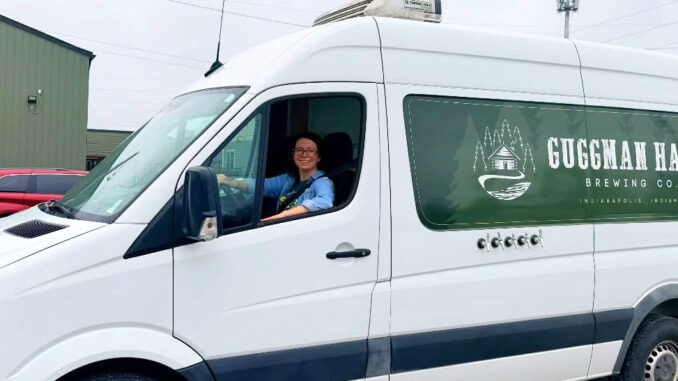
But Guggman Haus has been careful not to let that logic become an excuse for premature expansion. The brewery’s logistics have grown alongside the demand. It initially relied on a small Ford Transit for deliveries. As the number of deliveries increased, that vehicle eventually required multiple trips each week. The next step was a used Sprinter van.
“We didn’t start off with buying this giant van to start with being like, ‘Well, now we’re going to have to find ways to fill it up,’” Derek said. “It’s like, OK, we filled up this other one. Now we can work into this next option.”
The brewery has since added a refrigerated tap truck that serves two purposes: distribution and off-site events. A smaller van can also be used when the brewery needs to run two loads.
That progression illustrates a broader capital-management principle for small and midsize breweries: Buy capacity when the existing system is creating a constraint, not simply because the larger asset appears to represent where the business eventually wants to go. A larger vehicle, a larger canning line or additional employees can all make future growth easier. But they also create fixed costs that the brewery then has to support.
Guggman Haus has instead tried to make each investment answer an existing operational need.
“It’s kind of our model. It’s slow and even,” Courtney said. “We don’t need to jump into something.”
That philosophy extends beyond trucks and distribution territory. The brewery has a larger long-term vision. Courtney said the company’s annual planning process includes a five- or 10-year vision that includes becoming known throughout the Midwest as a destination for beer and the overall experience surrounding it. The important distinction is that a long-term vision does not automatically become a short-term operating plan.
“We would love to be known in the Midwest as a great place to go for beer, and it’s a whole experience,” Courtney said. “But it doesn’t mean we’re going to do it tomorrow.”
READ MORE: Keeping Customers All Day: Guggman Haus Brewing
It shows that Guggman Haus can have a Midwest ambition while still making decisions one delivery route, one market and one piece of equipment at a time.
“Every little thing we do is intentional to get us there,” Courtney said.
The question is not simply whether distribution produces an acceptable margin. Nor is it whether a brewery can find enough accounts to move additional beer. The more useful question is what role distribution should play in the entire business. For Guggman Haus, it provides incremental revenue, expands brand awareness, helps move beer faster, creates more predictable production rhythms and introduces the brewery to potential taproom customers. But it also brings delivery labor, vehicles, refrigeration, market development and management complexity.
Those competing factors are not being ignored. They are being evaluated one at a time.
The goal is not to avoid growth. It is to make sure each new piece of growth strengthens the business that already exists.