For many breweries, collaboration beers begin with a friendship between brewers or an opportunity to create a unique recipe. At Michael Waltrip Brewing, the process starts somewhere else entirely.
“We approach it as publicity, connecting to audiences first and foremost, and then the beer is just part of that process,” President and CEO Bryan Sperber said.
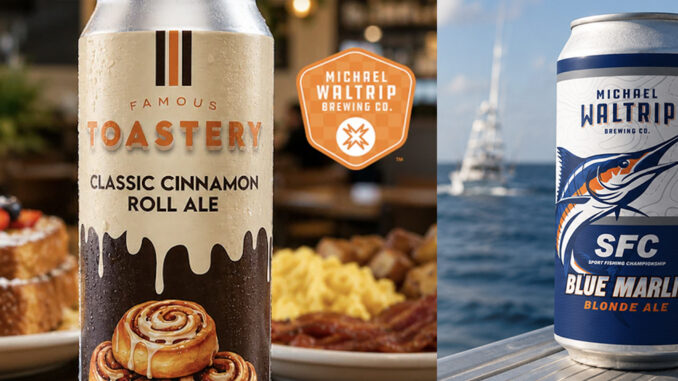
That philosophy has become increasingly evident through two of the company’s newest releases: the SFC Blue Marlin Blonde Ale with Sport Fishing Championship and the Famous Toastery Cinnamon Roll Ale. While vastly different in style and audience, both projects were built around the same question: Can two brands introduce each other to consumers they otherwise might never reach?
For Sperber, the answer lies in finding partnerships where both sides create value.
“The second part is, does it feel like there’s a natural crossover here?” he said. “Not only would they bring value to our brand, but our brand could help bring value to them.”
The Sport Fishing Championship collaboration was a natural fit because of the overlap between NASCAR and competitive fishing audiences. Sperber described the fishing community as “racing adjacent,” noting that Michael Waltrip’s own history with offshore fishing only strengthened the connection.
“We felt very comfortable in that space,” Sperber said.
The collaboration extends beyond simply producing a Blonde Ale. Sport Fishing Championship’s events receive exposure through ESPN, while Michael Waltrip Brewing brings its own media reach, NASCAR audience and promotional capabilities to the relationship.
“It really is a one plus one equals three marketing match,” Sperber said.
Rather than viewing the beer as the centerpiece, the companies built the broader partnership first.
“We approached this as a partnership between Waltrip Brands, the marketing and media company, and Sport Fishing Championship first and foremost,” Sperber said. “Then the idea started to surface of, ‘What if we anchored this around a product?'”
That sequence matters.
Instead of forcing a collaboration because a beer sounded interesting, the relationship drove the concept. The beer simply became a tangible way for consumers to engage with both brands.
The same thinking guided Michael Waltrip Brewing’s partnership with Famous Toastery, although the audience looked very different.
The collaboration originated through conversations between Sperber and Famous Toastery founder Robert Maynard, whose Southeastern regional breakfast chain has developed a loyal following while also embracing NASCAR sponsorships.
“We’d meet for coffee and just kind of talk about what was happening in your world and what was happening in our world,” Sperber said. “Over time, this idea of, ‘What would it look like if we decided to do something together?’ caught some traction.”
Rather than producing a conventional Coffee Stout or Breakfast Porter, the brewery leaned into Famous Toastery’s signature menu item by developing a Cinnamon Roll Ale.

The recipe became an opportunity to showcase brewing creativity as much as marketing.
Sperber credited brewer Levi Duncan with taking inspiration from brewing techniques dating back a century, incorporating bread yeast to create a richer, bakery-like character.
“He introduced bread yeast into the brewing process to give it a little bit more of a bready flavor,” Sperber said. “The beer itself tastes like you’re biting into one of their incredible cinnamon rolls.”
Even the brewery’s contract brewing partners at New Sarum Brewing initially questioned the approach.
“They kind of raised an eyebrow when he said we wanted to do this,” Sperber said with a laugh. “But they went with it, and I’m really grateful they did because the final result is just an incredible beer.”
For Michael Waltrip Brewing, both collaborations have also become possible because of another significant business decision made over the past several years.
The company transitioned away from operating its own production brewery and instead partnered with New Sarum Brewing while retaining Duncan as its own brewmaster. That structure allows the brewery to oversee recipe development and quality while gaining the flexibility to produce smaller batches without committing to large production runs.
“It’s really lowered the risk profile on being able to do partnerships,” Sperber said.
Instead of producing thousands of cases before knowing whether a collaboration will resonate, the brewery can launch moderate runs, evaluate demand and quickly return for additional production if necessary.
That flexibility has changed how the company thinks about partnerships.
“We’re super nimble,” Sperber said. “We can get beer in smaller runs produced very quickly. As it goes well, we’ll follow that up with another run.”
For breweries considering similar collaborations, Sperber believes too many focus first on the beer itself rather than the audience it can help reach.
READ MORE: 4 Collaboration Ideas That Connect Breweries, Businesses & People
“The truth is, most people don’t know anything about our brand,” he said. “We’re very, very tiny in the landscape of beer brands.”
That reality has led Michael Waltrip Brewing to evaluate partnerships beyond immediate sales numbers.
While volume certainly matters, Sperber said the larger opportunity comes from introducing the brewery to entirely new consumer groups while helping partner brands accomplish the same goal.
“The sky’s the limit,” he said. “There are so many brands out there looking for exposure, looking to extend their message into different audiences.”
His advice is for breweries to recognize the value they already bring.
“If there’s brands listening that have an audience, even if it’s a localized audience, that’s important to other brands,” Sperber said. “Know your worth.”
For Michael Waltrip Brewing, collaboration has become less about creating the next limited-release beer and more about creating conversations between brands, industries and consumers who may never have crossed paths otherwise.
With that approach, the beer isn’t the destination, it’s the introduction.