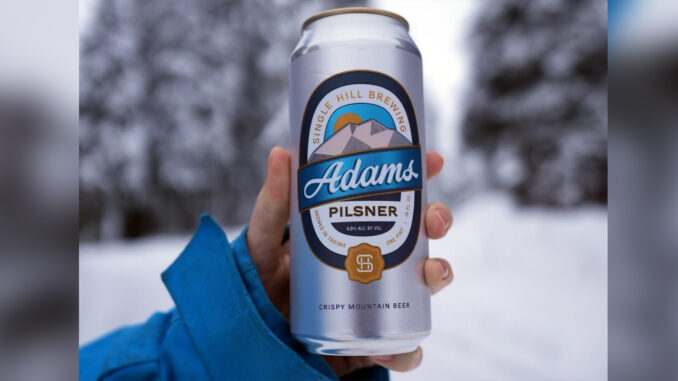
The pursuit of award-winning beer may often conjure an image of hop-forward specialties, barrel-aged projects or limited releases. But for Single Hill Brewing, one of its biggest success stories has come from a beer intentionally designed to be its most approachable.
Adams Pilsner recently earned Gold at the 2026 World Beer Cup in the Contemporary American-Style Lager category, a recognition the Yakima, Washington brewery sees as validation after years of steady refinement rather than a sudden breakthrough. The beer’s trajectory offers a look at how patience, portfolio strategy and continuous improvement can turn a foundational brand into a key business asset.
“In the early days it didn’t have much success,” said Andrew Pytel, director of sales and marketing for Single Hill. The beer was entered into the Great American Beer Fest’s annual event three times starting in 2020, but it wasn’t until GABF 2025 that Adams made it to the final table.
“No medal, but we were happy to have made it to the medal round,” Pytel said. The first and only time Adams was entered at the World Beer Cup was this year, where it took home the gold.
Now, the recognition did not arrive overnight.
Pytel said Adams has been evolving since the brewery’s early years, when Single Hill rotated several Pilsners and Pilsner-inspired Lagers through its taproom lineup. As the company expanded its packaging program, brewery leadership identified an opportunity to establish a flagship Lager.
“When we made the decision to can our beer in 2020, we locked in Adams as our core Pils,” Pytel said. “Back then, Adams was more bitter, it used a different yeast strain, and a different base malt. We aim to make each batch of our core beers the best batch yet, so over that amount of time there’s a bit of a ‘Ship of Theseus’ situation.”
That willingness to continually refine a core brand highlights a reality many breweries face. Flagship beers are often expected to provide consistency, but long-term success frequently requires measured parts of evolution as a brew team gains new process knowledge, ingredient access and customer feedback.
The results have translated into meaningful business performance. While the medal may bring additional attention, Adams already had become one of Single Hill’s most important brands before receiving this international recognition.
“Through persistence, recipe refinement and a bit of luck, Adams had significant growth as a draft beer in 2025,” Pytel said. “This year we’ve seen an increase in can sales. We expect Adams draft to keep growing in our Pacific Northwest market, maybe driven a little more due to the new hardware.”
More importantly, Single Hill evaluates the beer’s performance beyond simple depletion numbers.
“Sales are a good measure, but success is a combination of single-brand sales, position in the overall portfolio, and support for the Single Hill brand,” Pytel said. “With strong sales, a unique place in our brand lineup, and as a strong supporter of Single Hill’s offerings beyond IPA, Adams squarely hits all targets.”
The numbers reinforce that assessment. Adams represents 36% of Single Hill’s core beer sales volume and 12% of overall beer volume in 2026, making it far more than a niche Lager offering.

That portfolio impact may be one of the most significant lessons for any brewery’s decision-makers. As many continue searching for ways to diversify beyond IPA-heavy sales mixes, Adams Pils demonstrates how a well-executed Lager can serve both as a volume driver and as a brand-building tool.
What’s particularly notable is how Single Hill positioned the beer in the marketplace. Rather than treating it as a premium specialty product, the brewery leaned into accessibility.
“What’s really amazing about winning an international gold medal with Adams is that this beer, more than the others in our lineup, is marketed as the approachable, everyperson’s beer,” Pytel said. “It has a completely different label design than the rest of our core lineup, and we try to keep the price down to keep the accessibility high.”
The approach shows that award-winning beers don’t have to be marketed as premium or aspirational products. In Adams’ case, broad appeal became a strength rather than a compromise.
Pytel believes the beer succeeds because it balances regional identity with stylistic familiarity.
“We call it an American Pilsner. It enters competitions as American Contemporary Lager,” he said. “Adams showcases Idaho malt and Washington hops, but is brewed with classic Pilsner in mind.”
The beer utilizes Adeena and Loral hops alongside a streamlined malt profile designed to showcase balance rather than intensity.
“The super-clean, approachable malt bill lets the hops show just enough to make it come across as ‘American’ where it counts,” Pytel said.
Differentiation does not always require pushing boundaries. Sometimes success comes from executing a familiar style exceptionally well while creating a distinct place for it within a broader portfolio strategy.
READ MORE: The Discipline Behind Distinctive Brand Positioning
Even with the WBC Gold, Single Hill remains focused on sustainable growth rather than chasing immediate expansion opportunities.
“Nothing beyond its normal sales,” Pytel said when asked about new business opportunities created by the award. “I’d love to see cans of Adams featured at stadiums or something, to represent Washington Lager in a bigger way, but we’ll take what we can get for now.”
Awards may help create momentum, but the foundation for long-term success is often built years earlier through disciplined product development, portfolio positioning and a clear understanding of how a beer contributes to the overall health of the business.