
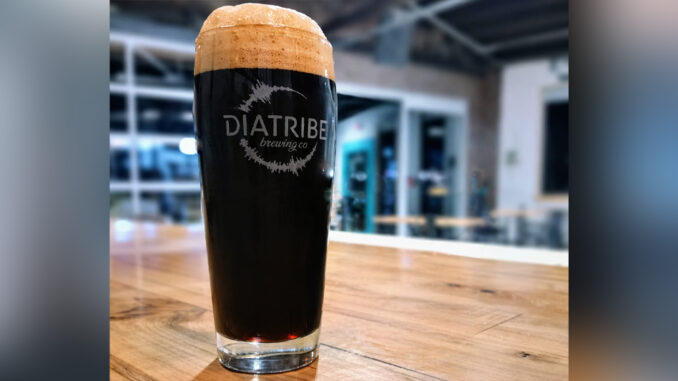
At a time when many breweries carefully engineer every release for visibility, promotion cycles, and social media traction, the story behind Diatribe Brewing Co.’s Irish Extra Stout moves in a different direction. It raises a quiet, but important, question for others: what happens when a beer is not actively marketed at all?
For owner and brewer Dave Byers, the answer begins with intention rather than promotion. “We haven’t” been marketing it differently than the rest of the lineup, he said, referring to the Stout that recently earned a Gold Medal at the 2026 World Beer Cup in the Export Stout category.
It’s the second year in a row the Asheville, North Carolina brewery has earned a high honor, capturing its first gold at the 2025 event in the Chocolate Beer category with its Chocolate Porter. But, don’t mistake that lack of differentiation as an oversight in his approach; it’s the point. The beer exists to be itself, not to be positioned as a campaign.
That stance extends even further when success is defined internally. Byers is explicit that traditional sales metrics are not the primary lens.
“I don’t care about the sales numbers, but rather whether my partner and I are happy with it and we’re hearing good feedback from industry peers and regulars,” he said. “If it’s a slower moving beer I want to make and it won’t move fast, I just make a smaller batch.”
That philosophy challenges a general thought in brewery planning: that production volume should be tied directly to perceived demand. In practice, Diatribe treats batch size as a flexible outcome of creative satisfaction rather than a forecasted sales target. The Stout itself, for example, has only been produced in half-barrel pilot batches, making its impact on the overall business intentionally minor.
But even in that restrained framework, external validation eventually arrived. The Irish Extra Stout was inspired by Byers’ long-running interest in comparing classic Stout expressions, particularly export versions against traditional dry Irish examples.
“I’ve always enjoyed trying the various versions of Guinness stouts against each other and seeing how the export versions compare to the classic,” he said.
The beer evolved with subtle adjustments rather than reinvention.
“This year I adjusted the recipe of the export version to incorporate a slightly sweeter base malt profile, which went over well with customers,” he added.
That kind of refinement is less about chasing novelty and more about calibrating drinkability within a tightly defined style boundary. But, the balance between stylistic discipline and competitive recognition is a crux to look at.
Byers is clear that he is not trying to “get weird or interesting” with classic styles.

“I just try to make them true to style with a focus on drinkability within the range of the style,” he said.
Yet that restraint is also what appears to have resonated most strongly with judges and customers alike. In a competition environment where technical precision is often rewarded, adherence to style can become a differentiator in itself. Still, it raises a practical question for others: if a beer earns top recognition without marketing or aggressive positioning, is that validation of product excellence or simply evidence of a niche that already existed in the customer base?
Byers points to his taproom audience as part of the answer.
“In Asheville we have a lot of educated beer drinkers, which means they also like classic styles like this one, so we have a lot of regulars who look forward to it every year for Saint Patrick’s Day,” he said.
The demand, in other words, is cyclical and community-driven rather than campaign-driven.
What is notable from an operations perspective is not just that the beer won, but that its success did not fundamentally alter its role in the business. Even with recognition from the World Beer Cup, there is no immediate pivot toward scaling or repositioning.
READ MORE: Unique Barrel Uses for Your Brewery’s Portfolio
“We focus on taproom sales, but we may do a small amount of distro on this one as we do with a few others,” Byers said.
That restraint may be the most instructive element. In an industry often pushed toward constant expansion, Diatribe’s approach suggests an alternative model: treat certain beers as creative anchors rather than growth engines, and allow recognition to follow without forcing it into a larger strategic shift.
The risk in this philosophy is obvious. A beer that is not actively marketed can remain invisible outside its immediate ecosystem, no matter how well it performs in competition. The counterpoint is equally clear: not every successful beer needs to carry the burden of brand growth. Some can simply confirm that the brewery is still making exactly what it intends to make.


1 Trackback / Pingback
Comments are closed.