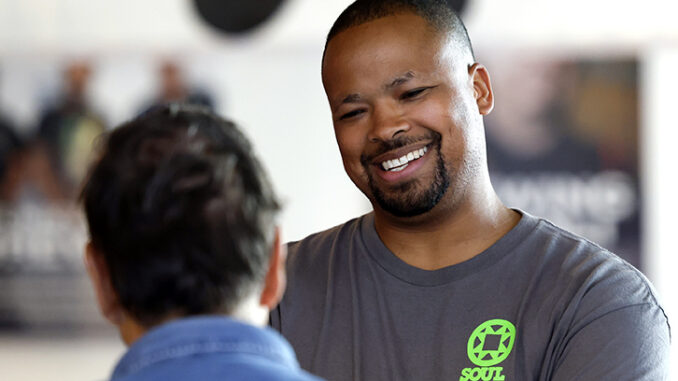
When Soul Mega was selected as the 2026 recipient of the Samuel Adams Brewing the American Dream Brewing & Business Experienceship, the recognition reflected more than the brewery’s momentum. It highlighted a business model that CEO and co-founder Elliott H. Johnson II says has always viewed beer “as both a product and a platform.”
That philosophy has helped Soul Mega grow from grassroots events into retail distribution across Washington, D.C., Maryland and Delaware by combining community events, cultural partnerships and direct relationships with consumers while building “the operational foundation needed to grow through traditional distribution.”
Johnson credits much of that approach to his background in finance, saying the company remains focused on the business fundamentals behind the brand.
“We think carefully about margins, production, inventory, account performance and where our limited resources can have the greatest impact,” he told BREWER. While Soul Mega is still growing, he says there has always been “a clear vision” for becoming “a sustainable regional — and eventually national — brand without losing the authenticity that made people connect with us in the first place.”
Now, with distribution established and relationships with more than 200 on- and off-premise accounts, Johnson says the brewery’s next challenge isn’t simply opening new doors. Instead, the priority is building stronger sales velocity in existing markets. “Sustainable growth cannot be based on continuously adding new doors,” he said. “It has to come from building productive accounts and loyal customers.”
BREWER spoke with Johnson about the business strategy that helped Soul Mega earn the recognition, how the experienceship can support the brewery’s next phase of growth and why strengthening existing markets has become the company’s top priority.
BREWER: Your brand has expanded into retailers like Whole Foods and Total Wine while continuing to build community around the brewery experience. Where do you currently see the greatest opportunity for future growth? Is it through retail distribution, on-premise accounts, events, collaborations, direct-to-consumer engagement or something else? How are you approaching that opportunity?
JOHNSON: The greatest opportunity for us is connecting on-premise growth with stronger retail performance. Restaurants, bars and cultural events are often where someone first experiences Soul Mega. Those environments allow the beer to be introduced with context and create an emotional connection that is difficult to replicate from a shelf alone. Retail then gives that consumer a convenient way to bring the brand home. We are approaching those channels as parts of the same customer journey rather than separate strategies. We want to build concentrated groups of strong on-premise and retail accounts, support them with tastings, events, collaborations and digital storytelling, and make it easy for consumers to find Soul Mega again. Our goal is not simply to be available in more places; it is to build markets where awareness, trial and repeat purchasing reinforce one another.
BREWER: Every growing brewery reaches points where important business decisions shape its future. What is one decision your team made over the past year that had a meaningful operational or financial impact, and what did you learn from that experience
JOHNSON: One of the most meaningful decisions was my decision to leave a 16-year career at NASA and begin working on Soul Mega full-time. Until then, I had been building the company while also managing the responsibilities of a demanding career. Making Soul Mega my complete professional focus gave me the capacity to become much more involved in sales, distributor management, financial planning and long-term strategy. It also reinforced that founder attention is a real business resource. Being present creates momentum, but attention alone does not solve every problem. It has to be supported by clear systems, measurable priorities and the discipline to distinguish activity from actual progress. I have learned to evaluate our decisions more closely based on whether they improve sales velocity, margins, cash flow or the long-term value of the brand.

BREWER: The Brewing & Business Experienceship centers around mentorship from experienced brewery professionals. As you’ve prepared for this opportunity, what aspects of your business are you most excited to refine or challenge, and where do you think there is still room for improvement?
JOHNSON: I am most excited to challenge our assumptions about what Soul Mega needs to look like at its next stage. We have been resourceful and entrepreneurial in getting the company to this point, but some of the practices that help a small company survive are not necessarily the same systems that allow it to scale. I want to refine our production economics, forecasting, distributor strategy, portfolio planning and approach to entering new markets. There is also room to improve how we translate consumer enthusiasm into predictable account-level sales. Learning from people who have built a brewery at scale will help us identify what we should strengthen, what we should simplify and what we may need to do differently altogether.
BREWER: What operational or financial challenge is currently top of mind for your business, and what strategies are you putting in place to address it while continuing to grow?
JOHNSON: Working capital is one of the biggest challenges. As a contract-brewed brand, we commit cash to ingredients and production well before the finished beer is sold and payment is collected. As volume increases, that timing gap becomes more significant. Growth can create financial pressure even when the underlying demand is positive. We are addressing that through better production forecasting, closer inventory management, improved account-level sales analysis and more deliberate production scheduling. We are also exploring additional capital that would allow us to finance growth responsibly rather than placing too much pressure on day-to-day operations. The goal is to align production more closely with real demand while still maintaining enough inventory to serve our distributors and customers reliably.
BREWER: Your company has built a reputation around creating experiences that extend beyond the beer itself. How has your philosophy for building a brewery brand evolved over the past several years, and what changes have delivered the biggest business benefits?
JOHNSON: Early in our journey, we focused heavily on creating memorable events and introducing people to Soul Mega through culture and community. That helped us build genuine affinity for the brand before we had broad distribution. Over time, our philosophy has evolved from simply creating great experiences to designing experiences that also support measurable business objectives. Today, we think more intentionally about what happens after someone attends an event, tries the beer or sees the brand online. Can they find Soul Mega nearby? Do they know which product to look for? Are we giving them a reason to return or tell someone else about us? The biggest benefit has come from connecting our cultural identity with greater commercial discipline. We have not moved away from experiences; we have become more strategic about how those experiences generate brand awareness, strengthen customer relationships and support the accounts carrying our beer.
BREWER: As you prepare to collaborate with Samuel Adams and attend the Great American Beer Festival, what do you hope to take away from those experiences that will influence Soul Mega’s business over the next three to five years?
JOHNSON: I want to gain a clearer understanding of what it takes to scale a brewery without separating the business from the values and personality that made it special. Samuel Adams has decades of experience in production, distribution, innovation and brand building. I am especially interested in seeing the systems behind those areas and understanding which lessons can be adapted for a company at our stage. The Great American Beer Festival will also provide an opportunity to learn directly from brewers, retailers, distributors and consumers from across the country. I hope to leave both experiences with stronger relationships, a more informed growth strategy and a better understanding of where Soul Mega can compete most effectively over the next three to five years.
READ MORE: How Checkerspot Plans to Capitalize on Samuel Adams’ Experienceship Win
BREWER: Looking across today’s craft beer landscape, what industry trend or shift are you watching most closely, and how do you expect it to influence your brewery’s decisions moving forward?
JOHNSON: I am watching the shift toward more selective and occasion-driven consumption. Consumers still value great beer, but they are being more intentional about what they purchase, how often they drink and which brands deserve their attention. At the same time, retailers and distributors are placing greater emphasis on products that demonstrate clear demand and consistent sales. For Soul Mega, that reinforces the importance of focus. We do not need to produce a constant stream of new products or pursue every available placement. We need to create approachable, high-quality beers, support the accounts that believe in us and make each interaction with the brand meaningful. Moving forward, our decisions around products, markets and partnerships will be guided by whether they deepen consumer loyalty and produce sustainable velocity—not simply whether they make the company appear larger.