For many breweries, a World Beer Cup gold medal is viewed as a potential game-changing moment. The thought process is fairly straightforward: win one of the craft beer industry’s most prestigious awards and sales will immediately follow.
The reality, however, can be more nuanced.
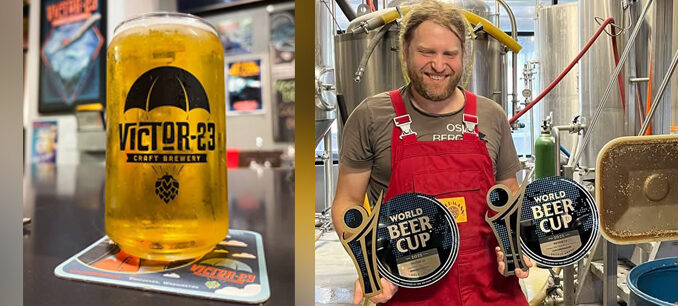
For Victor 23 Brewing in Vancouver, Washington, Birkebeinerpils recently earned a second consecutive World Beer Cup gold medal in the International-Style Pilsener category, giving the brewery one of the most decorated Lagers in the country. Yet owner Bryan Ward said the experience highlights both the value and limitations of awards in a crowded craft beer marketplace.
“Operating in the Pacific Northwest — an incredibly competitive and brewery-dense region — it can be challenging to stand out, even with major awards,” Ward said. “While we believed that winning a World Beer Cup medal might dramatically boost demand, the reality has been more gradual.”
Ward’s thoughts on this serve as an important reminder for others who may view medals as a direct path to explosive growth. Recognition can create opportunities, but it rarely replaces the need for deliberate sales and marketing efforts.
“Birkebeinerpils performs very well, particularly with our Seattle-area distributor and in our own taproom, but demand hasn’t exceeded production capacity,” Ward said. “That said, we see a clear opportunity to better leverage these awards to build broader awareness and growth.”
Rather than treating competition success as a finish line, Victor 23 has used it as a credibility-building tool.
The brewery self-distributes within approximately 30 miles of its brewery, serving accounts throughout Vancouver and nearby Portland, Oregon markets. In those conversations with retailers and customers, the awards provide a valuable introduction, Ward says.
“When connecting with new accounts and customers, we highlight Birkebeinerpils’ back-to-back Gold Medals at the World Beer Cup, which immediately establishes credibility and generates interest,” Ward said.
Awards may not automatically create demand, but they can reduce friction during sales conversations and open doors that otherwise might remain closed.
The beer’s success also underscores another lesson frequently cited by competition winners, that consistency remains one of the most difficult and valuable achievements in brewing.
“What makes this beer resonate so strongly with judges and drinkers? Consistency is a major factor,” Ward said. “Winning back-to-back Gold Medals at the World Beer Cup reflects a high level of precision and repeatability in the brewing process.”

That repeatability becomes even more noteworthy considering the style itself. While hop-forward beers often dominate consumer attention, Pilsners leave little room for flaws. Ward also points to the beer’s unique origin story as a differentiator.
“Beyond that, the beer’s Norwegian roots give it a distinctive character and flavor profile that sets it apart from other pilsners, which appears to resonate strongly with both judges and consumers,” he said.
The beer’s foundation traces back more than a decade. Birkebeinerpils was originally developed in 2011 by Victor 23 head brewer Tom Torresdal while working in Norway, an experience that helped shape both the beer’s identity and recipe. Birkebeinerpils demonstrates how a distinctive story paired with technical excellence can create lasting value. Yet Ward cautions against viewing any single beer as the sole driver of success.
“Success for us goes beyond raw sales,” he said.
Victor 23 has accumulated recognition across multiple competitions, including the World Beer Cup, Great American Beer Festival, World Beer Awards, Washington Beer Awards and Best of Craft Beer. The brewery’s Imitator IPA, for example, earned three consecutive gold medals at the Washington Beer Awards. Because of that broader portfolio strength, Ward said Birkebeinerpils serves an important role without becoming the brewery’s defining product.
“Because our portfolio is strong across multiple styles, Birkebeinerpils — while highly awarded — does not dominate overall sales,” Ward said. “Instead, it contributes to a balanced lineup that offers visitors a diverse, high-quality experience.”
READ MORE: This Core Idea Helps Great Lakes to Maintain Company Culture Since 1988
That portfolio perspective may be one of the more important business takeaways from what Ward and Victor 23 has experienced. While breweries often search for a flagship capable of carrying the entire brand, long-term resilience frequently comes from maintaining quality and relevance across multiple categories. The awards have also generated benefits beyond direct sales.
“The recognition Birkebeinerpils has received has increased interest in collaboration opportunities with other breweries and partners, helping us expand our reach and build new relationships within the industry,” Ward said.
Victor 23’s experience suggests that medals often provide value in ways that aren’t immediately visible on a sales report. They can strengthen brand credibility, create partnership opportunities, support distributor conversations and validate operational excellence. In an industry where differentiation continues to become more difficult, those advantages may prove just as valuable as any short-term sales bump.