For breweries with established followings, branding changes can feel less like marketing decisions and more like calculated leaps of faith. The risk is rarely abstract. It shows up immediately in social media comments, on retail shelves and, ultimately, in sales data. For several breweries, those risks have ranged from full-scale rebrands to one-off concepts that unexpectedly demanded long-term commitment.
In each case, these lessons offer practical guidance for those weighing how far to push their own brands.
Urban South took one of the most visible risks possible in 2020 by rebranding not just individual products, but the entire company. Marketing Director Kristin Marshall said the decision meant walking away from can art that had helped build a deeply loyal audience.
“We have a very loyal following with some pretty beloved can artwork,” Marshall said. “When we changed from navy, gold and brown to teal, pink and yellow, and the cans shifted from highly detailed, hand-drawn art to standout, playful patterns, and we received a considerable amount of flack online.”
The backlash was immediate and public, but Marshall said the team anticipated that reaction and focused on reassuring customers that the beer itself had not changed.
“It’s important to us that our brand reflects who we are,” she said. “We did a lot of work to reassure our loyal fans that the liquid inside was exactly the same, we just upgraded our look.”
That clarity, paired with consistency, helped stabilize sentiment.
“Pretty shortly after, online sentiment became positive again,” Marshall said. “We gained new fans from demographics we weren’t reaching before.
“Our products stand out like billboards on the shelf, and our brand is aligned with our eclectic, creative personality.”
For Short’s Brewing, branding risk has often been tied to timing and scale rather than visual identity alone. Brand and Marketing Director Christa Brenner said experimentation has been part of the brewery’s DNA for more than two decades. One of the earliest came after the company’s first profitable year, when founder Joe Short reinvested everything into bottles and ingredients for the 2007 Imperial Beer Series.
More recently, Short’s made a strategic decision that ran counter to industry hype cycles.
“When new breweries were popping up with new IPAs every day, we decided to really focus on the branding and positioning of Local’s Light,” Brenner said.
The result, she noted, was not incremental.
“It’s now nearly 50% of our portfolio and the number one selling craft lager in our home state of Michigan,” she said.
Even legacy brands require careful handling. For the 21st anniversary of the brewery’s flagship IPA, Huma Lupa Licious, Short’s rebranded the beer and invited consumers to weigh in.
“We included a component that let consumers vote between the old art and new,” Brenner said. “We were really surprised when the new branding barely eked out a victory.”
At 4 Noses Brewing, Director of Marketing Dustin Ramey said branding risk often shows up not in grand concepts, but in the details of execution, particularly packaging meant to communicate multiple products at once.

“Anytime we go into printed package, like cardboard, it always needs a second go,” Ramey said. “Mix packs have always been a struggle for us, trying to make sure people understand what they’re getting.”
Ramey said his biggest lesson has been learning when not to scale an idea.
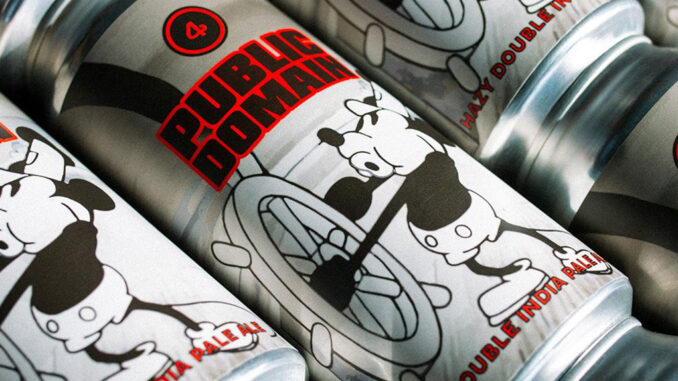
A one-off double IPA called Public Domain initially featured a black-and-white Steamboat Willie character after the image entered the public domain.
“It looked great,” Ramey said. “And then ownership said, ‘Let’s continue this as a series.’ That was never the intention.”
Subsequent releases leaned deeper into public-domain mashups, including a character blending Peter Pan and Ziggy Stardust.
“I loved it,” Ramey said. “But it flew right over people’s heads. I don’t think people gave a shit about it, sometimes.”
The series struggled to match the instant recognition of its first release.
“We started at such a high point,” he said. “Everything outside of Mickey Mouse was just kind of like, ‘Oh, I guess.’”
Rather than forcing the concept, 4 Noses pulled back.
“For 2026, we’re just going to do Public Domain with Steamboat Willie,” Ramey said. “If it sticks, let’s continue. We try not to force something on people.”
At Union Craft Brewing, branding risk took a more emotional form. In 2022, the Baltimore brewery launched Zadie’s Lager as a tribute to co-founder Henry “Zadie” Benesch, who worked at the brewery until his death at age 101.
READ MORE: Important Marketing Aspects to Remember in Label Debut
“What started as a memorial tribute with an authentic story and approachable flavor has evolved into one of Baltimore’s go-to light Lagers,” said Chris Attenborough, director of creative engagement, and Jenna Dutton, marketing and design manager, in an email.
The success reinforced the value of grounding brand moves in genuine stories rather than manufactured narratives.
Short’s has also leaned into flexibility rather than rigidity as a risk-mitigation strategy. Brenner said the brand’s playful approach to design made broader change easier to absorb.
“Our brand overall is very fluid and playful,” she said. When Short’s rebranded its core identity, the rollout was intentionally quiet.
“We introduced the new logo without saying anything about a rebrand,” she said. “The new logo was on our festival tents nearly a year before we launched new packaging and the website.”
With multi-state distribution, Brenner said a single, coordinated launch was unrealistic. The goal was clarity and recognition, not disruption.
“The new branding was intended to make us more recognizable, more contemporary and more clear,” she said. “Folks have reacted positively, and we still keep our OG sketch logo on merch. It’s not going anywhere.”
It shows that the risks that paid off shared common traits: a clear internal rationale, patience with customer reaction and a willingness to retreat or refine when an idea did not scale as expected. That means your company shouldn’t avoid risk, but look to define it carefully, communicate it clearly and let consumer response (not internal attachment) determine what lasts.