Even for a brewery with more than three decades of brand equity behind one of its flagship IPAs, launching another West Coast-style beer can feel counterintuitive. But for Dave Thibodeau, co-founder of Ska Brewing, the decision to introduce a modernized West Coast IPA wasn’t driven by strict data modeling or portfolio gap analysis. Instead, it reflected a broader philosophy about innovation, brand evolution and trusting instinct in an increasingly cautious market.
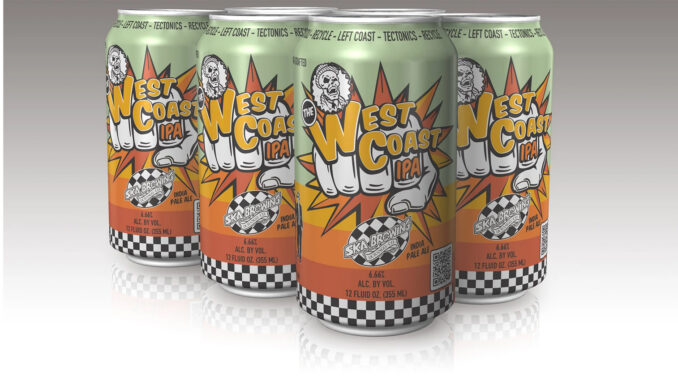
The brewery’s flagship IPA, Modus Hoperandi, leans heavily toward an ‘old school’ West Coast IPA and now the brewery has released a new 6.66% ABV brand, simply called, The West Coast IPA.
Ska debuted the beer over Super Bowl weekend at its World Headquarters in Durango, Colorado and it’s now available year-round on draft and in cans across Colorado, Arizona, Kansas, New Mexico, and Utah.
“As one of the first canned IPAs in the country and the beer that we built our World Headquarters on the back of, Modus certainly does carry that equity, and you’d think after 30-plus years we’d learn to use data instead of just doing what we feel like, but of course we haven’t,” Thibodeau said. “…while there is a slight extension to the Modus brand … it really ends there — Modus is its own beast.”
That distinction became central to the brewery’s decision to create a new brand rather than extend an existing one. Thibodeau acknowledged the move could create internal competition but saw it as a necessary trade-off for staying relevant.
“Will it steal some share of Modus and our other IPAs? Most likely, but we’re okay with that,” he said.
That willingness to accept portfolio cannibalization reflects a growing mindset among established breweries: protecting legacy brands without allowing them to limit internal innovation. In a segment where consumer preferences shift quickly, launching a new SKU can create opportunities that line extensions may not.
Process decisions also played a critical role in differentiating the beer from its predecessor. Rather than leaning into traditional dry-hopping techniques, Ska Brewing focused on newer hop formats and layered additions throughout fermentation to achieve a lighter, cleaner profile.
Ska’s new West Coast IPA is brewed with Cryo Mosaic, Cryo Citra, Alora, Eureka, CGX Idaho 7, and Strata Hyperboost, an amalgam of hops that pack a dank punch with citrus, peach and stone fruit notes.
“The beauty of using the newer hop formats like Cryo, CGX, and Hyperboost is that much of the vegetal matter is removed, resulting in a lighter, crisper flavor without the ‘grassy’ or astringent attributes a traditional West Coast IPA tends to have,” Thibodeau said. “We also lean more into hop additions at all stages of fermentation versus old-school dry-hop-only additions.”
He added that water chemistry adjustments also contributed to the shift in profile.
“Water chemistry adjustments and salt additions to lower pH contribute to a smoother hop profile versus an intentionally rougher hop profile like Modus,” Thibodeau said.
These production decisions weren’t just about flavor but also about aligning with evolving retailer and distributor expectations. As the IPA category matures, differentiation increasingly hinges on technical execution and clear positioning rather than simply labeling a beer “West Coast.”

Despite broader industry chatter about a West Coast resurgence, Thibodeau cautioned against assuming a full-scale comeback. Instead, Ska Brewing approached the launch as filling a niche rather than chasing a trend.
“I don’t feel like we’re launching West Coast IPA because we believe in a nationwide comeback. It’s simply a beer we love,” he said. “That said, I do think there is evidence of a profitable opening: haze still dominates broad shelf presence, but there is growing buyer and enthusiast appetite for cleaner, more traditional IPAs, and retailers are showing enough confidence to back West Coast offerings when they clearly fill a need.”
That pragmatic approach also extended to ingredient costs, where Ska leaned into premium hop formats despite tightening margins across the industry. Thibodeau admitted the decision wasn’t built around strict cost controls.
“First and foremost we’re trying to make a great beer, and one that sells, and then we’ll try to reverse engineer the profitability I guess,” he said. “We don’t want to create a beer from a price-sensitive perspective because I fear that can sometimes result in mediocrity.”
Still, he noted that premium hop formats may offer cost efficiencies when used strategically.
“The beauty of these hop formats is their concentrated potency and the right use should actually lower hops costs… in theory, he said.
READ MORE: How Ska Doubled the Fun of its Flagship, Modus Hoperandi
As far as a rollout strategy, Ska focused heavily on measurable distribution goals, particularly in its home market. Thibodeau outlined aggressive targets designed to quickly validate the beer’s viability.
“Our home market is obviously Colorado, and in six months we’d like to see The West Coast in 100% of Ska’s existing retailers here and hopefully 85% of all viable retail outlets,” he said. “At 12 months we hope to see the same in our neighboring markets.”
The brewery also prioritized draft placements early in the launch, which provided encouraging early signals.
“In the on-premise, draft specifically, we had an aggressive 50-day rollout plan, and without revealing the specifics, I can tell you that we just exceeded it by 146%,” Thibodeau said.
Even with KPI benchmarks in place, Thibodeau acknowledged that passion still plays a role in long-term portfolio decisions.
“Regardless of KPIs, I love the beer so much that I can tell you it will be sticking around,” he said.