Branding decisions in the cider world often carry risks that extend well beyond label design or logo refreshes. For many cideries, branding intersects with capital investments, customer expectations and long-term positioning. Those risks can shape not only perception but also profitability.
For Bob Manley, co-founder of Hermit Woods Winery & Eatery, one of the biggest branding and positioning risks wasn’t visual, it was packaging format. Entering cans meant repositioning how customers experienced the brand, but the path there proved costly.
“We entered canning far too aggressively at the outset, using a mobile canning line to get started,” Manley said. “The minimum production volumes required to make that model economical were ultimately larger than we could comfortably support.”
The operational strain quickly translated into financial risk. Technical challenges compounded the problem and led to significant product loss.
“Compounding that, we experienced technical issues with the mobile line that resulted in significant product loss, costing us tens of thousands of dollars over the first year or two,” he said.
Manley said the experience forced a pause and a reassessment of how format aligned with their brand and production scale. Eventually, Hermit Woods invested in its own equipment, a move that came with its own set of risks.
“Purchasing that equipment was a substantial financial risk,” he said. “We’re now in our second year operating with it and feel confident it was the right long-term decision, though it has not yet fully paid for itself.”
While Manley’s experience highlights operational risks tied to branding decisions, others have faced challenges around audience positioning and demographic balance.
At Rebel Sheep, winemaker Sarah Aromando said the brand’s foundation involved walking a careful line between honoring an existing customer base and reaching new audiences. The cidery operates within a long-established family farm, creating both opportunity and risk.
“Since the farm is so family friendly, we wanted to adopt that feature for the winery but in a different light,” Aromando said. “The winery is for the adults; however, we wanted the adults to know it was OK to bring the kids (and dogs) to the winery.”
The decision extended beyond messaging into layout and experience, with Rebel Sheep designing its space to reflect that dual identity.
“We centrally located the tasting room and outdoor patio so that parents can enjoy themselves while keeping an eye on their kids on the playground,” she said.
Aromando said the goal was to maintain continuity with existing customers while broadening appeal.
“We’re working with a preexisting customer base from Stony Hill, which is predominantly family based,” she said. “We wanted to bring the existing demographic to our winery, while also reaching out to new demographics of younger couples and singles.”
Balancing those audiences created uncertainty about whether the brand might alienate traditional customers, which was a concern that eventually turned into an opportunity.
“Our branding itself is a big risk for us,” Aromando said. “Stony Hill has been a very family-oriented business with over 30 years in the community.
“Rebel Sheep wanted to take that existing community presence and run with it.”
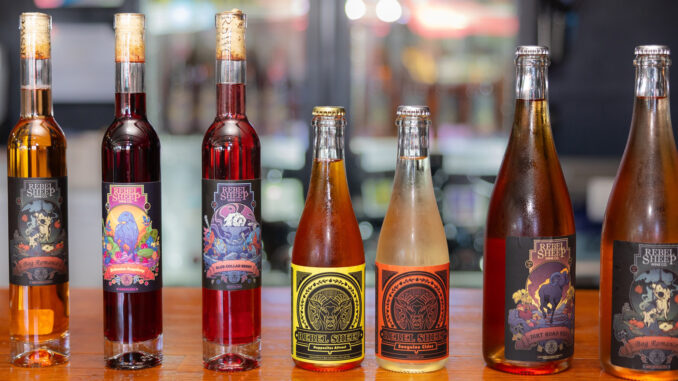
The Rebel Sheep identity leaned into boldness and differentiation, something that initially caused hesitation.

“In the beginning, we were afraid our brand would be too different and scare our customer base away,” she said. “And maybe it has with some of the more traditional wine and cider drinkers.”
But Aromando said the brand ultimately opened doors to new audiences.
“As we’ve continued with our journey, it has become clear that these decisions early on have garnered the attention and interest we were looking for from consumers not previously involved with the farm,” she said. “Our logo, labels, and products are weird, eye-catching, and pique curiosity. We can be different while also being a part of the family business.”
That balance between differentiation and continuity is something Richard Yi of Brooklyn Cider House has also navigated, particularly as the cidery evolves its brand architecture.
“Right now we’re in the process of separating our higher-end brand from Brooklyn Cider House,” Yi said. “That’s been a complicated process.”
Geographic shifts added another layer of complexity.
“Moving from Brooklyn to New Paltz during COVID also caused some confusion for customers,” he said.
Yi said communication became critical to maintaining trust during transitions.
READ MORE: Letting Apples ‘Speak for Themselves’
“The key has been transparency,” he said. “If you communicate openly, most customers are very understanding.”
While branding risks can create uncertainty, several cideries reported surprising customer responses when leaning into premium positioning or unconventional products.
Manley said Hermit Woods has seen strong customer demand for higher-end offerings, even when more affordable options are available.
“We continue to be pleasantly surprised that many of our customers still choose the higher-priced vintage bottle over a four-pack of cans that costs roughly 30% less,” he said. “It reinforces our belief that presentation, perceived craftsmanship, and occasion matter just as much as price … sometimes more.”
Yi saw a similar response when Brooklyn Cider House launched a culturally inspired cider built around Asian pears sourced from a local grower.
“One example was our Korean-inspired cider,” Yi said. “We make it using locally grown Asian pears from a Korean grandmother named Susan.”
The product required additional investment, including custom label art and more expensive ingredients, but the market response exceeded expectations.
“The pears are expensive, and we even commissioned custom artwork,” Yi said. “Despite the higher cost, it ended up becoming one of our top sellers.”
These array of experiences show that branding risks often extend beyond visuals you create or messaging you look to deliver. They involve format decisions, audience positioning, premium pricing and brand architecture and eachcarries operational and financial implications.
It shows that you can’t just avoid risk, but try to understand how branding decisions intersect with long-term business strategy. Whether investing in packaging formats, redefining audiences or separating product tiers, finding traction means being willing to embrace calculated risks while remaining transparent with customers and being flexible in execution.