A collaboration beer built for a single festival pour rarely begins a year in advance. But for Verboten Brewing and Barrel Project, and Gravity Brewing, the decision to commit early — from ingredient selection to barrel acquisition — became the central business lesson behind their 2026 Collaboration Fest release that will be on tap next Saturday, April 4 in Westminster, Colorado.
The beer, Viener Vino, is a honey whiskey barrel-aged Viennawine, began not as a festival idea but as a conversation between breweries that already shared a mutual appreciation for long-aged beers and the planning required to execute them well.
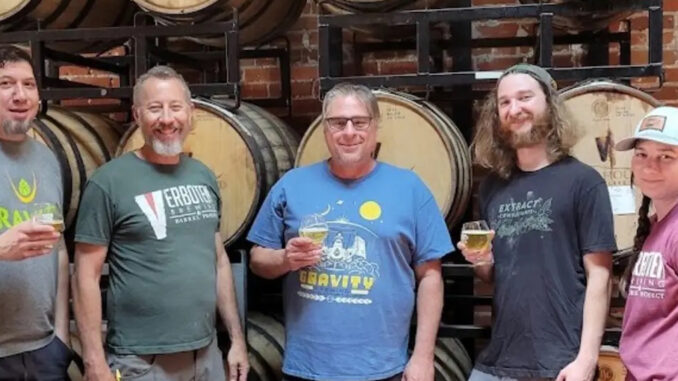
“We actually did a collab with Gravity for last year’s Collabfest in which we brewed a Peanut Butter Siracha Imperial Stout in which they hosted the brew,” said Josh Grenz, co-owner and COO of Verboten Brewing and Barrel Project. “On that brew day, we discussed the idea of making a Barleywine with a Vienna malt. We decided to brew it at Verboten as soon as possible and get it in whiskey barrels.
Both breweries have a strong love of Barleywines and so it made for an easy recipe collaboration.”
That early decision after the 2025 event shaped everything that followed. Rather than designing a beer around a festival deadline, Grenz said the breweries worked backward from the aging timeline and built a beer designed to hold up in barrels.
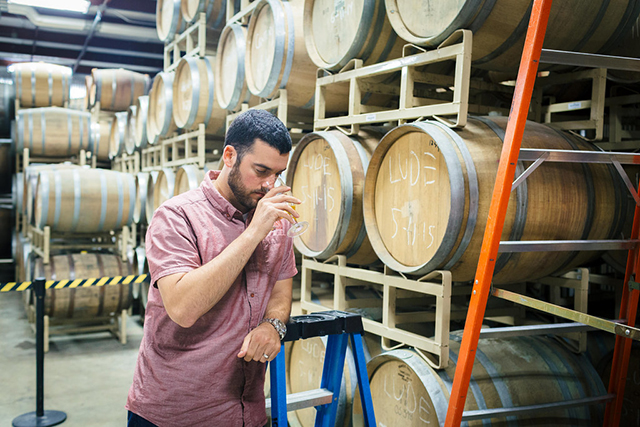
“We definitely built the beer with these barrels in mind and locked up getting them right away,” Grenz said.
The foundation of that planning began with an ingredient decision that also carried operational implications. Verboten had brewed Barleywines with a variety of base malts before but had never used Vienna as the backbone.
“We wanted to see what the additional flavors of honeysuckle, graham cracker, and nuttiness would bring to an English-style Barleywine,” Grenz said.
They used Root Shoot Malting’s Vienna as the base, which won a gold in 2023 at the Craft Maltsters Cup. While the ingredient choice helped differentiate the beer, it also required adjustments throughout the brewing process. Grenz said the team intentionally modified the grain bill and hopping schedule to maintain balance once the beer hit the barrels.
“We decided to lower the amount of crystal malt we normally use to adjust for the additional sweetness and color the Vienna malt would add,” he said. “We also bittered slightly more to account for the additional sweetness of Vienna malt, and the barrels we would age them in.”

That approach shows that recipe development must anticipate the full lifecycle of the beer, not just the base fermentation. Grenz said the barrel choice further reinforced that philosophy. Honey whiskey barrels, while distinctive, can easily dominate a beer if not managed carefully.
“We were wanting the honey whiskey flavors of the barrel to play with the honey-like flavors of Root Shoot’s Vienna malt and knowing we would add some sweetness, we made the beer with higher bitterness,” Grenz said.
Timing also became a strategic lever. Rather than defaulting to longer aging, the breweries shortened their typical barrel window to preserve balance.
“In both breweries’ experience, we find that around 10-13 months is the ideal time for Barleywines in barrels, but with this one we were looking right at 9-10 months so the beer wouldn’t be aged so long that it would create additional sweetness and dark fruit character, so as not to overwhelm the Vienna malt,” Grenz said.
READ MORE: A Journey Like Sketchbook’s Shows How to Strengthen Community Roots
After completing the full cycle of planning and brewing to long-term aging and the festival release in April, Grenz said the project reinforced several business-focused lessons for future collaborations.
“To always decide on what barrels we want and secure them before brewing the collab, schedule time(s) to get together and taste it as it ages, and always keep it fun,” Grenz said.
While the annual Collaboration Fest often highlights experimentation, the Viener Vino project shows that operational discipline with early planning, ingredient strategy and shared expectations can be just as important as creativity.