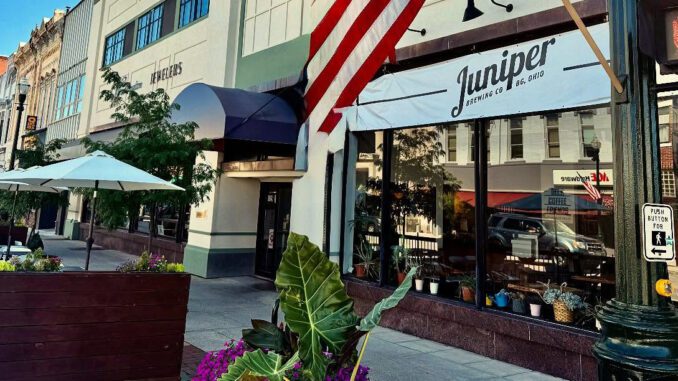
Diversifying beyond taproom sales and adding another revenue stream can create new opportunities — but it also brings new staffing, operational and management challenges. At Juniper Brewing in Bowling Green, Ohio, Zach and Christina Tracy have learned that building a business around beer, a full-service restaurant, a coffee shop and catering requires as much attention to organizational structure as it does to the products being sold.
The brewery’s four primary revenue lines — beer distribution, restaurant service, coffee and catering or special events — serve different customers throughout the day. That variety helps Juniper avoid relying on a single source of income, but managing the businesses together has required years of adjustments.
“The glory of that is you’re not dependent on just one, right?” Christina said during a BREWER Podcast. “It’s all four kind of coming together.”
The challenge is making those revenue streams complement one another rather than simply adding more work to the same operation.
Juniper’s model wasn’t entirely planned from the beginning. The couple originally envisioned a brewery and restaurant with a coffee component, but the pandemic delayed equipment installation on the beer side. Rather than wait for the brewery to open, they invested more into the cafe, including an espresso machine, and opened that operation in February 2021. Beer followed in April, with food service beginning in May.
The staggered opening helped keep the project moving, but it created confusion among customers and employees about what Juniper was supposed to be. That experience offers an important lesson for others pursuing multiple concepts: A diversified business still needs a clear identity. Customers must understand what a brewery offers, while employees need to know how the different parts of the business fit together.
READ MORE: Stop Asking Food to Do Everything: How Smart Brewpubs Define Menu Strategy
Christina said the couple’s broader goal was to create a place where people could connect, whether they came in for morning coffee, lunch or an evening beer.
“The premise of the beer and the culture of Juniper is really important,” she said, “but ultimately what I think we’re in the business of is creating connection. That’s at the heart of what we’re trying to do. And the beer, the food, the coffee is all just the vehicle to do that.”
That purpose gives the different revenue streams a common thread, even as they serve different needs.
The financial contribution of each operation also matters. Christina said food was Juniper’s largest revenue driver, followed by beer, which was gaining ground as the brewery expanded distribution through a distributor and secured opportunities tied to Bowling Green State University and Kroger. That ranking shows that beer doesn’t always have to be the primary engine of a brewery’s business. For Juniper, the restaurant is a major part of the model, and the menu has evolved through experience.
The business started with a limited selection of food before developing a more extensive, elevated comfort-food menu. One item emerged as a clear leader. The smash burger outperforms everything else on the menu, she said.
Identifying that kind of standout product can help focus purchasing, preparation and marketing efforts on what customers actually want. The broader lesson is to let sales performance and customer behavior inform the menu rather than continually expanding it for the sake of variety.
Juniper is also exploring ways to capture sales that its existing operations might be missing. Christina identified lunch as an opportunity, prompting plans for a more accessible fast-casual cafe menu with grab-and-go options. Those offerings could also support a catering line, including boxed meals and snacks for university athletics. The strategy is to build related revenue streams around shared products and existing relationships instead of creating entirely separate businesses from scratch. A menu item developed for cafe customers, for example, might also work in a catering package.

That approach can improve the value of existing resources, although it still requires evaluation on whether new offerings generate enough incremental business to justify their labor, inventory and preparation costs.
Diversification also doesn’t eliminate the need to make difficult decisions about what not to do.
Juniper discontinued its recurring trivia and name-that-tune nights after finding that the events had become less effective. Christina said declining participation and increased competition from other local venues were factors, but table turnover was another concern. Customers could occupy tables for long periods, while the noise discouraged some families and other guests from staying.
“Listen, I don’t think trivia and name that tune are bad,” she said. “We kind of felt — for us — it had gotten stale and it had run its course.”
This is why breweries should measure events against their actual business objectives. An event that attracts a crowd isn’t necessarily profitable or beneficial to the rest of the operation. Consider spending, sales per table, customer mix and whether an activity supports the experience you want to create. For Juniper, replacing those events with concepts more closely aligned with its food and beer offerings became an opportunity to test something new.
Managing several operations has required similar experimentation with staffing. The couple initially separated departments, then tried individual managers for different areas and later hired general managers. Neither approach proved sustainable for Juniper.
“We’ve gone through multiple iterations of org charts and different structures because of the unique four revenue lines,” Christina said.
The current approach uses team leads and shift leads who oversee specific areas, with Zach managing the day-to-day operation and coordinating with those leaders. The structure gives employees clearer responsibilities without depending on a single general manager to oversee everything.
They also learned that cross-training helps the business respond when staffing problems arise. Juniper operates in a college town, where turnover and student schedules can make staffing unpredictable. Zach said the early approach kept employees in separate departments. Over time, the couple recognized the value of having employees who could move between roles when needed.
Christina pointed to an employee – Elena Wasserman — who started as a cashier at 19, learned bar operations and eventually trained to become the brewery’s full-time brewer. She can also help behind the coffee counter when that area gets busy.
That flexibility creates more options for filling immediate needs, while giving employees opportunities to develop new skills. It also requires deliberate training; you can’t assume employees can cover unfamiliar positions simply because they work under the same roof.
Juniper’s organizational structure continues to evolve, and the Tracys haven’t presented their model as a finished formula. Christina said the couple tries to balance designing roles around the company’s needs with recognizing employees’ individual strengths and interests. For breweries considering a similar expansion, that balance may be the central lesson. Additional revenue streams can spread risk and create new ways to reach customers, but each one adds operational complexity.
Juniper’s experience suggests that success depends on more than finding another product to sell. It requires a shared business identity, an understanding of which operations actually drive revenue, a willingness to discontinue underperforming activities and a staffing structure that can adapt as the business changes.
As Zach put it, the couple continues to make decisions, learn from them and regroup when necessary. For a business with several interconnected operations, that ability to adjust may be just as important as the diversification itself.