Deciding what belongs in a package, what stays in the taproom and what deserves a premium price point is often one of the most consequential decisions you have to make. The challenge isn’t simply creating products consumers enjoy. It’s creating a lineup where every cider has a purpose, whether that’s driving revenue, building brand credibility, generating customer loyalty or creating excitement around limited offerings.
As a cidery’s business matures, many find themselves balancing consumer demand against the realities of operating along with packaging costs and the economics of production. Those who navigate that balance successfully often approach their portfolios strategically rather than emotionally.
Packaging can be one of the most powerful tools available to support that strategy.
At Oregon-based Blossom Barn Cidery, co-founder Jeremy Hall said packaging has helped create clear distinctions between everyday products and premium offerings.
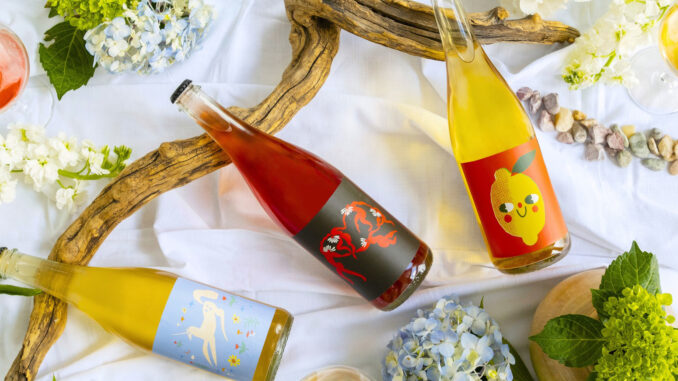
“Moving our most craft and award-winning perries into 750 mL bottles has allowed us to sell at a premium price with minimal pushback,” Hall explained to Cider Business.
The larger bottle format helps communicate value before the customer even takes a sip. Hall noted that customers who experience the products during tastings can better understand why estate-grown fruit, barrel aging, traditional perry pears and co-fermentations with wine grapes command higher prices.
“There is a hard ceiling on price on flagship ciders in cans, but it is possible to sell a bottle with a nice label for more than 8x the price per oz — especially if people get to taste it first,” Hall said.
That distinction between packaging formats is something many producers wrestle with as they look to maximize margins without alienating customers.
At New Hampshire’s Hermit Woods Winery & Eatery, co-founder Bob Manley said packaging affects far more than production costs.
“Packaging absolutely plays a role in profitability, not just in cost of goods, but in positioning, shelf placement and customer perception,” Manley said.
Hermit Woods currently packages cider in both 750 mL bottles and 12-ounce cans, and Manley said performance often depends on where products are sold.
“In some retail environments, cans move more quickly due to familiarity and convenience,” he said. “In others, the 750mL bottles — even at a higher price point — perform better because they signal craftsmanship and occasion-based consumption.”
Those differences underscore an important lesson for decision makers: packaging should be viewed as a marketing and positioning tool as much as a production decision. The same cider may perform differently depending on how it’s presented to consumers.
Still, adding packaging formats is not always a simple solution.
“We have considered expanding into additional formats, but the economics of adding new packaging lines can be prohibitive at our scale,” Manley said.
For many independent cideries, operational complexity can quickly erode the benefits of offering more choices. Additional inventory, packaging materials, equipment requirements and forecasting challenges all create new costs that must be justified by increased sales.
Brooklyn Cider House cidermaker Richard Yi said every new format requires careful consideration because of the investment involved.
“Packaging is very important, but every new format usually requires additional equipment and investment,” Yi said.
Instead of expanding formats indiscriminately, Yi focuses on disciplined forecasting.
“When we make cider, we try to estimate how much we can realistically sell,” he said. “I typically like to produce about 10% more than our projected sales to account for growth.”

That approach helps reduce excess inventory while still allowing room for increasing demand. It also creates flexibility for smaller-batch products designed primarily for tasting-room guests.
“For certain tasting room-only SKUs, though, selling out isn’t necessarily a bad thing,” Yi said.
That perspective runs counter to the instinct many have to keep every successful product continuously available. Limited availability can create urgency, preserve exclusivity and reduce the financial risk associated with niche products.
Ultimately, determining which products deserve continued investment requires evaluating more than sales numbers alone.
“Don’t chase margin alone, and don’t chase popularity alone,” Manley said.
Instead, he encourages other cideries to understand exactly what role each cider serves within the overall portfolio.
“Know your true costs and understand the role each product plays. Some drive profit, some build the brand, some create loyalty,” Manley said. “The sweet spot is a lineup where every SKU earns its place financially, strategically or emotionally. If it doesn’t do at least one of those well, it probably doesn’t belong.”
That philosophy highlights a reality many successful cideries eventually discover: not every product must be a top seller. Some products attract first-time customers. Others establish credibility among enthusiasts. Some provide strong margins. The key is ensuring every product contributes meaningfully to the business.
Yi echoed that idea while stressing the importance of pricing confidence.
“Generally speaking, the most popular ciders also end up being the most profitable,” Yi said. “Don’t be afraid to charge what your product is worth.”
At Brooklyn Cider House, artisanal ciders often retail between $22 and $35 per bottle.
“Not everyone is willing to pay that, but the customers who understand the product are usually happy to support it,” Yi said.
READ MORE: How Cideries Can Use Music to Build Branding & Influence Consumer Behavior
If you are looking to test new concepts, Yi recommends experimentation without excessive commitment.
“I’m also a big believer in a ‘fail fast’ approach,” he said. “Start with a small investment, test the idea, and if it doesn’t work, go back to the drawing board and figure out why.”
Successful portfolio management is less about finding the perfect cider and more about building a lineup with intentionality. Packaging should reinforce a product’s purpose. Pricing should reflect its value. Production should align with realistic demand. And every SKU should have a clearly defined role. The goal isn’t necessarily to offer more products. It’s to make sure every product earns its place.