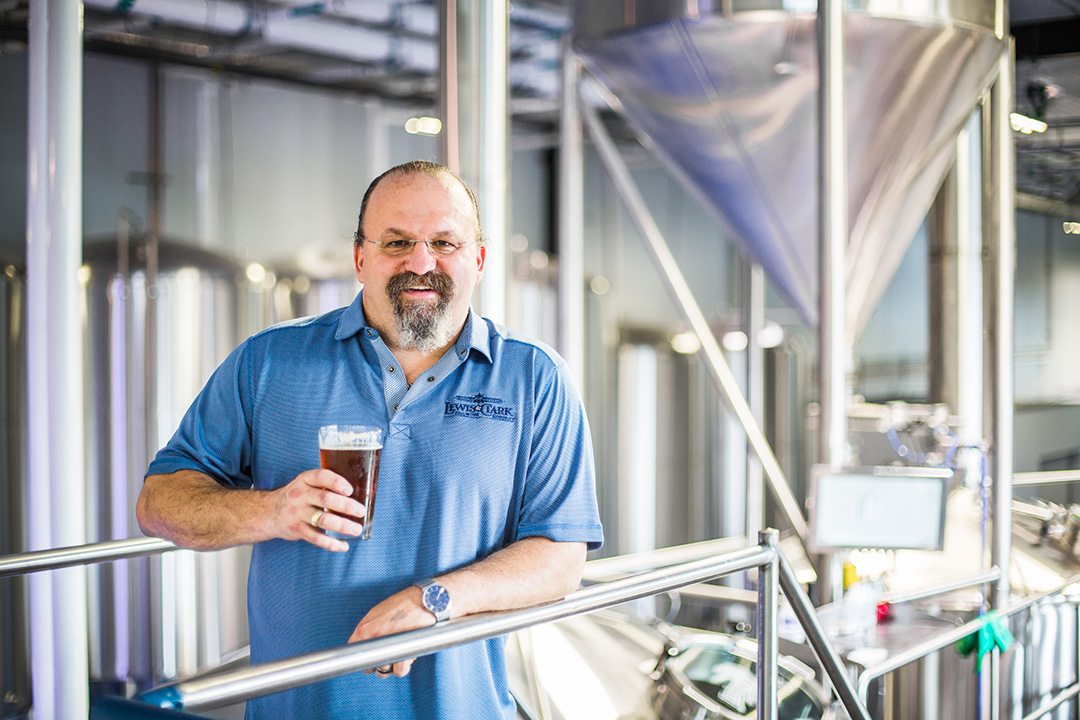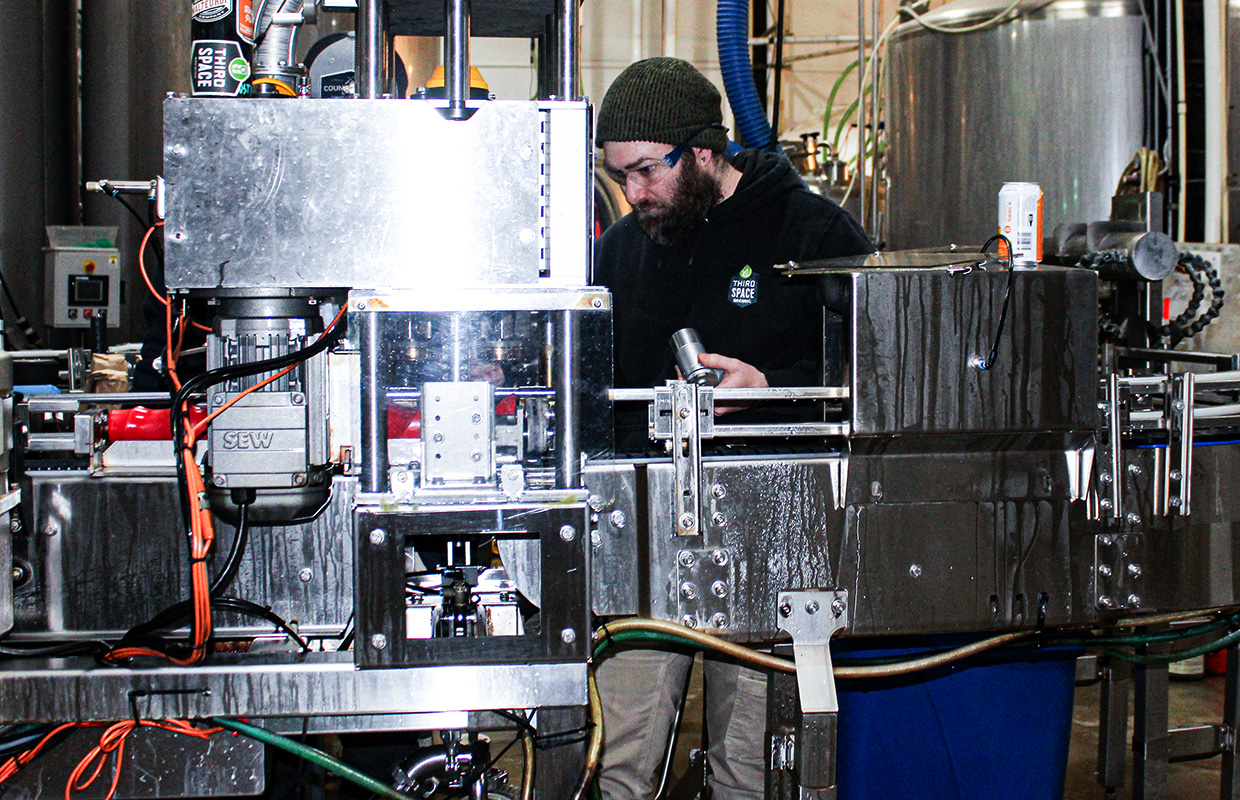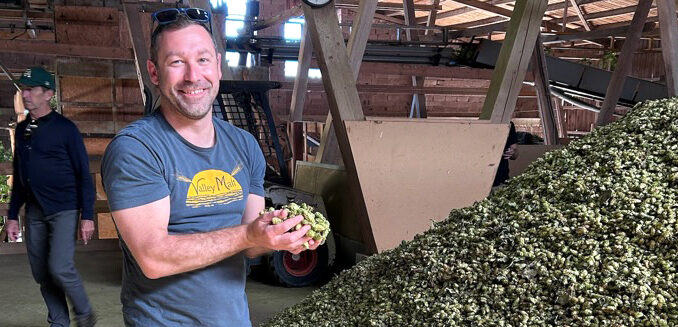
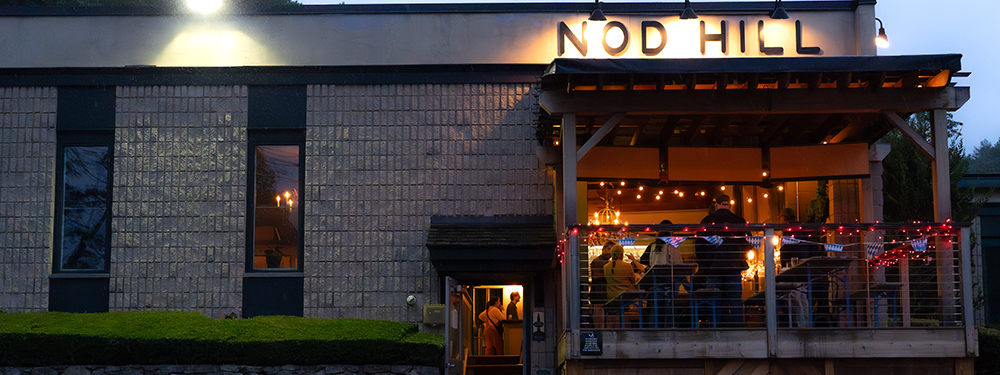
At a time when many breweries are taking a more cautious approach to capital spending, Nod Hill Brewery is making one of its largest production investments since opening in 2017. The Ridgefield, Connecticut brewery recently installed a new German-engineered BrauKon brewhouse as its wholesale business continues to grow, with sales increasing 40% in the first quarter of 2026 and continuing at roughly 35% growth.
But the new brewhouse is only one piece of a broader effort to prepare Nod Hill for its next stage. Since joining the brewery in early 2025, Head of Brewing Operations Rob Bollard has helped rebuild the production team, rework recipes, refine ingredient sourcing, restructure tank configurations and implement a custom water system. Bollard previously spent years working across Connecticut’s craft beer industry, including at Black Hog and Kent Falls.
That combination of production improvements, wholesale momentum and a significant capital investment raises a more interesting business question than simply what the new brewhouse can do: What is Nod Hill seeing in its business that makes now the right time to grow? Bollard shares in the BREWER Q&A about the changes happening behind the scenes, the production demands created by wholesale growth and how the brewery is thinking about scale, efficiency and quality as it enters its next chapter.
BREWER: At a time when many breweries are being cautious about capital investment, what showed that business for the brewery gave you the confidence that now was the right time to make your largest production investment since opening with the addition of a new brewhouse system?
BOLLARD: Making a significant capital investment in the current craft beer market and broader economic environment is certainly going against the grain. We understood that from the beginning, which is exactly why we were so deliberate about the planning behind it. This project really started more than two years ago. Before I came on board full-time at Nod Hill, Robert and David Kaye and I were already looking critically at the entire business and asking what we believed the brewery could realistically become. We looked at our position in the market, the quality of the beer, the opportunity in self-distribution, our marketing strategy, our production constraints and ultimately the long-term capacity of the building itself. An important part of that was developing the marketing and growth plan alongside the production plan. We weren’t interested in adding capacity simply because we could. We needed to understand where the additional beer was going to go, how we wanted Nod Hill positioned in the market, where we saw sustainable opportunities for growth and what the brewery needed to look like operationally to support that. The production investment needed to support the larger business plan, not become the business plan. We went as far as having the entire facility 3-D scanned so we could understand how the space could be utilized and what the maximum practical production capacity of the existing building could be. A tremendous number of hours went into coordination, analysis and planning before I was physically at Nod Hill full-time. From there, we started defining what we actually needed from a brewhouse. We weren’t committed to buying new equipment, and we weren’t committed to BrauKon. We spent considerable time searching for used German brewhouses that met a very specific set of requirements: a decoction-capable system with a dedicated mash mixer, the right level of automation and process control, and enough flexibility to produce a wide range of beer styles. Those capabilities were important to the beers I wanted us to be able to make and the level of control and repeatability we wanted to achieve as we grew. When I reconnected with BrauKon, the conversation changed. They were willing to work with us both technically and commercially to configure a system around those requirements while making the overall project fit Nod Hill’s current needs and where we believed the brewery could go in the future. At that particular moment, they had a level of flexibility and resources that we simply weren’t finding elsewhere. The BrauKon wasn’t the beginning of the plan. It was the equipment solution we arrived at after doing the planning. What has given me even more confidence throughout the process is how aligned everyone at Nod Hill has been around that plan. Working with the Kaye family has been a pleasure. We established what needed to happen, who was responsible for each piece and what success needed to look like. The buy-in has been exactly what you hope for. People have followed through, everyone has been meeting their deliverables and the pieces have continued to come together. There’s now a real sense of anticipation and excitement spreading through the brewery because people can see—and taste—the results of work that started more than two years ago. Making this investment in today’s market may be going against the grain, but it wasn’t a leap of faith. It was a calculated decision backed by years of planning and a team that has continued to deliver against that plan.
BREWER: What do you believe is driving that growth in wholesale right now, and how are you determining whether that momentum is something you can sustainably build on?
BOLLARD: We’re still entirely self-distributed and currently only distributing within Connecticut. Our sales approach is relationship-based. We don’t believe sales needs to be overly complicated. At its core, it’s about building genuine relationships with people, understanding what they need from us and then consistently providing for them. That’s one of the things I really value about self-distribution. Someone from Nod Hill is showing up at the account. We’re talking directly with the people selling our beer, listening to what’s working and what isn’t, and following through on what we say we’re going to do. Over time, that consistency builds trust. For us, sales isn’t about convincing somebody to buy something. It’s about building a relationship, providing something of value and then consistently delivering on that relationship. That philosophy extends well beyond the sales team. The beer has to be consistent. Production has to deliver what sales needs. Orders need to arrive when we say they’re going to arrive. If an account needs something from us, we need to respond. Every part of that experience contributes to the relationship. We’ve also put significantly more structure and accountability behind self-distribution as we’ve grown. We’re looking at territory development, account management, delivery planning and how we’re utilizing our people and resources. The systems behind the relationships have to become stronger as the business grows. When I’m determining whether that growth is sustainable, I’m much more interested in what happens after the first order than I am in simply counting new placements. Are accounts reordering? How quickly is the beer moving? Are we increasing volume within existing accounts? Are those relationships becoming stronger? A first order tells you someone was willing to try your beer. A consistent reorder tells you that you’ve given them a reason to keep working with you. We’re not interested in simply putting more dots on a map. We want to build density, trust and repeat demand in the market. What we’re seeing gives us confidence that there is still significant opportunity within Connecticut.
BREWER: With all the recent changes, what did you learn about the business or its production needs that led you to make so many changes before investing in the new brewhouse?
BOLLARD: One of the biggest things this project has taught me is to rethink what a properly designed production brewery can and should look like. I’ve worked in production breweries for more than a decade, and I came into this project with a lot of experience and some strong ideas about how a brewery should operate. But experience doesn’t necessarily mean you’ve always been doing something the best possible way. Working with BrauKon and spending time with their engineers, fabricators and commissioning team really opened my eyes to a different approach. There’s an incredible amount of thought that goes into the engineering, quality of the components, serviceability, process control and even relatively small details. They’re building equipment and infrastructure with the expectation that it should perform for decades. There’s a big difference between assembling the equipment necessary to make beer and engineering a brewery as a complete production facility. This project has taught me to think much more about the latter. It also doesn’t mean we’re finished. There are still infrastructure projects we want to complete, and we’ll continue refining and adding automation as we gain experience operating the system. Some of those projects intentionally have to happen in phases. Nod Hill had to remain operational throughout the transition. We built inventory ahead of the shutdown, disconnected and removed the old brewhouse, installed and commissioned the new one, and relied on that inventory to keep the rest of the business supplied during the downtime. We couldn’t simply shut the brewery down indefinitely while we perfected every part of the production facility. Our immediate priority now is to refill that inventory, dial our beers in on the new system and establish repeatable processes. At the same time, we’ll continue chipping away at infrastructure and automation improvements so we’re prepared to run the production facility progressively harder as demand grows. That’s another lesson I’ve taken away from this project: you don’t have to solve every problem with more labor or another piece of equipment. Sometimes the better answer is better engineering. We also took training and commissioning very seriously. Our team traveled to Germany to train before the system arrived, and I worked closely with Steffen during commissioning here at Nod Hill. Having access to talented engineers, fabricators and commissioning specialists challenged some of my own assumptions about how things should be done. If you come out of a project like this only knowing how to operate your new brewhouse, you’ve probably missed part of the opportunity. I came out of it with a different idea of how I want to build and operate a production brewery.

BREWER: Wholesale growth can create a very different set of pressures than taproom growth. What have you had to change operationally or organizationally to make sure the brewery can support increased wholesale demand without compromising the taproom experience or the beer itself?
BOLLARD: After nearly a decade at Kent Falls, I had the opportunity to live through a lot of these different stages of brewery growth firsthand. I’ve seen the pressures that come along with what we often call “good problems to have.” More demand, more volume and more customers are obviously positive things, but each new stage of growth creates a different set of challenges for production, staffing, logistics, sales and the rest of the organization. That experience influenced how we built the growth plan at Nod Hill. Rather than simply setting a sales target and figuring out the consequences afterward, we developed a volume-based plan that anticipates what the brewery should require at different levels of production. That includes capital investment, production capacity, staffing and some of the cross-department SOPs that become increasingly important as more people and departments have to work together. The reality is that growth challenges an organization in almost every area. Processes that work at one volume don’t necessarily work at the next. Informal communication eventually needs to become an SOP. A piece of equipment that was perfectly adequate can become a bottleneck. Responsibilities change, and you have to recognize those pressure points before they start affecting the beer or the customer. For me, the fundamentals are still quality, precision and consistency. Growth isn’t particularly valuable if you can’t reproduce the beer that created the demand in the first place. At the same time, growth creates a healthy sense of urgency. It keeps everybody busy and engaged, and it forces us to continue looking at how we can become more efficient. Production needs to support sales, sales needs to support our accounts, deliveries need to happen when they’re supposed to, and the taproom needs to continue receiving the same attention and quality our customers expect. Ultimately, we’re serving customers in two different environments—on-premise here at Nod Hill and off-premise through our wholesale accounts—and neither one can become secondary simply because the other is growing. “Good problems to have” are still problems you have to plan for. Our job is to anticipate them, build the infrastructure and systems around them, and keep the organization ahead of the growth rather than constantly trying to catch up.
BREWER: They brought you in and rebuilt the production team before making this investment. How important was having the right people and production leadership in place before expanding the brewery’s physical capabilities?
BOLLARD: I think it was a prerequisite, although in our case the planning relationship actually began well before I physically came on board full-time. I’ve spent more than a decade working in production brewing and leading brewing operations, and one thing I’ve learned is that you can’t separate the beer, the people, the equipment and the business from one another. They all have to work together. When ownership and I started working through the future of Nod Hill, we didn’t begin with, “What brewhouse should we buy?” We started with much bigger questions. Where is Nod Hill positioned in the market? Where is the opportunity? What can this building ultimately support? Where are the constraints? What needs to improve? What kind of beer do we want to make? And what kind of operation do we need to build around that? There’s also a financial reality to every one of those decisions. Brewing decisions and business decisions can’t exist independently when you’re talking about an investment of this scale. The equipment has to improve the beer, but it also needs to improve efficiency, support the volume you’re trying to reach and make economic sense for the business. I think good production leadership is ultimately about connecting those things. You have to think about the beer in the glass, the people making it, the equipment they’re using, the market you’re selling it into and the economics that allow you to keep doing it. What I’ve appreciated about working with the ownership team at Nod Hill is the level of trust and buy-in around that process. We developed a plan together, established responsibilities and then went to work executing it. People have consistently delivered on what they committed to. By the time we committed to the brewhouse, we weren’t hoping a piece of equipment would show us where to go. We already knew where we wanted to go and were choosing the equipment that could help us get there.
BREWER: What metrics will you be looking at to tell you over the next 12–24 months whether these investments are successful and why do you feel that can be key indicators?
BOLLARD: There isn’t one number that’s going to tell us whether this was successful, because the investment wasn’t designed to solve one problem. From a production standpoint, I’m looking at consistency, efficiency, labor utilization, throughput and our ability to increase production without sacrificing quality. If we’ve made the right decisions, we should be able to make better beer more consistently while using our time, equipment and resources more effectively. I’m particularly interested in how much additional growth the production operation can absorb without simply adding labor at the same rate we’re adding volume. One of the reasons we invested in automation and process control was to give the brewery room to grow efficiently. On the wholesale side, I’m looking at volume growth, reorder rates and velocity within existing accounts. I don’t just want to know how many accounts carry Nod Hill. I want to know whether people are actually drinking the beer, whether those accounts need more of it and whether the relationships behind that business are getting stronger. We’ll also continue comparing what actually happens against the longer-term growth and marketing plan we developed. Growth by itself isn’t necessarily success. We want to know whether we’re growing in the areas we deliberately chose to pursue, whether that growth is repeatable and whether the underlying economics support it. And then there’s the simplest and most important metric of all: the beer itself. We’re already tasting what greater process control and consistency can do. There’s a sense of excitement throughout the brewery because after years of planning, people can finally see the pieces coming together and taste the results in the glass. The business metrics matter because the brewery has to be sustainable, but they can’t become disconnected from the product. If we’re making better beer, making it more consistently and efficiently, seeing stronger repeat demand and continuing to grow without compromising the experience at Nod Hill, then we’ll know the investment is doing exactly what we intended it to do.