For Beak & Skiff Apple Orchards, diversification wasn’t about abandoning the farm’s core business. It was about finding more ways to make the assets, expertise and customer relationships it already had work harder.
The fifth-generation New York family farm behind 1911 Established Cider has expanded into concerts, co-manufacturing, private-label production, coffee, spirits and cannabis. President and co-owner Eddie Brennan told BREWER and Cider Business in a recent podcast interview the evolution was driven less by a desire to become something different than by the need to ensure the family business could survive.
“At our core we’re a family farm that out of necessity, has had to go out and reinvent ourselves,” Brennan said. “We know that if we had stayed back and not made these changes, the business wouldn’t exist today.”
Of course, it isn’t necessarily to add another business to your cidery. But it’s an example that shows a business can examine what a cidery already owns, knows and does well, then identify where those resources might create another revenue stream.
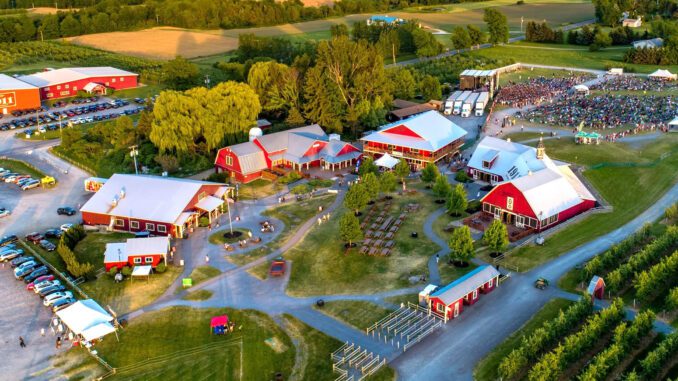
For Beak & Skiff, the orchard itself was one of those assets. The farm’s scenic Apple Hill campus provided an opportunity to address a seasonal challenge.
“It was really hard to get people to show up to an apple orchard when there’s no apples on the trees,” Brennan said.
Music became one answer. Concerts have since grown into a significant part of the business, helped by the venue’s setting and word-of-mouth among artists and managers.
But, it’s broader than entertainment. A business with an attractive property, production facility, customer base or specialized knowledge shouldn’t automatically think of those things only in terms of their traditional use. Diversification can come from putting an existing asset to work in a different way.
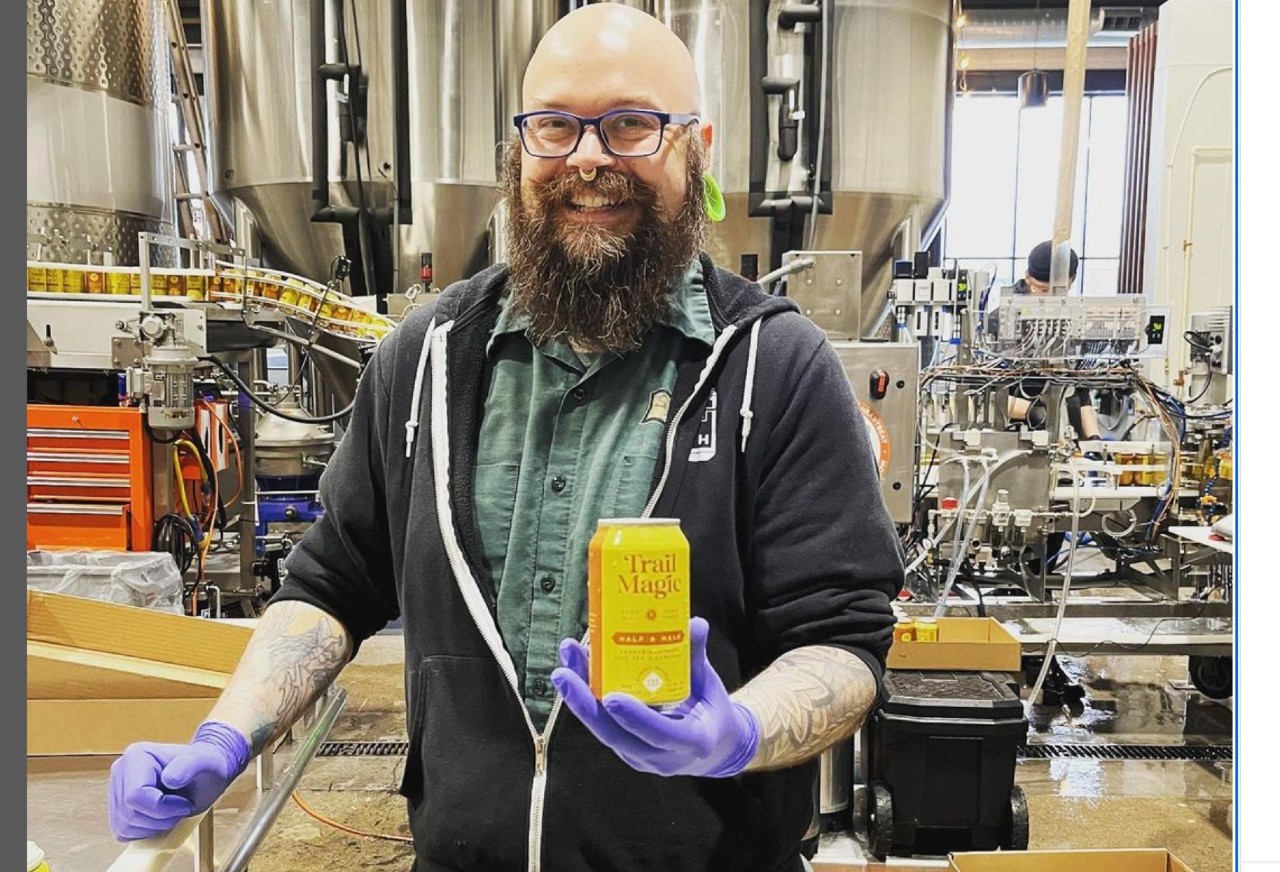
Beak & Skiff found another opportunity when it moved into a 30,000-square-foot facility and suddenly had more equipment and capacity than its own cider production required.
“We had all this space and we had all this equipment,” Brennan said. At the same time, other hard cider brands were looking for production partners. Beak & Skiff already had apples, fresh cider and manufacturing expertise, creating a natural fit. That eventually grew into co-manufacturing and private-label work that Brennan said now represents a substantial portion of the company’s revenue.
The important part wasn’t simply having excess capacity. Beak & Skiff had to recognize who might need that capacity and whether its existing capabilities could solve the problem. A similar opportunity came through its relationship with Wegmans. The grocery chain had long worked with Beak & Skiff on apples and fresh cider before approaching the company about cold brew coffee. Six years ago, Wegmans was looking to enter the category, while Beak & Skiff had a manufacturing operation that could potentially accommodate it.
“It was a perfect scenario,” Brennan said, although it also required significant investment and risk.

It illustrates another diversification lesson in that existing customers can be one of the best sources of ideas. Rather than starting with a blank sheet of paper and asking what new product a company should make, operators can listen for problems, requests and opportunities coming from people who already understand the business.
“We’re very attuned with what our customer wants, and we listen to our customer intently,” Brennan said.
The company’s entry into cannabis followed a similar philosophy, although on a much larger scale. Beak & Skiff initially entered New York’s hemp research program, learning how to grow the crop and work with CBD before eventually developing its Ayrloom cannabis business.
Brennan viewed cannabis not simply as a new consumer category but as another crop that could fit the farm’s vertically integrated model.
“If we just look at cannabis as purely a crop, it was another crop we could grow on our farm that we could vertically integrate all the way up to extracting and manufacturing,” he said.
That approach allowed the company to apply manufacturing knowledge it had developed elsewhere while also building on agricultural experience gained through the farm.
Not every diversification effort will work, and Beak & Skiff’s examples shouldn’t be interpreted as a prescription for every cidery to add concerts, private-label production or cannabis. The more useful part is the process behind the decisions.
Diversification can be strongest when it reinforces the existing business rather than distracting from it. Beak & Skiff uses co-manufacturing to help justify continued investment in manufacturing equipment. Its concert venue makes use of its property during periods when the orchard is less naturally attractive to visitors. Its cannabis operation draws on agricultural and beverage-manufacturing expertise already developed within the company.
“We’re a family farm that has ultimately become a beverage company,” Brennan explained.
Even with all those categories, Brennan doesn’t view the changing beverage landscape as a fight in which one product has to replace another. Consumers may drink less alcohol or incorporate cannabis and nonalcoholic products into occasions that once belonged exclusively to alcoholic beverages, but he believes the opportunity is to understand those changing occasions.
“There’s an occasion for everything,” he said. “Across our beverage companies we’re trying to meet people in those occasions.”
That may be the most useful place to start: not with the question of what business to enter next, but with what the business already has that customers, partners or other companies need. Beak & Skiff’s growth came from repeatedly finding those connections. The result is a business with more than one way to generate revenue, while still using diversification to support the family farm at its center.