When considering a second or third taproom, finding another building and bringing in more customers is only part of the equation. Successful expansion requires a business model that can travel, locations that complement rather than compete with one another, and an operational structure capable of supporting multiple communities without sacrificing the experience that made the original taproom successful.
StillFire Brewing‘s growth from its original Suwanee, Georgia, location (about 35 miles northeast of downtown Atlanta) to Smyrna and now Tucker — other northern suburbs of greater Atlanta — offers several lessons for breweries weighing that next step.
For Brewmaster Phil Farrell, expansion wasn’t simply about putting the StillFire name — which reported to the Brewers Association as producing around 1,500 barrels in 2025 — in more markets. It was also about improving production efficiency, strengthening distribution and building a network of locations close enough to support one another without pulling customers away from existing taprooms.
“Beer at our volume is something that can be more efficient and profitable at a slightly larger scale,” Farrell said. “Taking our model to three different cities in three different counties close enough to each other that we could support each other, yet far enough away that we weren’t cannibalizing current customers was part of the equation.”
That balance is an important starting point for any brewery considering another location. A new taproom should create incremental business, not simply redistribute the customers and revenue a brewery already has. Owners should evaluate the potential market’s population, existing competition, customer demographics and accessibility while determining whether the new location can generate enough demand to justify the additional overhead.
There can also be benefits beyond the taproom itself. Farrell said having a recognized brewery presence across a larger geographic area helps StillFire’s distribution sales, creating another potential return on the investment in additional locations.
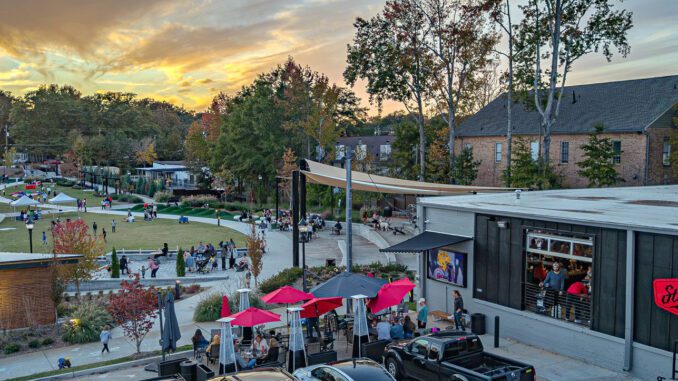
Still, geographic expansion only works if the brewery understands what makes a particular market attractive. StillFire’s Tucker location was appealing in part because of the city’s investment in a new park and special events area. The brewery would be positioned close enough to the Tucker Town Green to benefit from the additional activity. That relationship has become part of the location’s operating strategy. Rather than treating the park as simply a nearby amenity, StillFire coordinates its programming around the city’s event calendar.
“We schedule all events with an eye on what the City of Tucker has planned, then adjust from there,” Farrell said. “When the park has no special event or concert scheduled, we try to have more going on in the taproom, whether it’s music, trivia, comedy or our own special event.”
However, proximity to community activity doesn’t eliminate the need to create a reason for customers to stay. Farrell said StillFire’s three locations share a common hospitality philosophy, even as their surroundings and programming differ.
“We want to be the special ‘Third Place’ people think of after home and work,” he said.
The brewery has built its taprooms around large, beer-hall-style tables that encourage groups to socialize, while also providing smaller seating areas for customers looking for a quieter experience. Consistent beer quality is another priority, supported by nearly seven years of experimenting with a mix of family-friendly offerings and heavily rotated seasonal beers.
That consistency is important when expanding a brand. Customers visiting a second or third location should recognize the experience, but the brewery also needs to give each community reasons to make that location its own.
StillFire has also learned that a successful taproom experience doesn’t necessarily mean focusing exclusively on beer. Its locations offer a range of beer styles alongside seltzer, cider, wine, seasonal cocktails, soft drinks and mocktails. Farrell said offering variety helps accommodate larger groups, where individual customers may have different preferences. It also gives regulars reasons to return as the beverage and entertainment selections change.

Expanding the customer experience, however, creates additional operational demands behind the scenes. Production planning, inventory management and quality control become more complicated when employees and equipment are spread across multiple facilities. StillFire has addressed some of those challenges through standardization and strategic production decisions. Its locations use equipment from the same manufacturers, making it easier for brewers to work across facilities, scale recipes and maintain consistency. The brewery also determines where each batch should be produced to minimize the amount of beer that needs to be transported.
“We regularly taste everything in the breweries and then in the taprooms to make sure it is up to our standards,” Farrell said.
The brewery also expanded its Smyrna production capacity partly because of its proximity to its distributor, shortening delivery distances. These decisions illustrate why a multi-location strategy should account for the entire business, not just the individual taproom’s sales potential.
Management structure is another area that needs to evolve. Farrell remains StillFire’s brewmaster but has shifted much of his attention away from day-to-day brewing toward long-term strategy, recipe development, quality control and planning. The company’s head brewer was promoted to director of brewing operations, taking responsibility for coordinating production across all three facilities, including hiring, training, scheduling and inventory.
Farrell acknowledged that the company now requires considerably more planning and meetings than when everyone worked under one roof. Taproom operations also remain separate from brewery operations, with individual managers overseeing their respective locations.
Of course, another location still needs to prove it can make money. StillFire monitors traffic, guest transactions, average ticket size, beer volume, time spent in the taproom and takeout sales. Managers provide nightly reports, allowing leadership to identify trends and address problems before they become larger issues.
READ MORE: Managing Your Brand Story at Scale Beyond the Taproom
“Taproom numbers drive the profitability,” Farrell said. “Without profits, the business will fail.”
Farrell’s biggest advice for breweries considering another location is to be realistic about whether their existing business model can be replicated.
“First off, there will never be a perfect time to expand,” he said, noting that StillFire encountered budget pressures and contractor delays with all three projects. He also cautioned against assuming that a brewery’s reputation alone will draw customers to a new location. Taprooms are no longer a novelty. They need to offer an experience that gives people a reason to visit and return.
StillFire learned the importance of that connection early. The brewery had operated its original Suwanee taproom for about six months when COVID-19 restrictions forced it to close. It pivoted toward distribution and takeout sales, supported by customers who had quickly developed a connection to the business. For Farrell, that loyalty reinforced what makes a taproom model sustainable.
“It was because they felt community and at home in our taproom,” he said. “They didn’t want to lose their new best friends.”
Adding locations can expand a brewery’s reach, improve production efficiencies and create new revenue opportunities. But the foundation still needs to be a business model that gives people a reason to gather. Without that, another taproom is simply another set of expenses. With it, a brewery has a better chance of building a community that can support the business well beyond its opening.