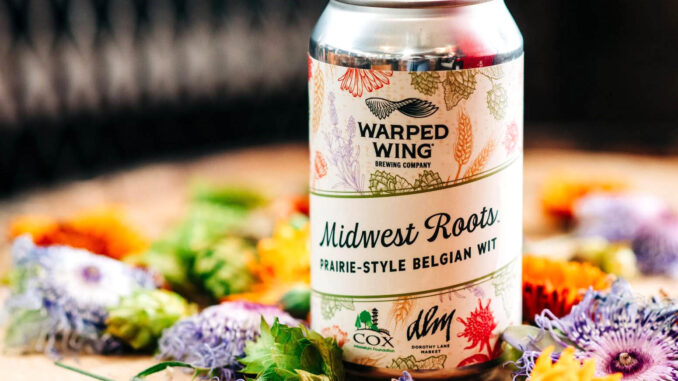
Midwest Roots, a new “prairie-style Belgian Wit” from Warped Wing is not just another seasonal release. For other brewery owners and decision makers, it can be a look at how to align community partnership, nontraditional ingredients and disciplined volume planning into a coherent business strategy rather than a one-off feel-good project.
The collaboration centers on Dayton, Ohio’s Cox Arboretum’s edible garden, where staff harvested botanicals and hops for the beer.
Brewed in collaboration with Dorothy Lane Market & Cox Arboretum Foundation, Midwest Roots is ade with heirloom Ohio-grown Red Fife Wheat & Chinook hops, along with lavender, calendula, passionflower, lemon balm and bee balm. Some plant material was dehydrated to stretch usability; other portions were picked the day before brew day. Warped Wing Brewmaster and co-founder, John Haggerty, told BREWER in an upcoming podcast the result is a beer that deliberately nudges people out of their comfort zone.
“It is going to challenge some people’s notions about beer a little bit,” Haggerty said. “It’s got a unique flavor. But I think it’s also interesting. It shows you what you can do with other materials that aren’t traditional.”
It shows that not every innovation has to be hop- or fruit-driven. In Midwest Roots, the primary aromatic drivers are lemon, bee balm and lavender, supported by Belgian yeast character. Haggerty said he’d like to “push the flower part a little more forward,” but acknowledged how delicate those ingredients are and how much raw material they require.
Warped Wing is not trying to scale this concept very far. There’s no state-wide release or even hitting all the markets they are in near Dayton. Instead, it’s building a tight, locally resonant program that can be repeated and refined.
“We did about 275 cases,” Haggerty said. “For us, it’s on the smaller side. It isn’t the tiniest run we’ve ever done, but it’s close to that. It’s really for the Dayton market mostly. Because that’s who knows Cox, who knows [Dorothy Lane Market] and, of course, ourselves.”
That small-batch discipline is intentional. Co-founder and head of sales, Nick Bowman, said the brewery sized the release with both consumer behavior and ingredient unfamiliarity in mind.
“Because it’s so unique, and you’re using ingredients that a lot of people may not be familiar with, I think you keep it tight,” Bowman said. “You keep the volume tight, and you make it a unique experience. You get in and out of it.”
For other breweries considering how much of a release to make, that approach addresses a recurring problem: how to say “yes” to creative, mission-aligned collaborations without saddling the brewery and trade partners with slow-moving inventory months later.
Bowman noted that Warped Wing worked closely with Dorothy Lane Market on volume projections and positioning before committing to batch size. The retailer, which is deeply rooted in the Dayton area, was given the chance to weigh in not just as an account, but as a strategic partner.
“We go out and say, here’s what we’re doing, and we get volume projections from them, what they’re comfortable with, and so that helps us define our decision as well,” Haggerty said.
Behind the scenes, practical brewing constraints also shaped the project. Haggerty said he can’t simply “make a half a batch” to chase a concept. Fermenter size, filler economics and yield targets still apply, even when the story skews toward community and creativity.
“Within our own brewery, I can’t just go make a half a batch or something,” he said. “It’s got to fit within our batch size, how we’re going to split it out. Nick and the sales team will tell me, this is what we would like to do in terms of numbers. They have a rough idea how it fits in as well. So that usually is pretty close… It’s negotiated. Like, okay, here’s where we’re at.”
If the liquid and logistics reflect operational discipline, the front end of the project shows how community roots can grow into a sustainable program. The relationship with Cox Arboretum didn’t start in a conference room; it began with a regular guest at Warped Wing’s Springboro taproom.
“As it turns out, Joe from Cox Arboretum is one of our regular customers at our Springboro location,” Haggerty said. “It really started with him talking to one of our bartenders, and then working its way back around to me, and that’s how we connected.”
Cox had decided on its own to start growing hops and eventually needed a meaningful outlet for the harvest.
“The Arboretum, just of its own accord, decided they were going to start growing hops,” Haggerty said. “That was sort of the impetus to get started down this path: ‘Hey, we planted these, now we don’t know what to do with them. Do you want them?’ And so we’re like, ‘Yeah, okay, we’ll see what we can figure out.’”
Last year’s version leaned more into the hops with a Red IPA for Midwest Roots. This year, the team pivoted toward botanicals and local wheat to better showcase what the edible garden and regional agriculture could offer.
“We wanted to move more over to the botanical side, just as a twist,” Haggerty said, adding that they also chose a style that would “let the wheat that we’re using from the [local] farm come a little more forward,” rather than getting “run over” by aggressive hopping.
For breweries considering similar projects, that pivot is an important takeaway: community collaborations don’t have to repeat the same playbook every year. They can evolve from hop-forward to botanical, from draft-heavy to packaged-focused, as partners, agriculture and consumer interest change.
Layered into the brewing and sourcing story is a charitable component that, while not the sole driver, reinforces the project’s purpose. A portion of the proceeds goes back to Cox to support the edible garden, which in turn supplies fruits and vegetables to local food banks.
“There’s a whole charitable wheel that’s spinning in the background as well,” Haggerty noted.
Bowman said that while it’s difficult to quantify exactly how much the give-back drives consumer purchases, it clearly strengthens internal motivation and partner relationships.

“When we gathered all around after the first Midwest Roots was finished, coming together and presenting them with a check — I mean, we’re not talking about a lot of money — but to them it was so important,” Bowman said. “To see the reaction, I think, made it that much more special for us.”
Haggerty believes the brewery would pursue this sort of project even without a donation component, but he acknowledged the added value.
“I think we would be doing it regardless,” he said. “But I think it’s a nice little bit of icing on the top of the cake. Does it help sell more? That’s hard to say. It’s not hurting the sales. I think either way, we’d be doing it. It makes us feel good.”
From a brand-positioning standpoint, Warped Wing treats these local collaborations as an expression of its identity, not as one-off marketing stunts.
“From the very beginning, that was important to us. It’s kind of who we are,” Bowman said. “It’s not just about doing beer collaborations with local entities, but strengthening those relationships. It’s about creating excitement and civic pride in our community, and highlighting the cool things that are happening.”
He added that projects like Midwest Roots can surface stories many locals don’t yet know about their own institutions and supply chains.
“There’s probably a lot of people out there that didn’t know Cox was growing their own hops, or had an edible garden to the extent that they do,” Bowman said. “And there’s probably people out there that support Dorothy Lane that maybe they don’t understand how tight they are with their local suppliers, and how much that means to them, and in turn that means a lot to us too.”
Midwest Roots offers several practical lessons. It includes the ability for breweries to use community collaborations to deepen authentic relationships that already exist — like a regular at the bar — rather than forcing a partnership around a convenient trend.
READ MORE: How Warped Wing is Saving Money While Being Sustainable in This Packaging Switch
Also, let local agriculture and partner capabilities shape the style and recipe, not the other way around.
Be realistic on volume. Keep it “tight,” in Bowman’s words, so that uniqueness and scarcity work in your favor instead of creating long-term inventory drag.
Also, align charitable giving with visible, local impact so partners and staff can see the results, even if the dollar figures aren’t huge.
And finally, keep the project fun and challenging for the brewing team. Haggerty admitted that when Bowman wants clear definitions up front, he sometimes has to resist.
“Nick wants me to define what we’re doing. I’m like, ‘Dude, I don’t know, I’m making it up,’” Haggerty said with a laugh. “But that’s also fun and it’s engaging. When we were on the brew day putting it together, all the guys on the team are like, ‘What are you doing? How do you do that?’ They’re all into it. It’s different than the normal day, so it’s fun.”
For breweries willing to balance experimentation, local agriculture and measured risk, Midwest Roots shows how a “small” beer release can punch above its weight in cultural and community impact and still make business sense.