Carbon dioxide is a brewery’s production input that can be easy to overlook until supply gets tight, prices rise or a delivery does not arrive when expected. Almanac Beer Co.’s Flow – Clean Air Edition offers a look at a different approach: producing a portion of that critical input onsite.
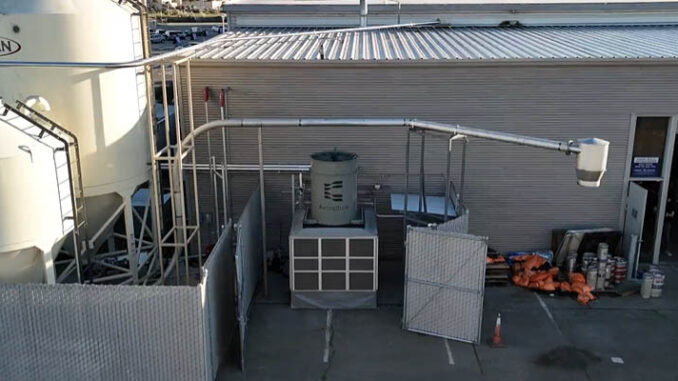
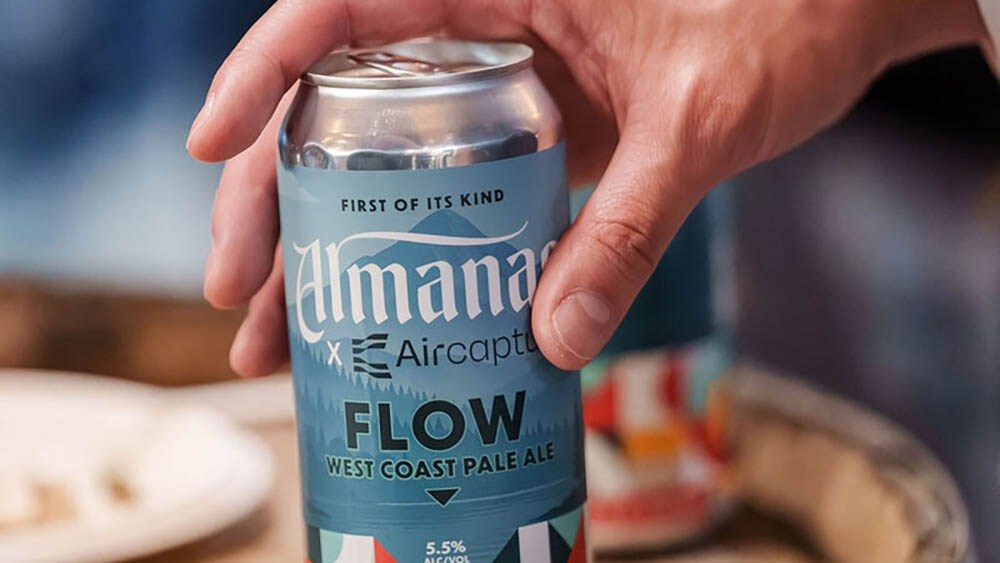
Created in partnership with Aircapture, this version of Flow is a West Coast Pale Ale that launched in March 2026 and is carbonated using CO₂ captured directly from ambient air at Almanac’s Alameda, California, brewery. The project gave a real-world test of whether direct air capture can move from an interesting technology into a practical piece of brewery infrastructure.
For Almanac Vice President of Operations Brendan Sinclair, the decision to move forward was based less on the novelty of the technology and more on whether the system could demonstrate operational reliability.
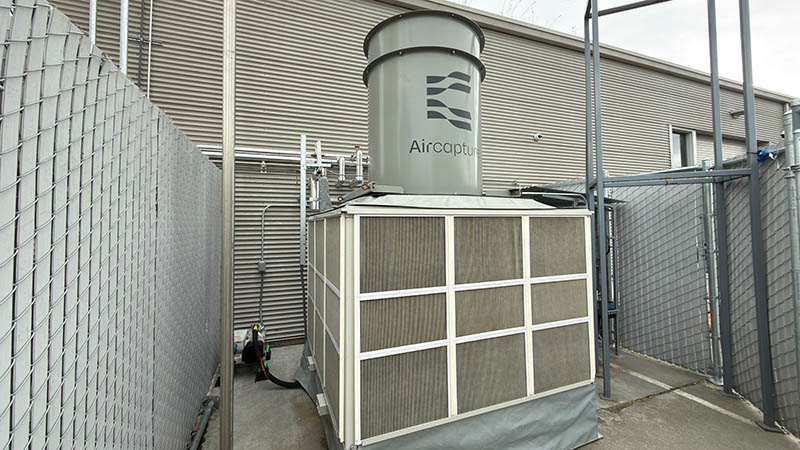
“We had the opportunity to visit Aircapture’s Berkeley facility and see the actual system that would be installed at our brewery operating and producing CO₂,” Sinclair said. “Knowing that the equipment had already been running successfully for some time gave us confidence that the technology had moved beyond the experimental stage.”
That due diligence also extended to the people behind the technology. Sinclair said Almanac was impressed by Aircapture’s technical expertise and viewed the company as a capable partner, an important consideration when adopting technology that becomes part of the production process.
A point worth noting for others considering such emerging technology. Being first can create advantages, but it also creates additional risk. A brewery may be buying more than equipment; it may be entering a long-term relationship with a technology provider. For Almanac, the decision was influenced by confidence in both.
The financial evaluation similarly went beyond comparing the new system with the brewery’s current CO₂ invoice.
“We evaluated the return on investment not only against the current price of delivered CO₂, but also against the long-term cost and operational risk of relying on a single supplier for an essential production input,” Sinclair pointed out.
Having a broader definition of ROI was useful in the project. Delivered CO₂ has a visible price, but the cost of supply uncertainty is harder to put on a spreadsheet. Price increases, shortages, delivery schedules and limited negotiating leverage can all affect production without appearing as a line item labeled “CO₂ risk.”
Sinclair said Aircapture’s fixed-cost structure gave Almanac greater predictability while reducing exposure to future price increases and supply uncertainty.
The brewery has not attempted to eliminate outside CO₂ overnight. Six months into the project, Almanac is taking what Sinclair described as a deliberate, phased approach because it is the first brewery to implement the technology for production.
“We have reduced outside deliveries and are on track for 50% of our CO₂ to come from the Aircapture system this year,” he said.
That phased approach also produced an unexpected benefit in that Almanac developed a much more detailed understanding of how much CO₂ the brewery actually uses.

For others in brewery management, that may be as valuable as the technology itself. Before investing in new equipment, measuring actual consumption can reveal opportunities to improve purchasing, scheduling and production efficiency. In Almanac’s case, implementing an onsite source appears to have forced a closer examination of an input that previously arrived largely through an established supply chain.
The bigger question, of course, is whether changing the source of CO₂ changes the beer.
According to Sinclair, it has not.
“Zero change,” he said when asked about carbonation quality, consistency, flavor and other quality-control considerations compared with conventionally supplied CO₂. “Initial tests from the CO₂ we are receiving, our quality may have gone up.”
In fact, the operational experience has been notably uneventful.
“What surprised us most was how consistently Aircapture followed through on its commitments and exceeded our expectations as a service partner,” Sinclair said. “They delivered a seamless solution, and as we ramp up production, the system continues to meet the metrics we established without material operational setbacks.”
The business model is also different from simply purchasing and maintaining a piece of equipment. Aircapture installed the system at Almanac, and the brewery pays the company for the CO₂ it delivers. That structure potentially changes the capital requirements and maintenance responsibilities associated with onsite production, while making the technology more comparable to a supply agreement than a traditional equipment purchase.
There is still a significant question for others: At what size does the economics make sense?
Sinclair is reluctant to offer a simple production-volume threshold based on Almanac’s experience.
“As the first brewery to implement this technology, we are still in what I would call ‘iPhone 1 territory,’ so our experience does not establish a clear minimum volume threshold,” he said. “As with most new technology, future generations will become practical for a broader range of breweries.”
That caveat is important. Almanac’s experience should not be treated as proof that every brewery should install direct-air-capture technology. The economics will depend on CO₂ consumption, existing supply costs, available space, capital structure, local supply conditions and the terms offered by a provider. But the project does demonstrate a broader business principle: breweries do not necessarily have to accept every production input and its supply chain as fixed.
READ MORE: Finding Innovation With New Dogfish Head-Inspired Technology
For Almanac, the first step was not simply adopting new technology. It was examining a critical input from multiple angles, like cost, reliability, supply risk, quality and operational control while determining whether changing the model could provide value.
The result is a Pale Ale that serves as a useful case study beyond the beer itself. Flow – Clean Air Edition shows that emerging technology becomes considerably more relevant when it can move from a sustainability conversation into the practical questions of cost, supply security, quality and day-to-day operations.