

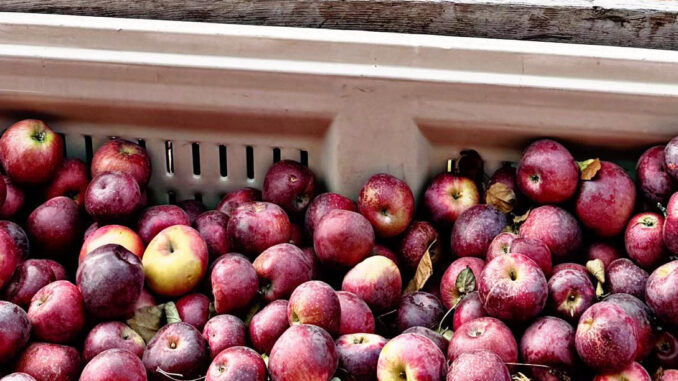
For cideries built around traditional orchard apples, differentiation often starts with a challenge: convincing consumers there’s a meaningful distinction between cider made from culinary apples or concentrate and cider produced from purpose-grown fruit. That gap is less about changing the product and more about changing the conversation.
Education, many cidermakers say, becomes the foundation of that effort.
Ben Wenk of Ploughman Cider In Pennsylvania said the advantage of traditional orchard apples is that the raw materials themselves already provide a storytelling opportunity that larger commercial cideries often can’t match.
“I think it’s all about education and communication,” Wenk told Cider Business. “Communication is going to be how the product is packaged and how you talk about it. It’s the easiest way to talk about apples.
”While commercial cideries are bringing in bulk juice or, worse yet, concentrate, you’re using actual varieties of apples with names and stories and characteristics that make them unique.”
Wenk believes apples offer a rare advantage compared to other fruits because consumers already have some familiarity with varieties, even if they don’t fully understand how those varieties influence flavor.
“There are only so many fruits in the world that have widespread knowledge of specific varieties and cultivars and of them, apples are certainly No. 1, with a bullet,” he said.
That philosophy shapes how Ploughman communicates its products. Wenk said the cidery lists every apple variety used on packaging, regardless of where the cider is sold, leaning into transparency as a differentiator.
“The apples matter and mainstream cider couldn’t do this, at least not transparently or in any truthful way,” he said.
But labeling alone doesn’t close the knowledge gap. Wenk said training staff and partners becomes essential when selling a more nuanced product at a typically higher price point.
“The other thing you need to do is make sure ALL of your staff can talk about the product and the apples intelligently and use the same words, making the same points,” he said. “You’re trying to differentiate yourself in the market, meaning you’re going to need to train your own staff, train your buyers, train their staff, and train the general public what the differences are.”
That investment, he added, is unavoidable for cideries that want to compete on quality rather than price.
“If that sounds like a lot, the only alternative is to make cider cheaper than everyone else,” Wenk said. “And that’s a race to extinction.”
Others echo that education-first strategy, while also broadening the conversation beyond apples themselves to include agriculture and place.
Bob Manley, co-founder of New Hampshire’s Hermit Woods Winery & Eatery, said his team frames traditional cider as both a beverage and an agricultural product.
“We position our ciders with a focus on both being agricultural products and beverages,” Manley said. “That means telling the story of the fruit, the orchard, and the grower, not just the flavor profile.”

Manley said traditional orchard apples naturally support that narrative because of their structural qualities.
“Traditional orchard apples bring tannin, acid structure, and complexity that you simply don’t get from concentrate or culinary apples,” he said. “We lean into that difference.”
That approach also helps shift cider into a category more closely aligned with wine, where discussions of terroir and production methods are more familiar to consumers.
“We also connect cider to the broader craft beverage conversation,” Manley said. “Just as wine reflects terroir, so does cider. When people understand that they’re tasting a place — not just a sweet apple drink — the conversation changes.”
That shift allows producers to step away from competing with mass-market cider on price or sweetness.
“We don’t compete with mass-produced cider on price or sweetness; we differentiate on authenticity, balance, and craftsmanship,” Manley said.
Richard Yi of Brooklyn Cider House said that positioning often requires reaching beyond traditional retail channels and focusing on the people most likely to communicate those nuances to consumers.
“A lot of this comes down to education,” Yi said. “We focus on educating our tasting room staff, distributors, customers, and retail partners.”
Yi noted that most consumers don’t read labels or websites closely enough to understand how cider is made, making in-person conversations more valuable.
“From a consumer’s perspective, there isn’t really a surefire way to know how a cider is made unless they read the label or website, which realistically doesn’t happen very often,” he said. “That’s why we emphasize training the people who sell our cider.”
READ MORE: Exploring the Benefits of Non-Traditional Venues
Brooklyn Cider House emphasizes production transparency in those conversations, including sourcing and process.
“We want them to be able to tell customers that our ciders are made with 100% New York–grown apples, not from concentrate, and with no flavor or sugar additives,” Yi said. “From there, we can talk more about the apples themselves.”
Yi said those apples often include bittersweet and bittersharp varieties that contribute structure and complexity, reinforcing the message that traditional cider offers a different experience.
“We primarily use higher-grade apples, including a good amount of bittersweet and bittersharp varieties, which add more character and complexity to the cider,” he said.
Beyond retail, Yi said restaurant placements and sommelier relationships can help accelerate consumer understanding.
“We’ve also been working with restaurants and Sommeliers,” Yi said. “They have more time to guide consumers and help them make informed choices, and they usually have a deeper appreciation for the work that goes into the cider.”
Taken together, those strategies suggest that positioning traditional orchard cider isn’t about a single tactic but a coordinated effort across packaging, staff training, and channel strategy. Those who succeed lean into transparency, agricultural storytelling and education while building long-term value rather than chasing short-term volume.
The challenge may be greater, but so is the opportunity. As Wenk mentioned, the alternative is competing on price, a path that few craft producers see as sustainable.

2 Trackbacks / Pingbacks
Comments are closed.