

Two of the many collaboration beers slated for April’s 2026 Collaboration Fest in Colorado illustrate a business reality many brewery owners are grappling with: in a crowded, cautious market, the path to attention (and sometimes relevance) increasingly runs through bold experimentation and strategic partnerships rather than predictable releases.
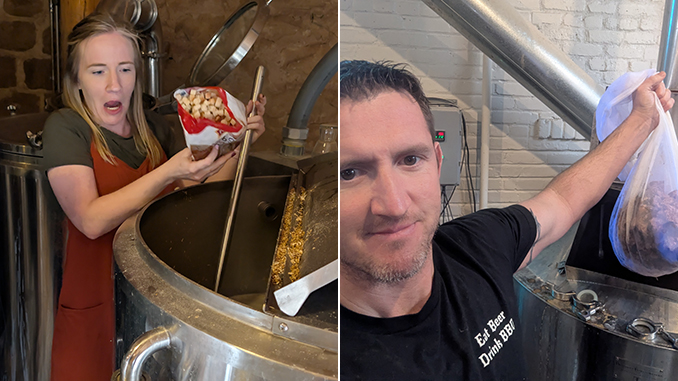
For A Bit Twisted Brewpub & BBQ and Monolith Brewing, that experimentation takes the form of a Smoked Stout built with house-smoked jalapeño sausage, the third installment in what has become an intentionally niche “smoked food beer” series that has captured. Rather than designing the beer around competition feedback or broad consumer trends, the collaborators leaned into what they already knew worked for their audiences — and for themselves.
The technical hurdles can be significant. Introducing 20 pounds of meat into beer can risk oxidation, off-flavors and destroyed head retention due to fats and oils. Stephen Monahan, head brewer of Monolith, said their solution has been simple but effective: physically removing the problem layer.
“We’ve never seen issues with oxidation,” Monahan said. “We actually withhold the last five gallons in the kettle and dump it since that’s all the oil that’s floated to the top that would normally kill the head.”
That kind of pragmatic process adaptation underscores how experimental beers often require operational flexibility that many production breweries cannot easily accommodate. Yet for brewpubs and smaller operations, those constraints can become competitive advantages.
Flavor development presents another layer of decision-making that blends art, science and cost management. Matt Vargocko, owner of A Bit Twisted, said the team adjusts meat quantities based on how much smoke character each protein contributes.
“Two years ago, we used 10 pounds of brisket per batch and about 10 pounds of pork,” he said. “Since the sausage doesn’t output as much smoke as a brisket or pork shoulder, we doubled it up to 20 pounds hoping it would contribute to the overall smoke flavor.”
Monahan added that smoked malts still provide the backbone, with the meat acting as a complex accent rather than the sole source of character.
“We used a combination of smoked malts and also smoked meats to contribute a more complex flavor,” he said, noting changes in wood selection each year. “As far as calculating how much to use, we just kind of winged it the first year and it turned out beautifully, so we kept the same ratio.”
The economics can be substantial. Double batches in previous years required roughly 80 pounds of meat, turning what might be a novelty ingredient into a meaningful cost center. That reality highlights a key business question: are experimental collaborations intended to generate profit, publicity or internal creative satisfaction?
For Monolith, the answer leans heavily toward the latter.
“Not really expecting any measurable strategic outcomes … this is one of the beers we kind of make for ourselves,” he said. “Matt sells a lot more of it a day than I do as he is a BBQ joint as well.”
Still, the beer produces secondary benefits that are harder to quantify but valuable nonetheless, including passionate word-of-mouth and unique demand.
“We do get a lot of requests to ship it to people’s uncles and whatnot who are really into barbecue,” Monahan said.
If the Stout collaboration demonstrates the power of hyper-specific identity, the partnership between Grossen Bart Brewery and Mountain Merman Brewing shows how humor and storytelling can convert a seemingly absurd idea into a brand-building opportunity.
Their entry, a “Veggie Casserole Pale Ale” dubbed Liquid Thanksgiving-Get Basted, originated as an inside joke that gradually evolved into a serious technical challenge.

“Sarah Hiller has been joking with brewers for years about making a veggie casserole beer,” said JD Lind, owner and brewer of Mountain Merman, referring to Grossen Bart’s head brewer. “When Collaboration Fest came around, I asked her what beer she’d always wanted to brew, and this felt like the perfect excuse.”
Turning a comfort-food concept into a drinkable Pale Ale required careful balancing to avoid producing something gimmicky but undrinkable, a risk that can damage brand credibility if executed poorly.
“The real challenge was capturing those veggie casserole flavors without making something that drank like soup,” the brewers said jointly. They incorporated carrots, celery, stuffing mix and vegetable bouillon into the mash while maintaining a clean, hop-forward base.
“Biscuit malt helped bring in a bread-crust character that ties into the stuffing vibe,” they said, noting they mashed slightly sweeter to offset the savory components.
Operationally, the brew day resembled a culinary exercise as much as a standard production run. Fresh produce required additional preparation, but the team intentionally kept the core brewing process familiar to preserve stylistic integrity.
“The goal was to keep the rest of the process as close to a normal Pale Ale as possible so the beer would still ferment clean and stay recognizable,” they said. “The savory ingredients added some complexity, but they behaved better than you might expect.”
READ MORE: Lagunitas Explores Baked Bread Option in Brewing Process
Beyond formulation, the collaboration itself functions as a marketing engine. With both breweries sharing similar irreverent sensibilities, the project reinforces brand alignment while cross-pollinating customer bases.
“Collaboration Fest is always a great excuse to work with breweries you respect while introducing your communities to each other,” they said. “People who know one brewery might discover the other through the collaboration, and the story behind a beer like this definitely gets people curious enough to try it.”
That curiosity can be especially valuable in an environment where consumers are drinking less overall but remain willing to sample something novel. For breweries, collaborations offer a way to generate trials without the long-term commitment of adding a risky product to the core lineup.
Perhaps the most important idea from a fest like this, the brewers said, is psychological rather than technical.
“One of the biggest lessons was not being afraid to push the limits of what beer can be,” they said. “Sometimes the ideas that sound the most ridiculous are the ones worth brewing.”
Just two of many different beers (albeit more on the extreme side of the coin from all the beers that will be available) illustrate a spectrum of collaboration strategy: one rooted in hyper-specialized culinary integration and loyal niche appeal, the other in playful concept development and audience expansion. Both rely on trust between partners, operational flexibility and a willingness to accept uncertain commercial outcomes in exchange for differentiation.
Unique collaborations can create reasons for customers to show up, talk about a brewery and remember it. Those outcomes can be something standard releases struggle to achieve on their own.
Of course, not every brewery should add sausage or stuffing to the mash, but that calculated creativity — especially when shared with like-minded partners — can produce strategic value even when immediate sales impact is unclear. In a market defined by sameness, the biggest risk may be playing it safe.
1 Trackback / Pingback
Comments are closed.