By the time February arrives on the North Coast of Oregon, Fort George Brewery is no longer planning for Stout Month. It’s executing it.
What began 17 years ago as a seasonal celebration has grown into a full-scale production effort that stretches across nearly the entire calendar year, involving multiple brewhouses, dozens of recipes, long-term barrel management and a brewery-wide commitment that extends well beyond the cellar. If your brewery is looking at large-format, month-long events as both a creative outlet and a business driver, Fort George’s Stout Month offers a glimpse into how early planning, internal buy-in and disciplined logistics keep an ambitious vision from collapsing under its own weight.
“We try to start planning Stout Month earlier and earlier every year,” said Brian Bovenizer, Fort George’s marketing director. “We still maintain three different brew houses, so we try to plan the right beer for the right size batch.”
That production footprint includes “Sweet Virginia,” the brewery’s original 8.5-barrel, two-vessel system; “Little Miss Texas,” a 30-barrel, three-vessel brewhouse; and Kingpin, a 60-barrel, four-vessel system. Matching recipe scope to brewhouse capacity is the first constraint Fort George works within, particularly as the number of brands for the month continue to grow.
The smallest system also serves a secondary purpose and a way to help have a staff-driven innovation. For the 8.5-barrel system, Fort George opens submissions to employees six to eight months ahead of Stout Month, allowing staff to pitch ideas that might never scale to distribution but fit the experimental ethos of the event.
“We then weigh these ideas against themselves to create a rounded-out list,” Bovenizer said.
From there, the challenge becomes operational. Sourcing the ingredients and adjuncts must align across brewing, quality assurance and purchasing, especially when recipes push beyond the conventional territory of a typical brew day.
“As far as the logistics go from there, it is really a team effort,” Bovenizer said. “Our purchasing manager, Colin Cummings, and our QA/QC manager, Chris Kind-Chalmers, and our brew staff really have to work lock step to dial in recipes, adjuncts and ordering.”
That coordination becomes more complex when ingredient lists include items not typically found on a brewery order sheet. This year’s Stouts called for vegan marshmallow fluff, Oreo cookies without the filling, Nutty Buddy bars, five-gallon buckets of vegan caramel, Jacobsen Sea Salt and gummy worms, among others.
“Production planning software and meetings help, but it is just a lot of communication,” Bovenizer said as a key to making it all work out correctly.
That communication extends into aging and evaluation, particularly for barrel-aged beers that may not see daylight for years. Fort George’s approach has evolved alongside its stock depth, allowing the brewery to be more selective and less reactive.
“The brew staff has learned over the 18 years of Fort George Stout Month to start slow and add more as needed when it comes to adjuncts and barrel aging,” Bovenizer said. “With barrels, nothing typically goes less than 12 months in the barrel.”
Having two- to five-year-old inventory available for blending has shifted how decisions are made and has reduced pressure to force outcomes and give the team more tools to correct course if needed.
“We now have enough stock to blend back when necessary, which has really upped our game,” Bovenizer said.
A dedicated barrel tasting group evaluates barrels at least once a year, maintaining detailed notes that guide blending and adjunct additions. This year, Fort George expanded that feedback loop by inviting outside perspectives into the process.
“We brought in our friends from Ruse and Holy Mountain to do some barrel tasting and blending with us,” Bovenizer said. “Sitting down with trusted industry friends and tasting through our stock was an eye-opening experience.”
That external input reinforced an internal philosophy where the barrels need to lead the charge while adjuncts can follow.
“For barrel-aged beers, that’s the start,” he said. “Start with the barrels that we like the most and then decide where the adjuncts go from there.
“When we do add adjuncts, we typically start small and add to taste.”

While Stout Month has become known for pushing flavor boundaries, Fort George still applies internal filters to determine which ideas make it to market. Novelty alone is not enough.
“Stout Month is pretty no-holds barred,” Bovenizer said. “We have a group of five of us that clear any beer concept before it goes to market.”
That group rarely vetoes ideas outright, but it does apply two guiding questions.
“In the end, I think we have two mantras: ‘Is it fun?’ and ‘Will it taste good?’” he said. “If we have consensus on one or both of those things, then let’s go.”
Those decisions do not exist in a vacuum. What they have learned from Stout Month often carry into the rest of the brewing calendar, particularly as consumer expectations around barrel-aged stouts have shifted.
Matryoshka, Fort George’s flagship barrel-aged stout, reflects that evolution. Earlier iterations leaned thinner and hotter, a product of shorter aging times and limited blending options. Today’s versions prioritize balance and expression of the base beer.
“If you go back and taste Matryoshka from eight or nine years ago, they were going to be fairly thin and likely pretty hot on the barrel side,” Bovenizer said. “We were not aging as long or blending with older stock as much.”
Collaboration played a significant role in accelerating that learning curve. During the pandemic, Fort George depleted much of its barrel inventory while packaging aggressively to maintain cash flow.
Rebuilding that stock coincided with intentional collaboration.
“In 2021 and 2022, we invited Moksa, Fremont, Structures and Bottle Logic out to brew some stouts and learned a lot,” he said.
A new production facility also opened up process options that had previously been impractical.
READ MORE: Barrel Aging: Finding New Flavors
“This also allowed us the luxury to dig into some long boils that would not interrupt our daily production flow,” Bovenizer said.
Even with a stronger technical foundation, Matryoshka remains a creative canvas.
“What haven’t we done? What is hot? What would ultimately taste good?” he said. “This year, we had fun with the Oreo x Reese’s craze.”
There are also lessons that have proven universally reliable.
“The other thing that we’ve found over the years is that a ton of vanilla makes every barrel-aged stout taste better,” Bovenizer said. “There are a ton of varieties of vanilla that can really let the base beer shine.”
As Stout Month has grown into a marquee event, so has the pressure to meet consumer expectations, particularly with the Festival of Dark Arts drawing national attention. Balancing that demand with internal sustainability remains a constant consideration.
“I try to let the brewers lead the recipes as much as possible,” Bovenizer said. “If the ingredients are going to be that much more expensive to make it a better beer, then let’s just raise the price and/or lower the amount that we will put in the market.”
For Fort George, the equation ultimately comes back to quality and morale.
“In the end, we just want to put out the best beer possible while having some fun,” he said. “I think we’re succeeding in that.
“But I am also not wax dipping all of those bottles.”
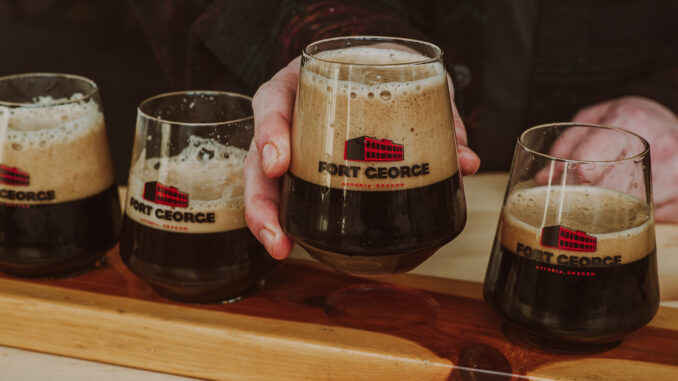
On Feb. 1, Fort George will kick off its 17th Stout Month with 28 straight days of Stouts pouring at the pub. Dozens of stouts, spanning styles, flavors and alcohol levels, will rotate throughout the month, from established favorites like 1,000 Years of Silence, a spiced Mexican chocolate stout, to small-batch experiments and collaborations.
The celebration culminates Feb. 14 with the Festival of Dark Arts, featuring more than 90 unique Stouts on tap, over two dozen live music acts across three stages and a slate of immersive experiences ranging from ice sculpting to live tattooing. The festival is sold out, and the entire Fort George block will be closed to the public for the event.
The following day, the brewery will reopen for regular service and release its 2026 Matryoshka variants alongside special barrel-aged collaborations with Ruse and Holy Mountain. Stouts will continue to flow through the end of February, closing out a month that, for Fort George, is less about spectacle than disciplined execution built over nearly two decades.