For MadTree Brewing, diversification was not a branding exercise or a hedge against boredom. It became a structural response to long-term shifts in consumer behavior and beer sales that the company could no longer ignore.
Co-owner Brady Duncan said in a recent Brewer Magazine podcast the reality of declining beer volumes over several years forced the Cincinnati-based company to reassess what growth actually looked like under a brewing banner. While some internal cannibalization was expected, the introduction of Sway, MadTree’s vodka soda brand, did more than soften the impact. Duncan said Sway effectively propped up the business during periods when beer sales were slipping, more than offsetting those declines.
Now, he said, both beer and alternative beverages are growing side by side, reinforcing the idea that diversification did not replace beer so much as stabilize the company around it.
“I’m sure there’s a little bit of cannibalization, but as we went through years and years of beer declines, Sway was the thing that really kind of was propping the business up,” Duncan said. “It was more than offsetting the beer declines.”
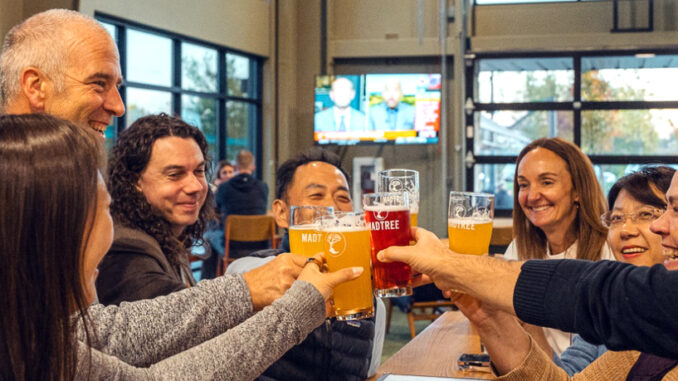
Inside MadTree’s taproom spaces, that philosophy shows up in a broader menu that reflects how people actually drink today. Duncan pointed to mocktails and nonalcoholic options as standard offerings, even though MadTree does not currently produce its own non-alcoholic beer. He said the company experimented with test batches and succeeded once, but could not consistently replicate the process at a quality level that met expectations. Rather than push a flawed product to market, MadTree chose to pause those efforts, though Duncan said NA beer remains an interest for the future.
He also acknowledged emerging categories such as THC beverages as areas MadTree expects to explore, framing them less as trends and more as responses to changing social habits. Duncan said he has been struck by how many consumers under 28 are drinking less or not at all, and when they do drink, they do so in moderation. He described that shift as positive for society, even if it challenges traditional beer-centric business models.
For co-founder Kenny McNutt, the hardest part of diversification was not the logistics but the first philosophical break from an all-beer identity. He said the initial shift came when MadTree introduced pre-batched cocktails, which required pulling several beer taps to make room. At the time, that meant scaling back from nearly 30 beers on draft to allocate five or six taps for cocktails. Wine followed shortly after, a move McNutt described as necessary to accommodate guests who would otherwise opt out entirely.
Those early decisions set the stage for bigger changes. McNutt said that after years of internal debate, MadTree added a full bar roughly eight years into its existence. The concern had always been that liquor sales would siphon off beer revenue. In practice, he said, the opposite often happened.
Guests who arrived not intending to drink beer were now staying, ordering cocktails, and remaining engaged with the space instead of leaving or skipping the visit altogether.

““It’s that person that comes in and says, ‘I don’t really want a beer and I’m probably not going to have anything,’” he said. “‘Oh, wait, I can have this cocktail. OK, I’ll have that.”
McNutt framed those choices as customer-first decisions rather than operational compromises. He said the company ultimately had to stop prioritizing internal discomfort over guest experience, noting that service staff quickly adapted to cocktail execution and that complexity behind the bar did not outweigh the value of meeting broader customer preferences.
Duncan said that shift required him personally to let go of rigid beliefs about what a brewery should and should not make. Early in MadTree’s history, he said, the company was built around aggressively hopped, higher-ABV beers inspired by the founders’ own tastes. The first beers on tap leaned heavily into that identity, and Duncan admitted he once resisted styles like light Lagers and even questioned the push toward products like Sway.
MORE: Brewer Mag Podcast with MadTree
Over time, he said, that mindset became untenable. Duncan said he no longer believes in drawing hard lines around styles or categories, arguing that the immovable priorities are quality, competitiveness and business sustainability. Whatever MadTree produces, he said, must meet or exceed customer expectations, stand up against alternatives in the market and contribute meaningfully to growth and community support.
He described that evolution not as abandoning craft principles but as redefining them in a broader beverage context.
““I’m not going to die on the sword of a certain style of beer or a certain ‘thou shalt make this, thou shalt not make that,’” Duncan said. “Whatever we are going to make needs to be quality, it needs to be better than the competition, and it needs to help us grow the business.”
The duo shows that diversification as an additive strategy is more rooted in realism rather than fear. By acknowledging shifts in consumption, resisting nostalgia-driven decision-making and focusing on the total guest experience.