Lagunitas has never been particularly interested in following the straightest line through the market. That instinct is showing up again in how the brewery is positioning Hoppy Refresher, its non-alcoholic sparkling water brewed with hops, at a time when much of the industry still frames non-alc almost exclusively through the lens of Dry January.
Rather than leaning into abstinence-forward messaging, Lagunitas has opted for what it calls “Wet January,” a deliberately looser idea that allows consumers to drink alcohol, avoid it, or land somewhere in between. For Lagunitas, that framing is less about a calendar moment and more about reinforcing a long-term portfolio strategy built around choice.
“Lagunitas is all about being unconventional,” said Kelsey Fermi, senior innovation manager for Lagunitas. “Owning ‘wet’ while everyone else is ‘dry’ aligns with our personality and signals ‘refreshing’ in a new way. ‘Wet’ allows us to align with our ‘No Rules. Just Options.’”
From a business standpoint, the move reflects a broader reality facing breweries exploring non-alcoholic extensions. The category has become crowded quickly, and breweries that enter it without a clear reason for being risk blending into a sea of wellness cues and generic positioning. Fermi said Lagunitas was intentional about not presenting Hoppy Refresher as a lifestyle product divorced from beer culture.
“In an ever-competitive landscape of non-alcoholic, Lagunitas is a brewery first and foremost, with a portfolio that aligns with consumer lifestyles and needs for choice without compromise,” she said.
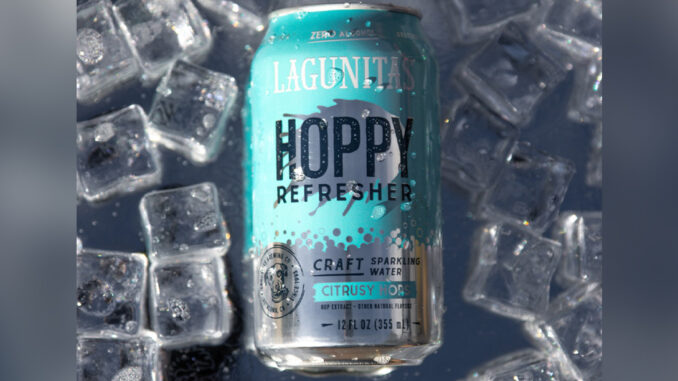
That brewer-first perspective guided the recent rebrand of Hoppy Refresher, which Lagunitas repackaged to more closely resemble its core beer lineup. Silver cans, bold graphics, the brand’s familiar dog stamp and flavor-forward callouts replaced a look that previously made the product feel disconnected from the rest of the portfolio.
The shift was not driven by dissatisfaction with the liquid or a belief that the category itself was flawed. Instead, Lagunitas’ internal research pointed to a communication problem.
“We conducted extensive research with craft consumers and asked them to describe what they perceived Hoppy Refresher to be,” Fermi said. “Their responses were broad, indicating confusion about whether it is a seltzer, a watered-down beer, a water that tastes like beer, a soda.”
That ambiguity made it difficult for consumers to understand when, why or how the product fit into their routines. For a brand rooted in craft beer, that lack of clarity was a red flag.
“Because Lagunitas is a craft brand, targeting craft beer drinkers as the primary target, we knew we needed to evolve not only the proposition to be explicitly ‘Craft Sparkling Water’ with clear flavor callouts, but to update the packaging to align with our Lagunitas masterbrand,” Fermi said.
The rebrand intentionally narrowed the audience to “beer lovers who don’t always want alcohol,” a decision that came with tradeoffs. Lagunitas knew that positioning would exclude consumers who shop the sparkling water aisle looking for low-cost hydration or wellness-forward benefits. The brewery was comfortable with that.
“Hoppy Refresher is, and has always been, primarily placed in the cold box alongside NA craft beer,” Fermi said. “Because of the reality of our placement, especially coming from a craft brewery, we knew we needed to target the consumer shopping in this section.”

That focus influenced more than just messaging. It shaped pricing strategy, retail conversations and visual design. The product was not built to compete with mass-market sparkling waters on price or function, and Lagunitas did not attempt to force it into that set.
“Our pricing and proposition were not the right fit for the sparkling water section and would not resonate as well,” Fermi said. “This narrowing allows us to optimize our positioning for the right person in the right channel.”
For others considering non-alcoholic options, Lagunitas’ approach offers a useful counterpoint to chasing trend-driven demand. Rather than stretching its brand into an adjacent space and hoping to pick up new drinkers, the company focused on better serving people who already understood and trusted Lagunitas.
“What we’ve seen with growth from recent rebrands wasn’t about finding new drinkers, but clarifying the message for existing ones,” Fermi said.
That clarity extends to how Lagunitas talks about craft in a non-alcoholic context. Hoppy Refresher is not a new experiment; the recipe has remained unchanged since its early development, which dates back several years. What changed was how openly the brewery connected the product to its brewing heritage.
READ MORE: Lagunitas Explores Baked Bread Option in Brewing Process
“Hoppy Refresher was born of our brewer-first mentality,” Fermi said. “Our brewing team began experimenting with non-alcoholic refreshments eight years ago, and the recipe has been the same ever since, a variation on a theme of 25 years of edgy brewing.”
Leaning into that history helped differentiate Hoppy Refresher from hop water brands that emerged without deep brewing roots. It also gave Lagunitas permission to talk about flavor first, highlighting citrus, blood orange, passionfruit and lemon berry rather than functional benefits.
“It is a craft sparkling water where ‘craft’ connects back to the hop taste,” Fermi said. “That connection sets us apart and speaks to consumers who come to Lagunitas for refreshing, quality beverages.”
As non-alcoholic options continue to expand beyond January-driven consumption, Lagunitas’ strategy underscores that success in the category is less about abandoning beer identity and more about translating it. For brands willing to zig while others zag, the opportunity may not be in redefining who they are, but in giving their existing audience more ways to engage with them.