When Pinthouse opens its San Antonio location, the Austin-based brewpub won’t just be looking to expand; instead, it will be extending a philosophy that’s defined its success for more than a decade: go deep, not wide.
Co-founder and Vice President of Marketing Nic Van Biene said the company’s focused growth strategy has never been about chasing markets, but rather about strengthening roots.
“From the beginning, we’ve intentionally kept our footprint concentrated around the Greater Austin area,” Van Biene said. “There’s still significant demand for Pinthouse brewpubs and our beer locally, so we’ve never felt the need to take on additional risk by expanding into cities too far from Austin.”
That cautious approach has paid off. In just over ten years, Pinthouse has grown from a single brewpub into a trusted entity that brewed 23,000 barrels of beer in 2024, making it Austin’s largest brewery by volume. It’s also the largest independently owned brewpub group in the United States, according to the Brewers Association’s 2024 report.
The brewery’s deliberate “mile deep, inch wide” model keeps it connected to its customers, employees, and community. That’s a business advantage that many fast-expanding companies can struggle to maintain.
“By staying local, we don’t need to reintroduce our brand to new markets,” Van Biene said. “The community already knows who we are and what we represent.”
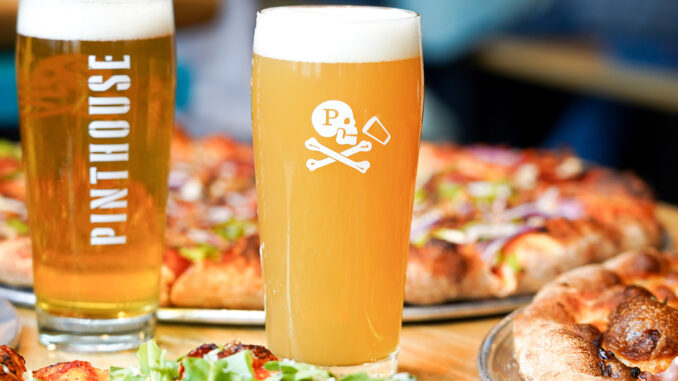
Even as Austin’s craft beer scene exploded, Pinthouse kept its focus on quality over quantity. Its Electric Jellyfish IPA, first brewed in 2015 as Texas’s original Hazy IPA, has become a statewide phenomenon, accounting for about 75% of the company’s total production and dominating draft sales in Central Texas.
In 2024 alone, nearly 4.1 million pints of the beer were poured between Austin and San Antonio. That connection between product and place is part of why Pinthouse’s expansion into San Antonio feels less like a leap and more like a progress in evolution.
“We began distributing beer in San Antonio during COVID, when many of our Austin accounts were temporarily or permanently closed,” Van Biene explained. “We already knew there was demand for Pinthouse in San Antonio, so expanding there was a natural next step.”
The bet has paid off. San Antonio beer sales are up 40% year to date, a sign that the market is ready for the brand’s first brewpub outside Austin.
“The San Antonio community has embraced our brand, and a large portion of the population is now familiar with our beer,” Van Biene said. “We see tremendous opportunity for a concept like ours there.”
The upcoming San Antonio location, which will include its own in-house brewery, continues the Pinthouse formula: hyperlocal production, consistent brand standards, and a genuine neighborhood feel. Each brewpub may share the same logo and high standards, but none are carbon copies.

“Each location is unmistakably a Pinthouse,” Van Biene said. “But we like to say, ‘If you’ve been to one Pinthouse Pizza, you’ve been to one Pinthouse Pizza,’ meaning each location is distinct in layout, size, and design while maintaining the same quality of food, beer, atmosphere, and service.”
That sense of individuality is what keeps Pinthouse from feeling like a chain despite its scale. Van Biene said the company’s emphasis on community interaction — such as knowing regulars by name and providing a space where people gather — is as central to its identity as its award-winning beer.
Those awards are numerous. Over the past decade, Pinthouse has earned 15 medals at the World Beer Cup and Great American Beer Festival. That’s more than any other Texas brewery in that span. Its Mosaic Takedown IPA most recently claimed gold in the West Coast IPA category at the recent World Beer Cup.
Still, for all its accolades, Van Biene said the company measures success less in medals or barrel counts and more in maintaining culture and consistency as it grows.
READ MORE: Developing Your Brewery’s First Major Expansion
“If we ever encounter recurring issues that compromise the guest experience or our culture, that’s a clear signal to reevaluate,” he said. “Our priority is always to ensure a great workplace for our team and a consistently exceptional experience for our guests. If either of those starts to slip, we know it’s time to slow down and refocus.”
That operational discipline extends to how the team approaches expansion. For Van Biene, sustainable growth means building from a foundation of systems, training, and shared values rather than chasing rapid market gains.
“Make sure you have the right training, systems, and processes in place before you scale,” he said when asked about advice for others looking to emulate their formula. “Without those, things start to break down quickly, and your business will struggle to maintain the quality your team and guests expect.”
As Pinthouse plants its flag in San Antonio, it does so with the same measured intent that’s guided its journey from neighborhood pizza-and-pint spot to one of Texas’s most respected beer brands.
“Growth should always be built on a solid operational foundation and a strong, cohesive culture,” Van Biene said. “That’s what has allowed us to grow successfully, and that’s what will continue to guide us.”