
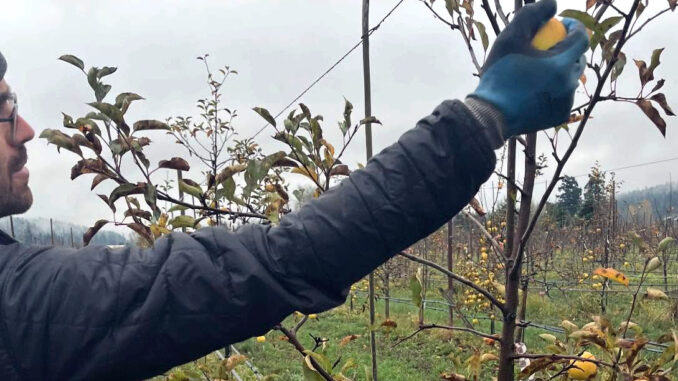
Finnriver Farm & Cidery frames biodiversity not as a marketing flourish but as a structural advantage that shapes the consistency and quality of its fruit. Co-owner and cidermaker Andrew Byers said the benefits don’t emerge as a distinctive “flavor of biodiversity,” but they do show up in the health of the orchard and the raw materials that reach the press.
“Diverse ecosystems support healthier trees through natural pest management and improved soil health,” he said, noting that reducing chemical inputs protects long-term resilience in a way conventional programs often fail to do.
The most noticeable gains appear in fruit set and harvest reliability.
“Robust pollinator populations — supported by biodiverse habitats — ensure reliable fruit set and stronger harvests,” Byers said.
Healthier trees, supported by those ecological systems, produce more reliable and higher-quality apples, he noted. For Finnriver, that reliability becomes the quiet backbone of premium cider production.
“Biodiversity provides the foundation for consistent, high-quality fruit,” Byers said. “The result isn’t a unique flavor signature, but rather the reliability and fruit quality that allows cider makers to consistently craft exceptional products.”

Finnriver’s approach to biodiversity is inseparable from its long-term investment in sustainable farming practices. The shift began more than a decade ago with a conservation easement on the 50-acre farm, which Byers said set the tone for every agricultural decision that followed.
“That foundation led to dual certifications — Certified Organic and Salmon Safe — which guide all our agricultural input decisions from compost to fertilizers,” he said.
Those standards helped the cidery build production systems centered on soil biology, including on-site composting and aerated compost teas aimed at feeding both trees and beneficial mycorrhizal fungi.
Weather volatility has made those investments more urgent.
“Heat dome events burn fruit and leaves while dehydrating soils,” Byers said.
Mulching and cover cropping have become central tools for keeping trees productive under increasingly erratic conditions. Mulch helps retain soil moisture, while cover crops reduce compaction and support root health.
That ecological scaffolding extends beyond tree rows. Finnriver has woven pollinator habitat throughout the farm, an approach Byers said reduces the orchard’s dependence on outside inputs as biodiversity builds on itself. The strategy resembles community-building more than simple farm management.
READ MORE: How Orchard-Based Cideries Strengthen Ecosystems with Collaboration
“Our goal is establishing young plantings in environments where they can thrive with minimal intervention,” he said.
Deep root systems, fungal networks, diverse habitat and healthy soil form the infrastructure that lets the orchard mature into a more self-sustaining system.
Over time, those layered relationships become the quiet but essential contributors to fruit quality — an upstream investment that strengthens every downstream step of cider production.


Be the first to comment