Business diversification often gets discussed as a hedge against slowing sales, but Urban South Brewery‘s experience suggests it’s just as much about building an organization capable of adapting when consumer behavior changes faster than legacy assumptions.
For the New Orleans brewery, entering the hemp-derived THC beverage market in 2023 with its Driftee sparkling water line wasn’t simply about chasing a trend. It became an exercise in testing new products, identifying an audience through real-world sales data and, perhaps most importantly, accepting that early assumptions about customers are often wrong.
Those lessons have become increasingly relevant as other breweries across the country weigh whether adjacent beverage categories belong in a long-term business strategy.
Urban South co-founder Jacob Landry said shifting drinking habits among younger consumers have forced breweries to acknowledge that alcohol no longer occupies the same place in social culture it once did.
“I don’t know why,” Landry said. “But we see it, and we see it even when a lot of the younger folk … we see it at Mardi Gras. We see the trends change.”
Even during one of New Orleans’ largest beer-drinking events, Landry said the rise of ready-to-drink beverages has been impossible to ignore.
“The ascendancy of High Noon has just been unbelievable,” he said. “We kind of held our own in the beer world, with Paradise Park particularly (the company’s American Lager), but there’s big changes happening.”
Kyle Huling, Urban South’s other co-founder, views those shifts less as a permanent loss for beer than as another stage in changing consumer preferences.
“People don’t want to do the things that their parents did,” Huling said. “At some point those kids who aren’t drinking today or drinking High Noon and tailgating or whatever, some point they’re going to be in the backyard barbecuing, and they’re gonna be drinking a beer, and hopefully it’s a craft beer and one of ours.”
That optimism hasn’t prevented the brewery from expanding beyond beer.
Instead, Urban South treated diversification as an opportunity to learn where future demand might exist while continuing to support its core business.
But entering an emerging category quickly exposed one of the biggest risks breweries face when launching new products: believing they already know who the customer is.
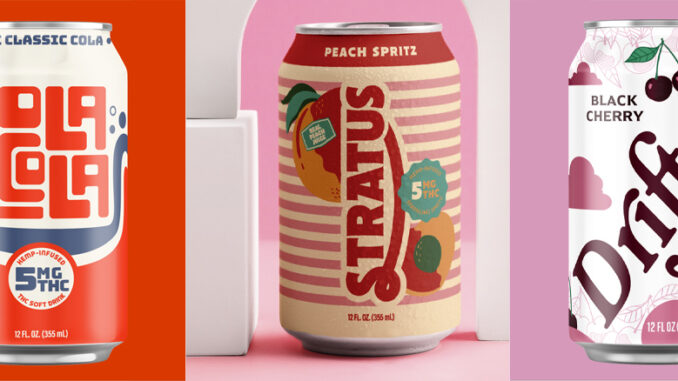
When Urban South first introduced its THC beverages, including Stratus as then a hard seltzer and now as a spritz, the branding reflected what leadership believed would appeal to experienced cannabis consumers. That assumption didn’t survive contact with the marketplace.
“We listened to feedback from our distributor,” Huling said. “As we’re doing samplings in grocery stores, as we’re seeing who’s buying Driftee, we’re seeing that it’s not that person (we thought it was). It’s soccer moms.”
That realization prompted a significant overhaul of the brand.
The psychedelic-inspired packaging gave way to a cleaner, brighter look, while the product itself evolved into Stratus Spritz, moving away from the increasingly crowded THC seltzer category toward a positioning that better matched how consumers viewed the beverage. For Huling, the change wasn’t simply cosmetic.
“It needed to be branded accordingly, to be something that they felt fit their personality,” he said.
Landry said the company’s original branding decisions were based largely on educated guesses because the category itself was still developing.
“When you’re launching a new product in a category that’s brand new … we really had no idea who the demographic is,” Landry said. “We’re making a lot of assumptions.”
Urban South intentionally launched multiple THC brands with distinct personalities (Driftee, Stratus along with Nola Cola), hoping to reach different customer segments before enough sales data existed to make informed decisions.
Over time, those assumptions gave way to evidence.

“We started to realize that we think the key demographic is women,” Landry said. “So we dial it back to a much friendlier tone.”
And it extends beyond packaging. New beverage categories often lack established consumer research at the independent brewery level. Rather than treating an initial launch as the finished product, Urban South approached it as the beginning of a learning process. Distributor feedback, in-store sampling and purchasing behavior ultimately proved more valuable than internal predictions.
The brewery’s willingness to reposition an existing brand rather than stubbornly defend its original concept illustrates another challenge facing beverage producers: successful innovation often requires abandoning assumptions that once felt logical.
Diversification, however, also introduces new forms of risk. Unlike expanding into cider, hard tea or another familiar alcohol segment, hemp-derived THC beverages remain subject to changing regulations. That uncertainty has complicated how Landry evaluates the strategy’s long-term success.
“That’s complicated with the looming federal ban on THC,” he said. “On one hand, it might have created a ton of instability.”
Still, if the category survives anticipated federal action, Landry believes the investment has already demonstrated its value.
“The diversification really has allowed us to continue to grow this great base that we’ve created,” he said. “It’s allowed us to maintain the staff that we built, even with a decline in beer sales.”
His final caveat underscores a reality many breweries now face when evaluating emerging categories.
“If it goes away,” Landry said, “then it will show that we spent a lot of time and effort and staff building something that created some instability.”
Diversification isn’t automatically a growth strategy, nor is it simply insurance against declining beer volumes. It requires continuous market validation, a willingness to rework products based on customer behavior rather than internal preferences, and an acceptance that new categories can carry both opportunity and regulatory uncertainty. Urban South’s experience suggests the competitive advantage isn’t necessarily entering first. It’s building an organization willing to test assumptions, respond quickly to what customers actually buy and evolve a brand before the market forces the change.