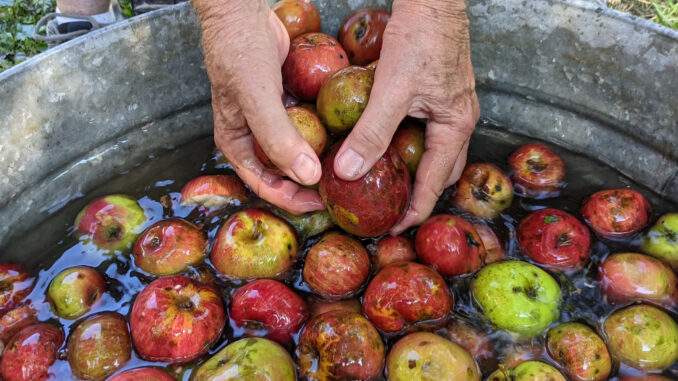
American cider makers have long debated whether apples from the orchard floor and harvesting off the ground belong in commercial production, but a growing number say the question is less about quality and more about process, perception and risk management.
While many US cideries remain cautious, some producers point to centuries of precedent in traditional cider regions.
“Every ounce of cider that’s made in Europe… those apples are hitting the ground first, and so they’ve been doing this for thousands of years,” said Dave Takush of 2 Towns Ciderhouse during a discussion at the 2026 CiderCon along with Ashley Lindsay of Pleasant Valley Cider and Clay Slaughter of Slaughter Orchard. “Everywhere else, it’s just here. We kind of have to navigate people that don’t know about hard cider.”
The hesitation in the US market often centers on food safety and regulatory uncertainty rather than fruit quality. Producers emphasized that while fermentation can provide a level of microbial control once alcohol is produced, alternative safety approaches cannot replace established kill steps without validation.
“Any novel approach to food safety usually requires a validation study,” Takush said, noting that third-party research is often needed before regulators will accept new methods.
Regulatory requirements further complicate decision-making, particularly for cideries working across multiple states or considering raw juice products.
“It all depends from state to state. It’s incredibly complicated,” Lindsay said, referring to differences in rules around UV treatment, pasteurization and raw cider.
Beyond compliance considerations, operational practices emerged as one of the most important factors when working with ground fruit. They described early trials that resulted in significant fruit loss, but those losses decreased as crews became more selective during harvest and shortened storage times. Cleaning orchard floors to remove heavily damaged fruit and debris also reduced microbial pressure without eliminating usable drops.
Harvest timing also plays a role. Some orchard managers wait until a significant portion of fruit has naturally dropped before harvesting, noting that ground fruit often reaches similar ripeness levels as tree-picked apples. Multiple passes through orchards can improve quality, though producers acknowledged that approach may not be practical for all operations.

For some, the conversation also ties into long-term efficiency. Mechanical harvesting systems, common in traditional European cider regions, typically rely on ground fruit. As US cideries explore ways to reduce labor costs and increase scalability, acceptance of ground fruit may become more important.
They also pointed to sustainability and cost benefits.
“It’s a really great way to take fruit on the ground that would normally be wasted,” Takush said. “It’s actually great cider-making fruit.”
READ MORE: Making Strategic Decisions Based on Data
Processing approaches varied, with some producers favoring minimal intervention and native fermentations while others used standardized techniques with commercial yeast and nutrients to isolate variables. Both approaches highlighted that fruit handling and processing decisions often matter more than whether apples come from the tree or the ground.
Apples from the orchard floor represent both opportunity and responsibility. With thoughtful harvest timing, careful fruit selection and a clear understanding of regulatory requirements, ground fruit can shift from a perceived risk to a viable tool for improving efficiency and reducing waste in commercial cider production.