The most useful feedback a brewpub receives from its customers is not necessarily what guests say they want. It is often what they actually order. That distinction can make the difference between a food program that supports a brewery’s business and one that gradually becomes a collection of expensive responses to every customer request.
The challenge is not simply determining what food guests like. It is figuring out which preferences are meaningful enough to influence the menu, which requests should be accommodated when possible, and which should be politely ignored when the sales data says otherwise.
At Lakewood Brewing, General Manager Cassie Henderson sees food as an important part of turning a beer visit into a repeatable habit. The objective, she said, is not to compete directly with restaurants but to make the brewery a place where customers have multiple reasons to spend time.
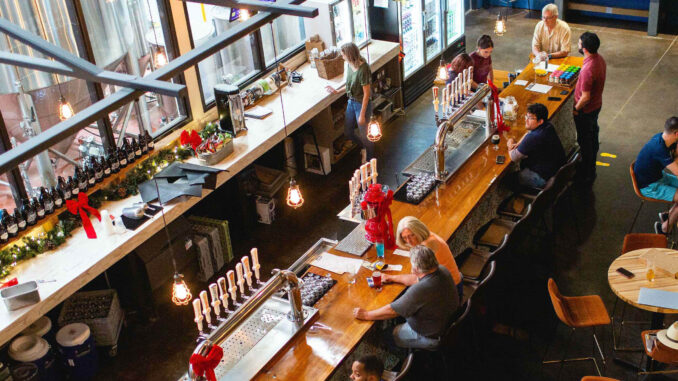
“Great beer gets people through the door,” Henderson said. “A complete experience gives them a reason to come back. We are creating a brewery experience where food makes the beer, the people, and the place more memorable,” Henderson said. “We work to create a third place where you can host your friends, hang out for a few hours, walk around and enjoy the brewery, get a bite, and just chill.”
That idea offers an important strategic distinction for brewpubs: Food does not necessarily have to become the primary attraction to be financially important. It can increase the number of occasions when a customer considers the brewery a destination. But once a brewery accepts that food is part of the overall guest experience, another question becomes unavoidable: How much should the customer influence what goes on the menu?
Henderson has learned that customers can be enthusiastic about variety without necessarily rewarding a business for providing it.
“Guests often say they want endless options, but what they really want is confidence that whatever they order will be delish,” she said.
That confidence can be easier to deliver with a focused menu than with one attempting to satisfy every possible preference. More choices also create additional operational complexity, from inventory and prep to training and execution. For Henderson, actual purchasing behavior carries more weight than stated preference.
“We pay more attention to what people actually order, what they reorder, and what they talk about afterward,” she said. “The performance of our top-selling items tells us much more than surveys sometimes do.”
That is a useful framework for any brewpub trying to make decisions about its food program. Customer feedback can identify an opportunity, but it does not necessarily prove demand. A request becomes more strategically interesting when it translates into repeat purchases.
Mike Key, Director of Operations at Silver Reef Brewery, has reached a similar conclusion from the other direction. His experience has taught him to be skeptical of requests for specific dietary products when those requests do not show up in the business’s actual sales. He has heard repeated requests for gluten-free, vegan and nonalcoholic options. But simply hearing those requests does not convince him that adding a dedicated menu item is the right move.
“I’m not going to make it because it’s not going to sell,” Key said of products that customers repeatedly ask about but rarely purchase. That does not mean a brewpub has to refuse every accommodation. Key said his operation can work with guests who need modifications, but he has not seen enough demand to justify building entire product categories around some of those requests.
The distinction is important. A brewery can be hospitable without making every individual preference a permanent line item.
Key pointed to his experience with nonalcoholic and gluten-free beer as an example. Rather than investing heavily in producing those products internally, a brewery could potentially bring in outside brands when appropriate and see whether customers actually buy them. That approach reduces the risk of turning a customer request into a significant capital investment before demand has been demonstrated.
The same principle applies to food.
Key said customers, owners and employees can all have strong opinions about what belongs on a menu. But the product mix ultimately provides a more objective answer.
He gave the example of fried pickles at Silver Reef. Key does not particularly believe it represents the quality of the brewery’s beer as well as some of its other food.
“But then you look at the product mix, and that’s how people order,” he said. “Alright, well, that’s what people want.”
That can be an uncomfortable conclusion for those who have a strong culinary vision. A manager may know which dishes he or she considers better, more interesting or more aligned with the brewery. Customers, however, are not required to share that judgment. The important business question is whether the item earns its place on the menu.
Key said Silver Reef is known for several core items, including its burger, fish and chips, fried chicken and a pork belly appetizer. Those products have developed an identity with customers that extends beyond simply being items available for purchase.
“When I’m walking through Home Depot wearing my Silver Reef Brewery shirt,” Key said, customers recognize him and tell him about the food they like. “We love your fried pickles. We love your this. We love your that.”
That kind of unsolicited recognition can be more valuable than a comment card because it indicates that a menu item has become part of the customer’s memory of the business. It also demonstrates why a brewpub should be cautious about dismissing a product simply because management does not personally like it.
Key said the pork belly appetizer produces a very different reaction internally. When it sells out, he wants to know why.
“That is incredible,” he said. “When it gets 86’d because we’re out of this… why are we out of this?”
The difference illustrates a broader point about menu management. Operators need to separate personal taste from customer value. A dish does not have to be the manager’s favorite to be a strong business asset. At the same time, popularity alone should not make a menu item untouchable. The next layer of analysis is whether the item is profitable and operationally sustainable.
A product that sells extremely well but requires excessive labor, creates waste or carries poor margins may not deserve the same treatment as a high-volume item that is easy to execute and profitable. That means product mix should ideally be considered alongside food cost, labor, prep time, waste and sales volume.

“People want it” is an important data point, but it is not the final answer
The most effective menu strategy may be less about chasing customer preferences and more about creating a feedback loop: listen to what guests ask for, test selectively, measure what they purchase, watch what they reorder and then adjust. That approach also gives brewpubs room to experiment without constantly expanding the permanent menu.
Henderson said Lakewood uses a rotating monthly special to combat menu fatigue and give its kitchen team an opportunity to be creative. A special can function as a relatively low-risk test: It introduces something different without requiring the operation to commit permanently.
That kind of testing can help bridge the gap between what guests say they want and what they will actually buy. It also protects the core menu from becoming bloated. If a special consistently performs, that shows there’s evidence to consider making it permanent. If it does not, you can move on without having built an entire purchasing and production system around it.
There is another strategic advantage to that approach: It allows the brewery to preserve its identity.
Henderson’s point about creating a “third place” is important because food should support the reason people choose the brewery rather than make the brewery indistinguishable from every other restaurant.
“We are not trying to compete with restaurants,” she said.
READ MORE: Stop Asking Food to Do Everything: How Smart Brewpubs Define Menu Strategy
For a brewpub, that can be a useful guardrail. The goal is not necessarily to build the largest menu or offer every dietary category. The goal is to build a food-and-beverage program that gives customers compelling reasons to visit, stay longer, return and associate the brewery with a reliable experience.
Key’s experience reinforces the other side of that equation. Silver Reef has spent time focusing on beer quality, and Key sees the food program as something that needs to live up to that standard.
“We make really good beer,” Key said. “We’re constantly obsessing about our beer, and we want the food to match it.”
That does not mean every dish has to satisfy management’s personal definition of culinary excellence. The fried-pickle example proves otherwise. Instead, the food program has to deliver an experience that customers value while making economic sense for the business. The challenge for brewpub decision-makers is not choosing between listening to customers and ignoring them. It is learning which customer signals deserve action.
If guests repeatedly ask for something but do not purchase it when given the opportunity, that request may not represent a viable business opportunity. If a product that management dislikes consistently sells, removing it because of personal preference could be equally misguided. And if a new dish performs well as a special, it may have earned the right to become part of the core menu.
You can hold all three ideas at once: Listen carefully, test deliberately and let customer behavior (not just customer enthusiasm alone) help make the decision.
Ultimately, food can be one of the reasons a beer drinker becomes a regular, but it does not have to turn a brewery into a restaurant. A focused menu, recognizable signature items, selective experimentation and close attention to actual purchasing behavior can give a brewpub the flexibility to meet guests where they are without allowing guest requests to dictate the business.
A customer can tell a brewery what they want. The brewpub owner still has to determine whether giving it to them makes the business better.