For much of craft beer’s history, diversification often carried a stigma. Contract brewing raised eyebrows. Producing beverages outside of beer prompted questions about authenticity. Even packaging beer in cans was once viewed as a compromise. Today, those debates have largely been replaced by a different question: How can a brewery better utilize the assets they’ve already built?
That question sits at the heart of Abita Brewing Company’s decision to launch the Abita Beverage Group as the Louisiana company enters its 40th year in 2026. While the announcement introduces a new corporate identity encompassing beer, spirits, non-alcoholic beverages and contract manufacturing, the bigger takeaway for brewery owners may be less about adding another product line and more about changing the way they think about their business.
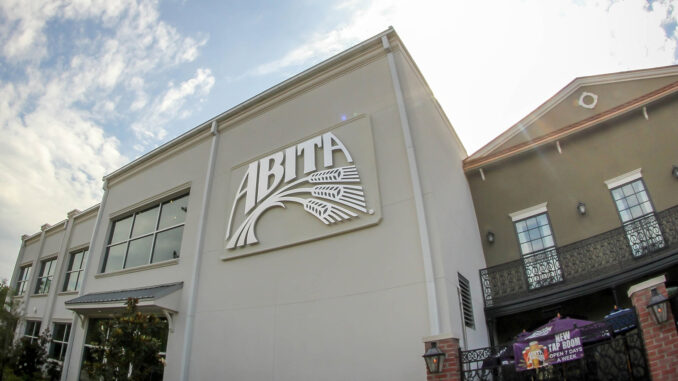
President Troy Ashley told BREWER in a recent sit-down podcast at the brewery’s New Orleans taproom the move wasn’t about reinventing the company as much as finally describing what it had already become.
“We thought that the name was important just to accurately describe the activities that we’ve been doing here for quite a while,” Ashley said.
Beer remains central to Abita’s identity, but Ashley acknowledged what many larger brewery owners already know firsthand: relying exclusively on craft beer is becoming a more difficult business model.
“Craft beer is one of the challenged segments in our industry,” Ashley said. “We need to diversify and optimize our own facilities, and we have an opportunity to do that.”
That philosophy is reflected in more than branding.
Over the past several years, Abita invested more than $6 million into production and packaging capabilities, not because its existing equipment wasn’t functional, but because it no longer matched what today’s beverage market demanded.
“We had a lot of capacity previously, but we were in the incorrect formats that people are looking for,” Ashley said.
Rather than adding more fermentation space, the company concentrated much of its capital spending on packaging flexibility. New canning equipment, separate bottling capabilities, 19.2-ounce can production, sleek cans, shrink-wrap systems and automated variety-pack equipment all expanded what the brewery could produce for itself and for partners.
“It was really in packaging where the primary efforts have gone,” Ashley said. “We’re more efficient this way from an operational standpoint.”
For breweries wrestling with slower beer sales, it can extend beyond packaging equipment itself. Excess capacity isn’t always a production problem. Sometimes it’s a packaging problem, a format problem or a customer problem.
Ashley said Abita increasingly views its brewery less as a beer factory and more as a beverage production platform.
“We have a beautiful facility with a lot of excess capacity,” he said. “We’re doing our best to optimize the resources that we have.”
That mindset has led the company deeper into contract manufacturing, supporting beverage partners ranging from startups to larger brands. Ashley believes Abita’s decades of experience give smaller companies something many larger co-packers cannot.
“We can do smaller-scale runs for people, but we can also accommodate larger customers,” he said. “Scaling brands is what we do best.”
Instead of simply renting tank space, Ashley sees Abita offering institutional knowledge accumulated from building its own brands over four decades.
“We’ve been building our own brands for 40 years,” he said. “We know how to do that, and we’re helping others achieve their goals.”
That broader perspective also changes how Abita evaluates future opportunities. Ashley said the company isn’t focused solely on contract manufacturing agreements but remains open to investments, partnerships or acquisitions that fit its capabilities.

“We don’t necessarily have a hit list,” he said. “Everything’s on the table.”
Perhaps the most notable aspect of Abita’s strategy is that Ashley doesn’t look at diversification as the veteran brewery abandoning craft beer. Instead, he sees it as protecting the business while allowing the company to continue investing in beer.
“We’re not just a craft brewery anymore,” Ashley said. “We’re in distilled spirits. We have some non-alcoholic offerings. We’re in sodas. All sorts of things.”
That approach also shapes the launch of Upbeat Vodka Cocktails, Abita’s new ready-to-drink line. Although RTDs represent one of the beverage industry’s strongest growth segments, Ashley said the company isn’t chasing volume for its own sake.
“We’re being careful about the launch,” he said. “We’re not just going far and wide.”
Instead, Abita is focusing first on core markets, strategic partnerships such as the French Quarter Festival held each April and measured brand development before broader expansion.
The philosophy shows something for other breweries exploring adjacent categories. Diversification doesn’t necessarily mean moving faster. Sometimes it means moving more deliberately.
Ashley said those decisions are informed by both consumer data and innovation.
“It’s certainly both,” he said. “We look at what things are doing in the marketplace, but we’re also trying to find the green space. We’re not just trying to emulate what someone else is doing. We’re creating something unique to ourselves.”
Ashley believes flexibility has become one of the industry’s most valuable competitive advantages. Consumer preferences continue to evolve and Ashley doesn’t expect successful breweries to simply wait for market conditions to improve. Still, he remains optimistic about craft beer’s future.
“I feel that things are cyclical in nature,” he said. “Craft beer will come back. I’m not sure it’ll get quite to the levels that we once were, but people are always going to be drinking craft beer.”
That optimism, however, isn’t rooted in nostalgia. It is built on preparing the business for multiple possible futures instead of betting on one.
READ MORE: BREWER Podcast with Abita Beverage Group
Ashley described Abita’s strategy as an offensive move rather than a defensive reaction to declining craft beer sales.
“We are trying to be offensive about it,” he said. “We’re not going to try to repeat doing the same things and hope for a different outcome.”
For breweries of similar size, that may be the most valuable takeaway from Abita’s evolution. The company’s biggest investment wasn’t simply in vodka cocktails, contract manufacturing or even new packaging equipment. It was in organizational flexibility.
Rather than asking how to protect its beer business from changing consumer habits, Abita asked how its facilities, expertise and infrastructure could solve more problems for more customers. In an industry increasingly defined by slower growth and tighter margins, that shift in thinking may prove more important than any single new beverage category.