
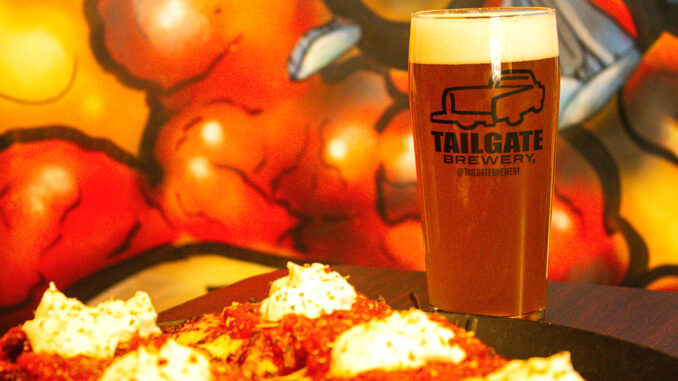
Trying to find your brewery’s footing in a crowded market, the temptation is to focus narrowly on production, distribution deals, or chasing shelf space. But according to Wes Keegan of TailGate Brewery, that kind of thinking misses how consumer expectations have fundamentally shifted and how much borrowing from outside beer has always mattered.
Keegan, who founded the Nashville-based brewery that opened in late 2014, argues that markets don’t evolve evenly, and timing matters more than originality. He also told BREWER in an extended interview and in the recent cover story that he treats competition as a force that expands demand rather than steals it. Also, he prioritizes structural independence, even when it limits outside capital and formal oversight.
Reading the market instead of chasing industry consensus was something he said he learned by moving between regions and watching consumer trends arrive at different speeds.
“The coasts in Chicago are about 10 years ahead of everywhere else in the middle of the United States,” Keegan said, describing what he once observed after moving from California to Nashville. “People were talking about, like, cake pops and froyo… and by the time I left, it was like, you open a Froyo shop, you’re dead. Out here, it was just starting.”
That gap, he suggested, created an opportunity to see what was coming before it fully arrived in Middle America markets. In beer, he said, that meant understanding that taprooms weren’t just production spaces with tables, but destinations shaped by broader hospitality expectations.
“People suddenly cared about taprooms,” he said of the shift he saw taking hold. “People really cared about where it came from. They really cared about freshness. They really cared about seeing that it happened.”
He extended that thinking beyond beer entirely. Instead of treating brewing as a closed system, he compared it to other consumer categories that had already solved similar problems.
“All of those different factors that we’ve deployed here, they’ve already been solved in the wine business. They were already solved in the liquor business,” he said. “Any artisan industry at all that circled around food or drink, they did this kind of thing. So why did beer think that it didn’t have to?”
That question eventually shaped how food became central to the business model rather than an accessory to it. Keegan said the decision to lean into pizza wasn’t part of a romantic vision but a practical response to what guests were already telling the industry they wanted.
“We already had barbecue here in Nashville. We had good barbecue. There was no pizza and beer,” he said. “I’d never worked in pizza, but I’m going to go figure out and become a pizza expert.”
The approach, he said, wasn’t about novelty. It was about translating process discipline across categories.
“You can’t cut corners,” he said, drawing a parallel between brewing consistency and dough handling. “You can’t have, like, a loose grain bed when you’re brewing. You can’t short your dough processes, either.”
The second idea shaping his philosophy is how he views competition. It wasn’t seen as a threat, but as a signal of a healthy market.
“I don’t look at them as competition. I look at them as, like, the rising tide,” Keegan said. “We want people excited about beer to go stand in line and think that they can’t get a product. That’s the best thing that could happen for our market.”
In his view, a strong regional scene benefits from momentum created by multiple successful brands rather than dominance by a single one. New entrants, even well-funded or highly hyped ones, can expand awareness in ways that lift all producers.

Also, ownership structure and control comes with a more complicated tradeoff. Keegan described starting without investors or family backing, which forced a slower, more self-reliant build. But it also shaped how decisions are made today.
“I grew up on welfare and food stamps,” he said. “There was no daddy to, like, write a big check.”
That history, he suggested, created a preference for independence over outside capital, even when capital would have accelerated growth. It also allowed for faster internal decision-making without external approval layers.
“Anybody with their head on their shoulders that has put money into a business is gonna say, ‘What the eff are we?’” he said, describing how investor expectations often constrain operational choices. “We’re just gonna follow the norm.”
Without that structure, he said, leadership decisions can be made more directly, including ones that may not look efficient on paper but align with long-term culture and retention goals.
READ MORE: BREWER Podcast with TailGate Brewery
“We’re gonna pay people 100% healthcare. That’s a bad business decision on paper,” he said. “But I can make decisions that I think are correct.”
Still, he was clear that independence isn’t a romantic ideal. It comes with years of strain, limited safety nets, and a level of personal responsibility that doesn’t disappear once a business stabilizes.
Even so, he suggested the model only works if the business is willing to accept both the freedom and the burden that comes with it. Strategic boards or investors may offer expertise and scale advantages, he acknowledged, but they also change the speed and direction of decision-making.
Keegan’s perspective lands less as a blueprint and more as a set of tensions owners and managers have to navigate: speed versus structure, independence versus capital, and competition versus collaboration. The businesses that thrive, he suggested, are often the ones willing to borrow freely from outside their category, pay close attention to how consumers actually spend their time, and recognize that growth rarely comes from isolation.

1 Trackback / Pingback
Comments are closed.