In the waning days of 2025, the Brewers Association (BA)—the not-for-profit trade association dedicated to small and independent American craft brewers—recaps a year of continued contraction, punctuated by creativity and innovation.
The headwinds facing the industry did not diminish compared to a year ago, and in some areas only strengthened. Measured in July in the BA’s midyear survey, craft volume was estimated to be down 5%, a somewhat steeper decline than the full-year trend of 2024 (-4%). While full 2025 production numbers will not be finalized until the Beer Industry Production Survey in Q1 2026, scan data for Q3 2025 suggests a continued weakening in the back half of 2025. As such, we may expect contraction slightly beyond that midyear figure for the full year of 2025.
Barring a drastic change in the last few weeks of the year, 2025 will be the second consecutive year in which brewery closings outpace brewery openings. Throughout the year, the BA has tracked 268 new brewery openings and 434 closings. While striking in headlines, closings still represent a relatively low percentage (4.4%) of total operating breweries, especially when compared against leisure and hospitality businesses broadly.
“If the craft beer industry is a ship, we can comfortably say we’re no longer in the safety of a harbor. The days of relative calm are behind, and brewers are getting their sea legs in this new, challenging open water,” said Matt Gacioch, staff economist at the BA. “Changing consumer behaviors, retailer rationalization, cost increases due to inflation and tariffs, and more competition than ever have been compounding difficulties in 2025. And still, brewers are stepping up to meet today’s challenges head on by adjusting their offerings and, sometimes, their entire business models.”
Here’s a look at some other statistical highlights defining this Year in Beer.
Craft Beer by the Numbers
- Count: The number of small and independent breweries in operation in the U.S. in 2025 totaled 9,778.
- Employment: The craft beer industry supported over 443,000 jobs nationwide, fostering local economies and creating opportunities.
- Economic Impact: Craft beer’s contribution to the U.S. economy reached $72.5 billion, demonstrating its vital role in the broader beverage market.
The Trends of 2025
- Consolidation: This year, there was a continued democratization and expansion of what it means to be a “brewer.” With acquisitions, mergers, and collaborations, the stainless tanks in the background may not be as important as the brand story.
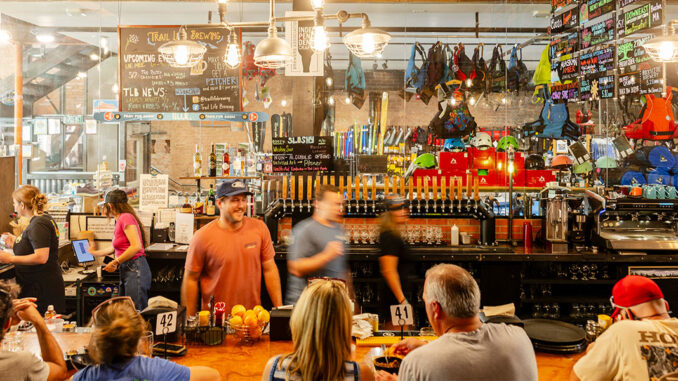
- New Approaches to Hospitality: As consumers increasingly seek meaningful opportunities to connect, craft breweries are leaning into their role as community “third spaces.” Whether through more substantial food offerings, an expanded range of beverage types, or more targeted programming, breweries are diversifying their revenue streams by appealing to specific consumer groups.
- Growth in Low ABV: In addition to non-alc’s continued growth streak, there has also been significant expansion in the low- to mid-strength segments (typically defined as <4.0% ABV). Brewers are seeking to capture more occasions that call for great flavor without the buzz.
Major Events of 2025
- Great American Beer Festival®Opens in new window (GABF®): October’s GABF welcomed more than 28,000 attendees and featured 2,000+ beers from 386 beverage producers across 46 states and D.C. Producers highlighted the best American craft beer, ciders, ready-to-drink cocktails, hard teas, and, for the first time, spirits.
- World Beer Cup®Opens in new window (WBC): Known as “The Olympics of Beer,” the 2025 WBC evaluated 8,300 entries with breweries from 49 countries across the globe.
- Beer Weeks: Communities across the U.S. celebrated American Craft Beer Week® in May, strengthening the bond between breweries and their fans.
A Look Ahead
While many of the headwinds currently facing the industry aren’t expected to disappear in 2026, there may be reason for cautious optimism in some areas. With interest rates expected to continue declining, the opportunity for measured expansion will become more viable. The Supreme Court may issue guidance shortly on the legality of certain tariffs, potentially reducing some of the ambiguity in procurement planning. Some consumer research also indicates that consumers are expecting to socialize more in the year ahead—always a good sign for craft beer.
“The craft beer industry has always been characterized by creativity and resilience. Brewers today know that success comes through exceptional products, efficient operations, and connections with consumers,” said Gacioch. “The path ahead will not be without its bumps, but I’d never bet against the steady tenacity of the people behind the beer.”